


Democratic Progressive Party (DPP) legislative candidate Wellington Koo (顧立雄) yesterday “tearfully” agreed to stop campaigning for Green Party-Social Democratic Party Alliance candidates, after being reprimanded by DPP leaders.
“After being told [to stop campaigning] by party leadership, my only choice is to tearfully accept — what else can I do?” said Koo, who is ranked fourth on the DPP’s legislator-at-large candidate list.
He appeared to rule out supporting several candidates with “pan-blue” backgrounds, who the DPP endorsed earlier this week, passing over competing candidates from the alliance.
“My heart has its own measuring stick. Party leaders can only tell me what I cannot do — they cannot require me to do anything,” he said.
Koo on Thursday had said he planned to continue campaigning for the alliance’s candidates, adding that there was “no way I could accept” the party’s endorsement process.
A lawyer and long-time civil activist, Koo had previously campaigned for Taipei district candidates Lee Yen-jong (李晏榕), Lu Hsin-chieh (呂欣潔) and Miao Po-ya (苗博雅).
The DPP on Wednesday endorsed rival independent candidates Billy Pan (潘建志), Yang Shih-chiu (楊實秋) and Lee Ching-yuan (李慶元).
The party’s support of the candidates has caused controversy among local party members because of their past criticism of the DPP, with Lee and Yang serving as Chinese Nationalist Party (KMT) city councilors before being ejected from the party earlier this year.
DPP Deputy Secretary-General Hung Yao-fu (洪耀福) was on Thursday quoted in reports as saying that barring party officials from campaigning for unendorsed candidates was necessary to keep the vote from being split in competitive districts, which would guarantee a KMT victory.
The “sum” of the “good” and “bad” of candidates was ultimately reflected on the “objective measure” of their poll numbers, he said, adding that the party had given third-force candidates half a year to integrate before announcing its endorsements.
The alliance’s candidates had rejected previous DPP offers to facilitate “integration” in their districts, citing ideological incompatibility with competing candidates.
Miao said she “understood” that Koo was obligated to tow the party line, adding that she was confident he would continue to support her in private.
She said voters could “make their own judgement” about the DPP’s decision, adding that it highlighted the tensions between party discipline and individual conscience.
Additional reporting by Chen Hui-ping
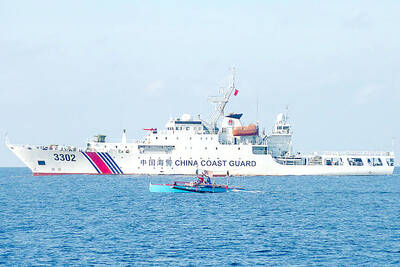
EXPANSIONIST: China deploys an average of 40 to 50 warships and coast guard vessels daily in the South China Sea, despite pledges not to militarize the region, an official said China is attempting to expand its influence across the First Island Chain and increase pressure on Japan by sending coast guard vessels into waters off of Taiwan under the pretext of maritime negotiations with Japan and the Philippines, a national security official said yesterday. China’s recent actions in the waters east of Taiwan and Japan and the Philippines’ exclusive economic zones (EEZ) are attempts to establish dominance in First Island Chain waters, said the official who declined to be named, adding that this is “expansion disguised as law enforcement.” Framing China’s actions solely as a cross-strait issue is a serious misjudgment that
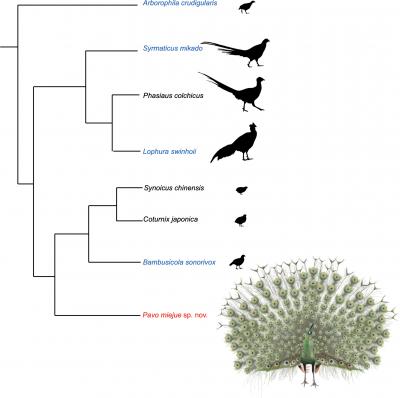
Through analyzing fossil evidence, a research team at National Taiwan University (NTU) discovered the largest endemic bird to have lived in Taiwan, naming it Pavo miejue, or extinct peafowl (滅絕孔雀). The Mikado pheasant, which is printed on the back of the NT$1,000 bank note, was previously believed to be the biggest endemic bird to Taiwan. The research team’s findings suggest that Pavo miejue lived during the Pleistocene epoch tens of thousands of years ago. It is the first endemic extinct bird species discovered and formally named in Taiwan. The study was coauthored by NTU Institute of Ecology and Evolutionary Biology professor Tsai Cheng-hsiu (蔡政修),
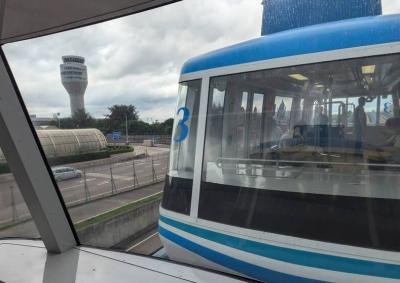
Taiwan Taoyuan International Airport is to suspend its automated Skytrain service connecting Terminal 1 and Terminal 2 starting on July 1 to facilitate connection works for the upcoming Terminal 3, the airport operator said today. Passengers and staff who need to travel between the two terminals after the suspension can instead use the Taoyuan MRT or the airport's 24-hour shuttle bus service, Taoyuan International Airport Corp said. The Taoyuan MRT Airport Line directly links the two terminals, while the shuttle buses are to operate around the clock, the company added. The Skytrain provides free transportation between the airport’s two terminals for travelers and
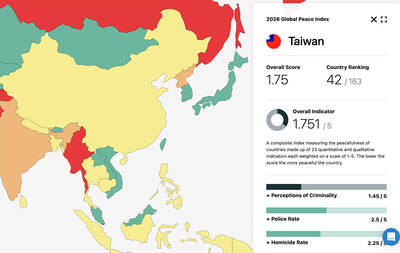
Taiwan ranked 42nd in terms of peacefulness among 163 countries, down five places from last year, according to this year’s Global Peace Index. With an overall score of 1.751, Taiwan dropped from 37th last year, the report published by the global Institute for Economics and Peace showed. The overall score measures a country’s level of peacefulness using 23 quantitative and qualitative indicators across three domains — ongoing domestic and international conflict, societal safety and security, and militarization. While Taiwan ranked 42nd worldwide, it was listed in ninth place among the 19 Asian-Pacific countries in the report, after New Zealand, Singapore, Japan, Malaysia,


 RSS
RSS