


The Atomic Energy Council (AEC) yesterday faced criticism over a proposal by Taiwan Power Co (Taipower) to store radioactive waste in an outdoor facility, with lawmakers and experts raising concerns over possible radiation leaks, as well as challenging the council and the company over a delayed report about an incident last month at a nuclear plant.
Taipower completed an outdoor, dry-cast storage facility at the Jinshan Nuclear Power Plant in New Taipei City’s Shimen District (石門) last year, with steel cylinders surrounded by a concrete shell designed as a deposit for spent fuel rods with the plant’s fuel pool nearing capacity.
Operations at the new storage facility are pending approval from the New Taipei City Government.
At a question-and-answer session at a meeting of the Legislative Yuan’s Education and Culture Committee in Taipei, Democratic Progressive Party (DPP) Legislator Ho Hsin-chun (何欣純) asked whether the Jinshan facility is the safest and most optimal storage option the council had surveyed.
AEC Minister Tsai Chuen-horng (蔡春鴻) said the council could only ensure that the facility meets safety standards, it could not guarantee that it is the safest or most optimal of facilities.
“It is not the council’s obligation to assess how a facility might compare with others, but rather to investigate whether Taipower’s proposals are safe,” Tsai said. “The council has approved several of Taipower’s proposals, but it is up to the company to decide which to adopt.”
Ho called on the council to reconsider all possible storage options in addition to those proposed by the company, adding that the council should not just be a rubber stamp for Taipower.
DPP Legislator Chen Ting-fei (陳亭妃) asked why Taipower did not immediately report an incident at the Ma-anshan Nuclear Power Plant in Ma-anshan (馬鞍山), Pingtung County.
The company failed to retrieve a screw from reactor No. 2 during a scheduled maintenance on Nov. 12, but the company did not notify the council or the Pingtung County Government until Nov. 16.
Tsai said the incident did not pose an immediate risk and therefore there was no need to report it straight away.
The council can only ask that Taipower make immediate reports of emergency incidents, Tsai said.
DPP Legislator Cheng Li-chun (鄭麗君) said the council should revise its regulations to demand that the company immediately report every incident, adding that Taipower did not immediately report a fire in April at the Pingtung plant to the local government.
Former Institute of Nuclear Energy Research official He Li-wei (賀立維) said the retrieval of a screw from a nuclear reactor might increase the risk of a radiation leak.
Dry casks should be stored in an indoor facility to maintain a constant temperature and avoid possible terror attacks, while Taipower’s casks — which weigh more than 200 tonnes each — would be welded shut, making it impossible to either open the casks to further process the nuclear waster or relocate the casks in the event of nuclear disaster, He said.

The military has spotted two Chinese warships operating in waters near Penghu County in the Taiwan Strait and sent its own naval and air forces to monitor the vessels, the Ministry of National Defense (MND) said. Beijing sends warships and warplanes into the waters and skies around Taiwan on an almost daily basis, drawing condemnation from Taipei. While the ministry offers daily updates on the locations of Chinese military aircraft, it only rarely gives details of where Chinese warships are operating, generally only when it detects aircraft carriers, as happened last week. A Chinese destroyer and a frigate entered waters to the southwest
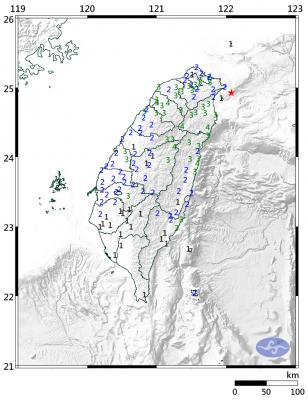
A magnitude 6.1 earthquake struck off the coast of Yilan County at 8:39pm tonight, the Central Weather Administration (CWA) said, with no immediate reports of damage or injuries. The epicenter was 38.7km east-northeast of Yilan County Hall at a focal depth of 98.3km, the CWA’s Seismological Center said. The quake’s maximum intensity, which gauges the actual physical effect of a seismic event, was a level 4 on Taiwan’s 7-tier intensity scale, the center said. That intensity level was recorded in Yilan County’s Nanao Township (南澳), Hsinchu County’s Guansi Township (關西), Nantou County’s Hehuanshan (合歡山) and Hualien County’s Yanliao (鹽寮). An intensity of 3 was

Japanese Prime Minister Sanae Takaichi’s comment last year on Tokyo’s potential reaction to a Taiwan-China conflict has forced Beijing to rewrite its invasion plans, a retired Japanese general said. Takaichi told the Diet on Nov. 7 last year that a Chinese naval blockade or military attack on Taiwan could constitute a “survival-threatening situation” for Japan, potentially allowing Tokyo to exercise its right to collective self-defense. Former Japan Ground Self-Defense Force general Kiyofumi Ogawa said in a recent speech that the remark has been interpreted as meaning Japan could intervene in the early stages of a Taiwan Strait conflict, undermining China’s previous assumptions
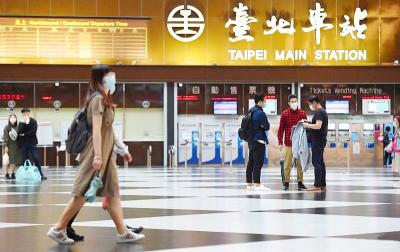
Taiwan Railways Corp (TRC) today announced that Shin Kong Mitsukoshi has been selected as the preferred bidder to operate the Taipei Railway Station shopping mall, replacing the current operator, Breeze Development Co Ltd. Among eight qualified firms that delivered presentations and were evaluated by a review committee, Shin Kong Mitsukoshi was ranked first, while Breeze was named the runner-up, the rail company said in a statement. Contract negotiations are to proceed in accordance with regulations, it said, adding that if negotiations with the top bidder fail, it could invite the second-ranked applicant to enter talks. Breeze in a statement today expressed doubts over


 RSS
RSS