


The Chinese Nationalist Party’s (KMT) third convention of the Central Committee formally confirmed all 34 nominees for legislator-at-large positions yesterday.
The top 12 members on the list are considered to be “safe” — meaning they are virtually assured of getting legislative seats — and include five holding expertise or knowledge in other fields: academic Ko Chih-en (柯志恩), doctor Chen Yi-min (陳宜民), Lin Li-chan (林麗蟬), whose wife is an immigrant from Cambodia, TEDxTaipei cofounder Jason Hsu (許毓仁) and Financial Supervisory Commission Chairman William Tseng (曾銘宗).
The other candidates who secured “safe seats” are all political veterans: Legislative Speaker Wang Jin-pyng (王金平), Legislator Huang Chao-shun (黃昭順), former Taoyuan County commissioner John Wu (吳志揚), former legislator Chang Li-shan (張麗善), Hualien County Commissioner Fu Kun-chi’s (傅崑萁) wife, Hsu Chen-wei (徐榛蔚), Presidential Office Secretary-General Tseng Yung-chuan (曾永權) and Legislator Alicia Wang (王育敏).
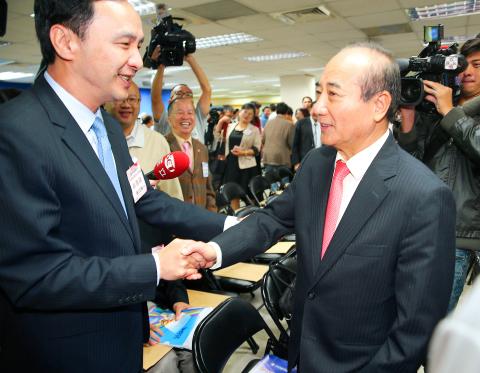
Photo: CNA
KMT Chairman Eric Chu (朱立倫) said legislator-at-large candidates are considered for conforming to social expectations and political realities, and half are nominated for their professional skills and knowledge.
“We wish to put more professionals in the Legislative Yuan, and while the KMT has the talent needed for political negotiation, representation of different areas must also be considered,” Chu said.
“The KMT has faced great difficulties and it has persevered by facing challenges head-on,” Chu said.
He said the list of nominees would likely face some criticism, but that the party cannot stop the reform process, adding that the KMT must always look forward, not back.
Chu said that while the party welcomes any criticism and apologizes to those who did not make the nomination list, members should trust the party and believe it has done its best to balance the needs of each district.
He said the party would make certain the legislators-at-large know the responsibilities that come with their title in order to avoid a situation similar to that of Huang, who in September withdrew from the legislative election in her Kaohsiung constituency for “purely personal reasons.”
Huang had said at the time that after a “painful mental struggle” she decided to withdraw, adding that her decision had nothing to do with “fear of combat” and that she was not “jumping ship.” Huang was replaced in the Kaohsiung race by former Mainland Affairs Council (MAC) deputy director Chang Hsien-yao (張顯耀), who last year was accused by then-MAC minister Wang Yu-chi (王郁琦) of leaking confidential information to China, but in the end was not indicted by prosecutors.
KMT Secretary-General Lee Shu-chuan (李四川) said after yesterday’s convention that, according to party regulations, rejecting a nomination requires half of all attending votes to be against a nominee, and that Jason Hsu, who some consider too “green,” received 66 against and 62 in support of his candidacy.
A total of 158 committee members cast their votes yesterday, meaning Jason Hsu would need 79 votes against him to have his nomination revoked. Jason Hsu had the most nay votes, followed by 60 for Hsu Chiao-hsin (徐巧芯), Chu’s campaign office spokesperson, who is 17th on the list, and KMT Yilan chapter director Lin Hsin-hua (林信華) with 55 votes.
“The regulations are in place for good reason, and personal wishes for nominated candidates to make it into the ‘safe seats’ makes the job of the secretary-general unenviable,” Lee said, adding that the party would be in trouble if members do not put aside their personal wishes.
Chu said that while many people considered it impossible to win the Jan. 16 elections, the party must be strong and determined because it is not running for their generation, but for the next generation.
“Taiwan should offer its children the chance of ‘standing on the shoulders of giants’ when competing against others,” Chu said, adding that his generation’s duty is to be giants, so that Taiwanese children will be able to see more.

FUKUOKA SITUATION: Japanese media reported that the pathogen is expected to be identified by the summer, while the CDC downplayed the idea that it was hMPV A “mysterious cold-like illness” reported in Japan’s Fukuoka Prefecture does not seem to be a new disease, but Japanese authorities have been asked about the situation, the Centers for Disease Control (CDC) said yesterday. The Fukuoka Prefectural Medical Association on Wednesday told a news conference that a “mystery cold” that has become a hot topic on social media is “highly likely to be caused by some kind of viral infection,” Japan’s KBC News reported. “Many people are experiencing symptoms starting with a sore throat, followed by a runny nose, phlegm and a severe cough,” KBC News reported, citing association officials. Health authorities are

Nvidia Corp CEO Jensen Huang (黃仁勳) arrived in Taiwan yesterday ahead of upcoming AI and technology events, saying he plans to meet with clients and Taiwan Semiconductor Manufacturing Co Chairman C.C. Wei (魏哲家) during his visit. After landing at Taipei Songshan Airport, Huang posed for photos with fans and handed out Yakult drinks to reporters and supporters waiting at the scene, saying he has “a lot to do” during the trip. Asked about reports that Nvidia’s planned headquarters site in Taipei’s Beitou Shilin Technology Park could break ground on May 27, Huang said that if the company holds an event, he would

The Ministry of Finance this afternoon announced the winning numbers for the March-April uniform invoice lottery. The winning number for the NT$10 million (US$318,060) special prize is 19531471, and the winning number for the NT$2 million grand prize is 85941329. Three numbers were drawn for the NT$200,000 first prize: 07225810, 20231230 and 83518781. Those with receipts matching the last seven digits of any of the first-prize numbers will win the NT$40,000 second prize, while those matching the last six digits will win the NT$10,000 third prize. Those whose receipts match the last five digits of the first-prize numbers can claim the NT$4,000 fourth prize,
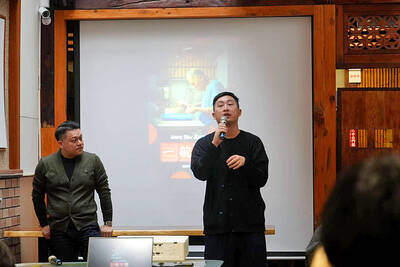
Taiwan Travelogue (臺灣漫遊錄), which earlier this week became the first Taiwanese novel to win the International Booker Prize, is to be adapted into a television series through a Taiwan-Japan coproduction, producer Chang Chen-yu (張辰漁) said yesterday. Chang, a producer at World Softest Production Film Co, wrote on Facebook that the company had been searching for projects with international appeal that retain a strong Taiwanese identity after colleagues and Japanese partners strongly recommended the novel. After reading the book, Chang said he immediately decided to pursue the screen rights. “A great story has the power to transcend time and borders, and connect countless people,”


 RSS
RSS