


Lawmakers serving on the Legislative Yuan’s Transportation Committee yesterday froze 50 percent of the budget allocated for the TPE Aviation Security Co (桃園機場保全股份有限公司), an reinvestment of Taoyuan International Airport Co (TIAC), citing the airport company’s broken promise to not pay the head of aviation security firm.
The aviation security firm was created to handle the specific security requirements of an international airport.
When proposing its own aviation security firm, TIAC said that the firm’s president and chairman would not receive compensation. However, lawmakers found that this was not the case.
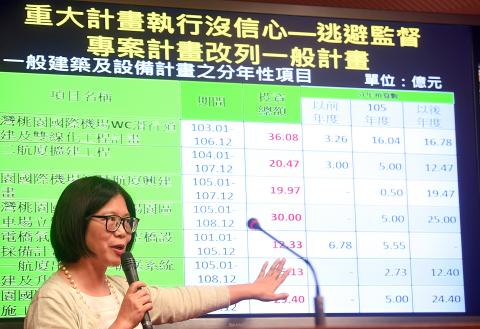
Photo: Chien Jung-fong, Taipei Times
The aviation security firm is managed by Hu Ching-fu (胡景富), a former chief secretary of the National Immigration Agency who is the company’s president and acting chairman.
Chinese Nationalist Party (KMT) Legislator Lo Shu-lei (羅淑蕾) and Democratic Progressive Party lawmakers Lee Kun-tse (李昆澤) and Kuan Bi-ling (管碧玲) said that Hu is being paid NT$150,000 per month, which is more than the Aviation Police Bureau chief makes.
Despite TIAC saying that the aviation security firm would not use its budget for public relations expenses, lawmakers also found that the company listed NT$800,000 for such uses in its budget plan.
The legislators said TIAC deceived the committee, and threatened to completely eliminate the budget earmarked for the salaries of the aviation security firm’s president and chairman.
“These reinvestments have been created to give retired officials jobs,” Lo said. “The aviation security firm is simply another way to nurture ‘fat cats.’”
Lo asked if TIAC plans to set up a cleaning company as well, as it now has an aviation security firm.
Lo said the company was created to handle the airport’s security needs, but TIAC still holds a public tender every year in order to employ security guards trained by its own aviation security firm.
The firm’s security guards need 64 hours of training before they are placed on active duty, of which 33 hours are instructional courses, Lee said, which he found “ridiculous.”
In response, Minister of Transportation and Communications Chen Jian-yu (陳建宇) said the Act on the Recusal of Public Servants Due to Conflict of Interest (公職人員利益衝突迴避法) and Administrative Act of State-Owned Enterprises (國營事業管理法) stipulate that the members of the board and supervisory board of a state-run corporation cannot assume the chairmanship or presidency of a firm in which it has reinvested if they are also 10th-grade government employees, which is why TIAC uses recruitment advertisements to find potential employees.
It was not the intention of the company to deceive the committee, Chen said, adding that the group that established the aviation security firm might have been unaware of these regulations.
TIAC plans to change its regulations to allow it to use the security guards trained by its aviation security firm without having to hold a public tender, Chen said.

The Centers for Disease Control (CDC) yesterday reported the first case of a new COVID-19 subvariant — BA.3.2 — in a 10-year-old Singaporean girl who had a fever upon arrival in Taiwan and tested positive for the disease. The girl left Taiwan on March 20 and the case did not have a direct impact on the local community, it said. The WHO added the BA.3.2 strain to its list of Variants Under Monitoring in December last year, but this was the first imported case of the COVID-19 variant in Taiwan, CDC Deputy Director-General Lin Ming-cheng (林明誠) said. The girl arrived in Taiwan on

South Korea is planning to revise its controversial electronic arrival card, a step Taiwanese officials said prompted them to hold off on planned retaliatory measures, a South Korean media report said yesterday. A Yonhap News Agency report said that the South Korean Ministry of Foreign Affairs is planning to remove the “previous departure place” and “next destination” fields from its e-arrival card system. The plan, reached after interagency consultations, is under review and aims to simplify entry procedures and align the electronic form with the paper version, a South Korean ministry official said. The fields — which appeared only on the electronic form

The Ministry of Foreign Affairs (MOFA) is suspending retaliation measures against South Korea that were set to take effect tomorrow, after Seoul said it is updating its e-arrival system, MOFA said today. The measures were to be a new round of retaliation after Taiwan on March 1 changed South Korea's designation on government-issued alien resident certificates held by South Korean nationals to "South Korea” from the "Republic of Korea," the country’s official name. The move came after months of protests to Seoul over its listing of Taiwan as "China (Taiwan)" in dropdown menus on its new online immigration entry system. MOFA last week
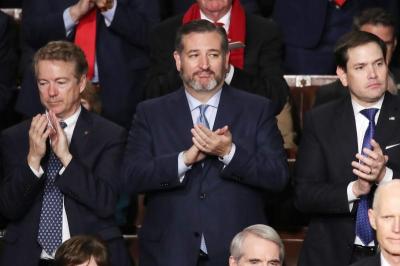
A bipartisan group of US senators has introduced a bill to enhance cooperation with Taiwan on drone development and to reduce reliance on supply chains linked to China. The proposed Blue Skies for Taiwan Act of 2026 was introduced by Republican US senators Ted Cruz and John Curtis, and Democratic US senators Jeff Merkley and Andy Kim. The legislation seeks to ease constraints on Taiwan-US cooperation in uncrewed aerial systems (UAS), including dependence on China-sourced components, limited access to capital and regulatory barriers under US export controls, a news release issued by Cruz on Wednesday said. The bill would establish a "Blue UAS


 RSS
RSS