


Mainland Affairs Council (MAC) Minister Andrew Hsia (夏立言) yesterday said that the existence of the so-called “1992 consensus” is a historical fact that needs to be respected, while calling for goodwill and mutual understanding from both sides of the Taiwan Strait when dealing with major cross-strait issues.
Hsia made the remarks during his second meeting with his Chinese counterpart, China’s Taiwan Affairs Office Minister Zhang Zhijun (張志軍), in Guangzhou, China — talks that are expected to be the last high-level cross-strait interaction of President Ma Ying-jeou’s (馬英九) second term.
“Seventeen years ago today, four consensuses were reached at the 1998 Koo-Wang [then-Straits Exchange Foundation chairman Koo Chen-fu (辜振甫) and Association for Relations Across the Taiwan Straits chairman Wang Daohan (汪道涵)] talks held on the basis of the ‘1992 consensus,’ which was reached during a meeting in Hong Kong in 1992 between Taiwanese and Chinese representatives,” Hsia said.
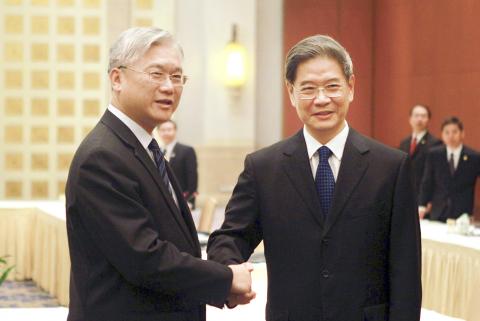
Photo: Reuters
At the time, China invited Taiwan to negotiate over the “one China” principle, Hsia said, prompting Taipei to propose the concept of each side of the Taiwan Strait verbally expressing their adherence to the principle.
“China respected and accepted Taiwan’s proposal, which later became known as the ‘1992 consensus,’” Hsia said.
“This historical fact must be respected, given that it is this very consensus that has facilitated the institutionalization of cross-strait exchanges,” he said.
The “1992 consensus,” is a term that refers to a tacit understanding between the Chinese Nationalist Party (KMT) and the Chinese government that both sides of the Strait acknowledge there is “one China,” with each side having its own interpretation of what “China” means.
However, the consensus has been a subject of much contention in Taiwan for years.
Former MAC chairman Su Chi (蘇起) said in 2006, when he was a KMT lawmaker, that he had made up the term in 2000 when he was still head of the council.
The Democratic Progressive Party (DPP) and former president Lee Teng-hui (李登輝) have repeatedly denied the existence of such a consensus.
The KMT has adamantly adhered to the “consensus,” with Ma urging future presidents to continue pursuing a cross-strait policy based upon it.
At a post-meeting press conference, Hsia said he also told Zhang about the government’s stern reaction to China’s unilateral decision last month to introduce a new electronic “Taiwan compatriot travel document” card for Taiwanese visitors.
“I jokingly told [Zhang] that our lawmakers had demanded that I lodge a protest over the travel card issue, or I should not bother going home,” Hsia said.
He said that both sides have agreed to step up communications over major cross-strait issues.
As for the much-expected proposed policy of allowing Chinese to transit in Taiwan en route to other nations, Hsia said both sides failed to reach a consensus at the meeting, as it would take the government longer to handle Beijing’s requests for optimized flight routes across the Strait.
“Hopefully, we will see the implementation of the transit policy by the end of the year,” he said.

FUKUOKA SITUATION: Japanese media reported that the pathogen is expected to be identified by the summer, while the CDC downplayed the idea that it was hMPV A “mysterious cold-like illness” reported in Japan’s Fukuoka Prefecture does not seem to be a new disease, but Japanese authorities have been asked about the situation, the Centers for Disease Control (CDC) said yesterday. The Fukuoka Prefectural Medical Association on Wednesday told a news conference that a “mystery cold” that has become a hot topic on social media is “highly likely to be caused by some kind of viral infection,” Japan’s KBC News reported. “Many people are experiencing symptoms starting with a sore throat, followed by a runny nose, phlegm and a severe cough,” KBC News reported, citing association officials. Health authorities are

Nvidia Corp CEO Jensen Huang (黃仁勳) arrived in Taiwan yesterday ahead of upcoming AI and technology events, saying he plans to meet with clients and Taiwan Semiconductor Manufacturing Co Chairman C.C. Wei (魏哲家) during his visit. After landing at Taipei Songshan Airport, Huang posed for photos with fans and handed out Yakult drinks to reporters and supporters waiting at the scene, saying he has “a lot to do” during the trip. Asked about reports that Nvidia’s planned headquarters site in Taipei’s Beitou Shilin Technology Park could break ground on May 27, Huang said that if the company holds an event, he would

Carrefour Taiwan is to begin using a new name from the start of July, but it cannot divulge the name until then, the chairman of the supermarket chain's parent company said today. President Chain Store Co chairman Lo Chih-hsien (羅智先) was asked by reporters after a shareholders' meeting to confirm whether the company has settled on a new name for the supermarket brand. In March, the government-registered name of two Carrefour Taiwan branches was quietly changed to "Le Chia Kang" (樂家康) in Chinese, raising speculation that has been selected as the name. Lo said that because of local regulations and contractual obligations, the
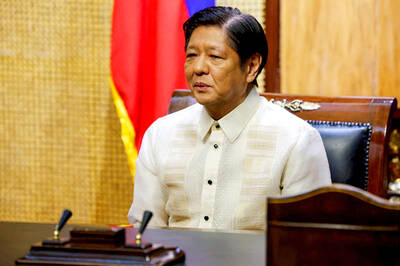
The Philippines would likely be involved in any conflict over Taiwan due to its proximity to the democracy claimed by China, President Ferdinand Marcos Jr said, reiterating a stance that risks angering Beijing. “In the Philippines, we do not have a choice because Taiwan is so close to the Philippines and we have almost 200,000 Filipino nationals living and working in Taiwan,” Marcos said in an interview with Japanese media in Manila on Monday. The Philippine leader’s comments come ahead of a state visit to Japan next week, where he is to meet with Japanese Prime Minister Sanae Takaichi to discuss security


 RSS
RSS