


Taiwan’s principal human rights problems are labor exploitation of migrant workers by fishing companies, exploitation of domestic workers by brokerage agencies and official corruption, a new report from the US Department of State says.
While Taiwan gets generally high marks in the report, it notes that authorities indicted 687 officials, including 69 high-ranking officials, on corruption charges last year.
Country Reports on Human Rights Practices for 2014 was issued on Thursday — four months after a deadline set by the US Congress.
There was widespread speculation that the delay was deliberate to avoid upsetting China before a series of strategic and diplomatic talks were completed this week and to appease Iran where nuclear talks are being finalized.
In stark contrast to Taiwan’s mostly clean bill of health, the report said that China was guilty of repression, coercion, corruption and persecution.
The report accused China of using forced disappearance and strict house arrest, including house arrest of family members, to prevent public expression of independent opinions.
It portrayed China’s political system as ruthlessly repressive and one that regularly deployed extralegal measures to keep dissent in check.
Turning to Taiwan, the report said that the judicial system suffered from some corruption, although efforts were being made to diminish political influence in the judiciary.
The impartiality of judges and prosecutors involved in high-profile and politically sensitive cases had been publicly questioned, the report said.
It also said that local media had reported incidents of police obstruction and violence directed at journalists who were covering protests against administration policies.
“Local academics and media activists alleged that self-censorship continued, as some media chose to present news stories in favor of the People’s Republic of China (PRC) due to political considerations and the influence of local businesses with close ties to the PRC,” the report said.
“Some legal scholars and politicians alleged that the Ministry of Justice was not sufficiently independent, claiming that ministry authorities conducted politically motivated investigations of politicians,” it said.
According to the report, female employees in Taiwan continued to be promoted less frequently, occupied fewer management positions and worked for lower pay than their male counterparts.
The report also said foreign-born spouses were targets of discrimination both inside and outside the home.
“There was reported discrimination, including employment discrimination, against people with HIV/AIDS and 60 percent of HIV carriers left their jobs due to coercion from their supervisors or workplace bullying,” the report said.
It said there was evidence of forced or compulsory labor amongst domestic service workers, farm workers, fishermen and in manufacturing and construction.
“NGOs reported that some labor brokers and employers regularly collected high fees or loan payments from foreign workers, using debts incurred in the source country as a tool for involuntary servitude,” the report said.

LOUD AND PROUD Taiwan might have taken a drubbing against Australia and Japan, but you might not know it from the enthusiasm and numbers of the fans Taiwan might not be expected to win the World Baseball Classic (WBC) but their fans are making their presence felt in Tokyo, with tens of thousands decked out in the team’s blue, blowing horns and singing songs. Taiwanese fans have packed out the Tokyo Dome for all three of their games so far and even threatened to drown out home team supporters when their team played Japan on Friday. They blew trumpets, chanted for their favorite players and had their own cheerleading squad who dance on a stage during the game. The team struggled to match that exuberance on the field, with
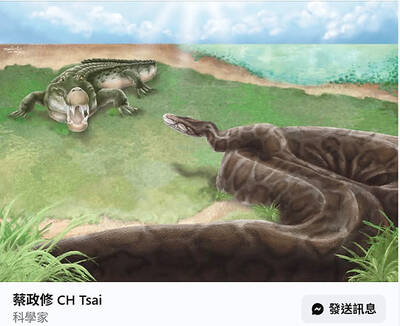
Taiwanese paleontologists have discovered fossil evidence that pythons up to 4m long inhabited Taiwan during the Pleistocene epoch, reporting their findings in the international scientific journal Historical Biology. National Taiwan University (NTU) Institute of Ecology and Evolutionary Biology associate professor Tsai Cheng-hsiu (蔡政修) led the team that discovered the largest snake fossil ever found in Taiwan. The single trunk vertebra was discovered in Tainan at the Chiting Formation, dated to between 400,000 and 800,000 years ago in the Middle Pleistocene, the paper said. The area also produced Taiwan’s first avian fossil, as well as crocodile, mammoth, saber-toothed cat and rhinoceros fossils, it said. Discoveries

Taiwanese paleontologists have discovered fossil evidence that pythons up to 4m long inhabited Taiwan during the Pleistocene epoch, reporting their findings in the international scientific journal Historical Biology. National Taiwan University (NTU) Institute of Ecology and Evolutionary Biology associate professor Tsai Cheng-hsiu (蔡政修) led the team that discovered the largest snake fossil ever found in Taiwan. A single trunk vertebra was discovered in Tainan at the Chiting Formation, dated to between 800,000 to 400,000 years ago in the Middle Pleistocene, the paper said. The area also produced Taiwan’s first avian fossil, as well as crocodile, mammoth, sabre-toothed cat and rhinoceros fossils, it said. Discoveries

Whether Japan would help defend Taiwan in case of a cross-strait conflict would depend on the US and the extent to which Japan would be allowed to act under the US-Japan Security Treaty, former Japanese minister of defense Satoshi Morimoto said. As China has not given up on the idea of invading Taiwan by force, to what extent Japan could support US military action would hinge on Washington’s intention and its negotiation with Tokyo, Morimoto said in an interview with the Liberty Times (sister paper of the Taipei Times) yesterday. There has to be sufficient mutual recognition of how Japan could provide


 RSS
RSS