


Students from 120 high schools and vocational high schools nationwide had as of press time last night signed a petition to protest the Ministry of Education’s planned adjustments to curriculum guidelines.
The ministry faces opposition from teachers and politicians, who claim the planned adjustments would force high-school students to use “China-centric” texts that gloss over past atrocities of the Chinese Nationalist Party (KMT) during the White Terror era, as well as suppressing information on efforts of Taiwanese who fought for democracy.
Students from National Taiwan Normal University’s (NTNU) Department of History supported the petitions, adding that it is necessary to support the “simple and sublime ideals” of high-school students in light of what they called “the forced passage of illegal curriculum changes.”
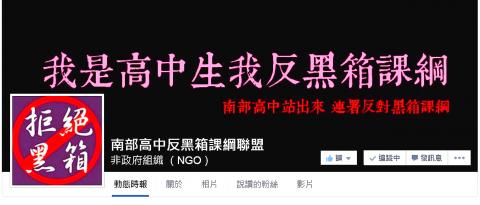
Screenshot by Hung Ting-hung, Taipei Times
Education has become a means by which the state influences students, but the passage of the “black-box” curriculum adjustment has no legal basis, as it has strong ideological suppositions, the students said.
Textbooks written with the proposed changes in mind would not offer high-school students a complete picture of history nor allow them to “decide for themselves what their historical consciousness should be,” the students said.
If textbooks lack a legal basis during procedural determination and have content that is lacking, how can ministry officials live with their consciences, the students said.
The students quoted German historian Max Weber’s work Science as Vocation, in which he wrote: “Without this passion, this conviction that thousands of years must pass before you enter into life and thousands more wait in silence, according to whether you succeed in this conjecture without all this, one has no vocation for science and should do something else.”
The students said the ministry should heed calls for textbooks to adhere to historical truths.
Taichung City Bureau of Education Director-General Yen Ching-hsiang (顏慶祥) said the goal of education in many countries was to allow students to develop the ability to think independently as well as foster democratic values.
Yen said he was happy to see that the ministry’s “erroneous” policy has not harmed democratic values in the hearts of students and has instead motivated them to participate in an effort to change society.
There are 503 high schools across the nation — 155 national high schools, 99 municipal high schools, 38 county high schools and 211 private high schools, according to the ministry.
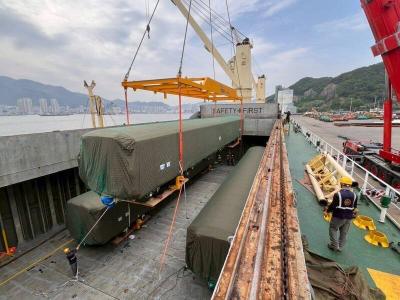
The first of 10 new high-capacity trains purchased from South Korea’s Hyundai Rotem arrived at the Port of Taipei yesterday to meet the demands of an expanding metro network, Taipei Rapid Transit Corp (TRTC) said yesterday. The train completed a three-day, 1,200km voyage from the Port of Masan in South Korea, the company said. Costing NT$590 million (US$18.79 million) each, the new six-carriage trains feature a redesigned interior based on "human-centric" transportation concepts, TRTC said. The design utilizes continuous longitudinal seating to widen the aisles and optimize passenger flow, while also upgrading passenger information displays and driving control systems for a more comfortable

AGING: While Japan has 22 submarines, Taiwan only operates four, two of which were commissioned by the US in 1945 and 1946, and transferred to Taiwan in 1973 Taiwan would need at least 12 submarines to reach modern fleet capabilities, CSBC Corp, Taiwan chairman Chen Cheng-hung (陳政宏) said in an interview broadcast on Friday, citing a US assessment. CSBC is testing the nation’s first indigenous defense submarine, the Hai Kun (海鯤, Narwhal), which is scheduled to be delivered to the navy next month or in July. The Hai Kun has completed torpedo-firing tests and is scheduled to undergo overnight sea trials, Chen said on an SET TV military affairs program. Taiwan would require at least 12 submarines to establish a modern submarine force after assessing the nation’s operational environment and defense
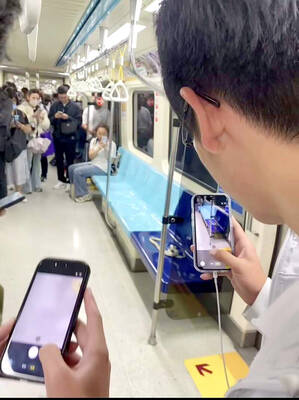
A white king snake that frightened passengers and caused a stir on a Taipei MRT train on Friday evening has been claimed by its owner, who would be fined, Taipei Rapid Transit Corp (TRTC) said yesterday. A person on Threads posted that he thought he was lucky to find an empty row of seats on Friday after boarding a train on the Bannan (Blue) Line, only to spot a white snake with black stripes after sitting down. Startled, he jumped up, he wrote, describing the encounter as “terrifying.” “Taipei’s rat control plan: Release snakes on the metro,” one person wrote in reply, referring
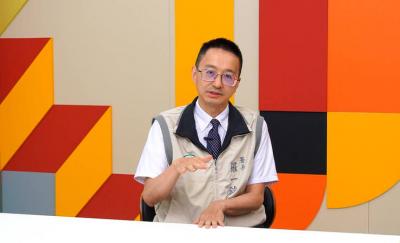
Taiwan’s two cases of hantavirus so far this year are on par with previous years’ case numbers, and the government is coordinating rat extermination work, so there should not be any outbreaks, Centers for Disease Control (CDC) Director-General Philip Lo (羅一鈞) said today in an interview with the Liberty Times (the Taipei Times’ sister newspaper). An increase in rat sightings in Taipei and New Taipei City has raised concerns about the spread of hantavirus, as rats can carry the disease. In January, a man in his 70s who lived in Taipei’s Daan District (大安) tested positive posthumously for hantavirus, Taiwan’s


 RSS
RSS