


A new poll on next year’s presidential election has Democratic Progressive Party (DPP) Chairperson Tsai Ing-wen (蔡英文) ahead against five potential Chinese Nationalist Party (KMT) contenders.
The results of the poll conducted by the Taiwan Thinktank were released yesterday at a news conference in Taipei and show that Legislative Speaker Wang Jin-pyng (王金平) would be the strongest opponent, given his support rating was just 3 percent less than Tsai’s.
Tsai received much more support if judged against Deputy Legislative Speaker Hung Hsiu-chu (洪秀柱) and former department of health head Yaung Chih-liang (楊志良) — who have registered for the KMT presidential primary — the poll found, with Tsai backed by 63.6 percent of respondents when compared to Hung, who was backed by 21.5 percent, and supported by 63.4 percent if up against Yuang, who was favored by 17.5 percent.
When polled against Wang, KMT Chairman Eric Chu (朱立倫) and Vice President Wu Den-yih (吳敦義) — none of whom have entered the KMT primary, but are still seen as possible “recruits” — Tsai beat Wang by 44.1 percent to 41.3 percent, Chu by 46.7 percent to 41 percent and Wu by 64.1 percent to 20.2 percent, the poll showed.
The think tank said that Wang, in a poll that pitted the five KMT members against each other, was backed by 38.2 percent of respondents, followed by Chu with 29 percent, while Wu attracted 6.2 percent support, Yaung 6 percent and Hung 5.4 percent.
Think tank deputy chief executive Lai I-chung (賴怡忠) said that Wang and Chu would be the strongest KMT candidates.
Conducted on Saturday last week, the poll surveyed people aged 20 or older and collected 1,079 valid samples, with a 95 percent confidence level and a marginal error of plus or minus 3 percent.
When asked later about the poll results, Wang declined to comment.
“I do not know,” the legislative speaker said when reporters asked him about President Ma Ying-jeou’s (馬英九) comment that he hoped that the KMT’s presidential candidate would be the one most likely to win, and that Wang has the highest poll numbers among possible KMT candidates.
Meanwhile, Hung, who was backed by less than 30 percent of respondents in a similar poll conducted by the Chinese-language Apple Daily, said that she expects a turnaround toward the end of the presidential campaign.
She cited former US president Bill Clinton’s low popularity when he began his race against then-US president George H.W. Bush and the Conservative Party’s victory in the British general election this month as examples of politicians who came from behind to win victories.
Additional reporting by Alison Hsiao
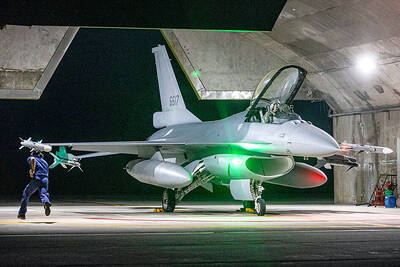
Taiwan has received more than US$70 million in royalties as of the end of last year from developing the F-16V jet as countries worldwide purchase or upgrade to this popular model, government and military officials said on Saturday. Taiwan funded the development of the F-16V jet and ended up the sole investor as other countries withdrew from the program. Now the F-16V is increasingly popular and countries must pay Taiwan a percentage in royalties when they purchase new F-16V aircraft or upgrade older F-16 models. The next five years are expected to be the peak for these royalties, with Taiwan potentially earning
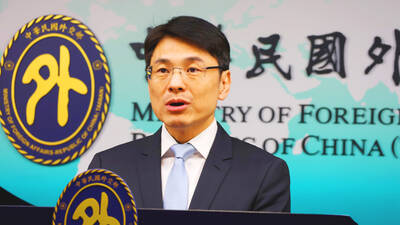
STAY IN YOUR LANE: As the US and Israel attack Iran, the ministry has warned China not to overstep by including Taiwanese citizens in its evacuation orders The Ministry of Foreign Affairs (MOFA) yesterday rebuked a statement by China’s embassy in Israel that it would evacuate Taiwanese holders of Chinese travel documents from Israel amid the latter’s escalating conflict with Iran. Tensions have risen across the Middle East in the wake of US and Israeli airstrikes on Iran beginning Saturday. China subsequently issued an evacuation notice for its citizens. In a news release, the Chinese embassy in Israel said holders of “Taiwan compatriot permits (台胞證)” issued to Taiwanese nationals by Chinese authorities for travel to China — could register for evacuation to Egypt. In Taipei, the ministry yesterday said Taiwan
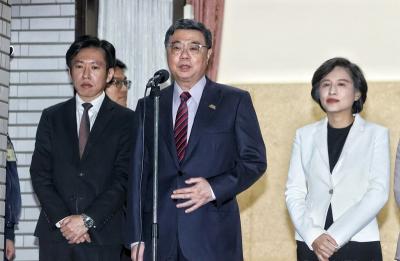
Taiwan is awaiting official notification from the US regarding the status of the Agreement on Reciprocal Trade (ART) after the US Supreme Court ruled US President Donald Trump's global tariffs unconstitutional. Speaking to reporters before a legislative hearing today, Premier Cho Jung-tai (卓榮泰) said that Taiwan's negotiation team remains focused on ensuring that the bilateral trade deal remains intact despite the legal challenge to Trump's tariff policy. "The US has pledged to notify its trade partners once the subsequent administrative and legal processes are finalized, and that certainly includes Taiwan," Cho said when asked about opposition parties’ doubts that the ART was
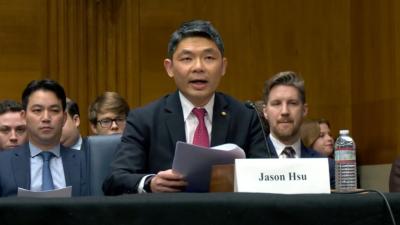
If China chose to invade Taiwan tomorrow, it would only have to sever three undersea fiber-optic cable clusters to cause a data blackout, Jason Hsu (許毓仁), a senior fellow at the Hudson Institute and former Chinese Nationalist Party (KMT) legislator, told a US security panel yesterday. In a Taiwan contingency, cable disruption would be one of the earliest preinvasion actions and the signal that escalation had begun, he said, adding that Taiwan’s current cable repair capabilities are insufficient. The US-China Economic and Security Review Commission (USCC) yesterday held a hearing on US-China Competition Under the Sea, with Hsu speaking on


 RSS
RSS