


Taiwan is a key component of US Asia-Pacific policies, including the rebalance to Asia, US Secretary of State John Kerry said in a written statement on Thursday.
“The US continues to expand and enhance its strong and multifaceted unofficial relationship with Taiwan,” he said in a formal answer to questions asked more than two months ago by Representative Ed Royce, chairman of the House of Representatives’ Foreign Affairs Committee.
Kerry’s statement came just three days after Chinese President Xi Jinping (習近平) met with Chinese Nationalist Party (KMT) Chairman Eric Chu (朱立倫) and reaffirmed Beijing’s support for closer cross-strait economic ties.
While Kerry made no mention of the Chu-Xi meeting, he appeared to be reassuring Taipei that it still had strong US support.
“Taiwan is an important security and economic partner of the US, an important part of global value chains, a vibrant democracy and our 10th largest trading partner,” Kerry said.
He said the US would continue deepening its engagement with Taipei on trade and investment issues through the Trade and Investment Framework Agreement (TIFA) process and that the US welcomed Taiwan’s interest in joining the Trans-Pacific Partnership (TPP).
“We work cooperatively with Taiwan in APEC to promote regional economic integration initiatives, including enhanced trade and investment,” he said.
Kerry said the US made sure Taiwan could maintain a sufficient self-defense capability through the Taiwan Relations Act (TRA).
“Collectively, these activities demonstrate our continued commitment to Taiwan’s peace, security and prosperity as part of the US rebalance,” he said.
Through TIFA, the US encouraged the development of a “more liberalized” trade policy for Taiwan “to allow Taiwan to diversify its trade portfolio, which has become increasingly dependent on China,” he said, adding that the TPP was a “concrete manifestation” of the US rebalancing strategy.
“Other economies are negotiating agreements that do not protect workers’ rights or environmental interests, do not protect intellectual property rights or maintain a free and open Internet and do not address unfair competition from state-owned enterprises to the level we seek,” Kerry said.
“If that becomes the model for the fastest growing region of the world, it will put our workers and firms at a significant disadvantage,” he said.
“TPP will help the US to remain a major economic and strategic force, allow US companies and exporters to be leading commercial players and ensure regional initiatives to reflect US values and principles,” he said.
Kerry acknowledged that Taiwan wants to join the TPP, but said consensus among the 12 original partners would be required for any new countries to join.
At this stage, the US was “sharply focused” on finishing negotiations among the original TPP members and Taiwan would not be considered until the first round was successful completed, he said.
While Taiwan’s government has said that it is “vital” for the nation to win TPP membership in the second round of entry negotiations, there has been widespread speculation that China will pressure the original members to keep Taipei out.
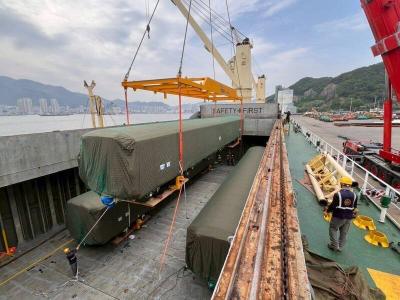
The first of 10 new high-capacity trains purchased from South Korea’s Hyundai Rotem arrived at the Port of Taipei yesterday to meet the demands of an expanding metro network, Taipei Rapid Transit Corp (TRTC) said yesterday. The train completed a three-day, 1,200km voyage from the Port of Masan in South Korea, the company said. Costing NT$590 million (US$18.79 million) each, the new six-carriage trains feature a redesigned interior based on "human-centric" transportation concepts, TRTC said. The design utilizes continuous longitudinal seating to widen the aisles and optimize passenger flow, while also upgrading passenger information displays and driving control systems for a more comfortable
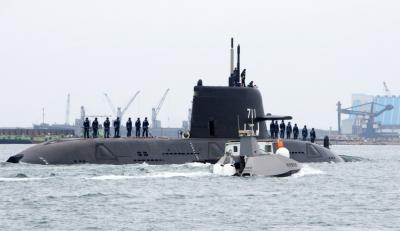
Taiwan's first indigenous defense submarine, the SS-711 Hai Kun (海鯤, or Narwhal), departed for its 13th sea trial at 7am today, marking its seventh submerged test, with delivery to the navy scheduled for July. The outing also marked its first sea deployment since President William Lai (賴清德) boarded the submarine for an inspection on March 19, drawing a crowd of military enthusiasts who gathered to show support. The submarine this morning departed port accompanied by CSBC Corp’s Endeavor Manta (奮進魔鬼魚號) uncrewed surface vessel and a navy M109 assault boat. Amid public interest in key milestones such as torpedo-launching operations and overnight submerged trials,
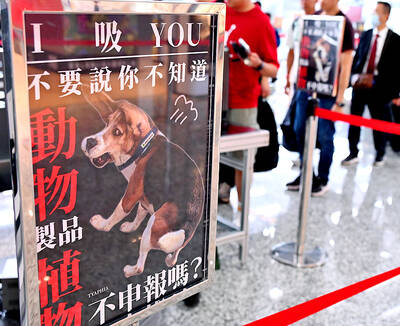
Quarantine awareness posters at Taiwan Taoyuan International Airport have gone viral for their use of wordplay. Issued by the airport branch of the Animal and Plant Health Inspection Agency, the posters feature sniffer dogs making a range of facial expressions, paired with advisory messages built around homophones. “We update the messages for holidays and campaign needs, periodically refreshing materials to attract people’s attention,” quarantine officials said. “The aim is to use the dogs’ appeal to draw focus to quarantine regulations.” A Japanese traveler visiting Taiwan has posted a photo on X of a poster showing a quarantine dog with a
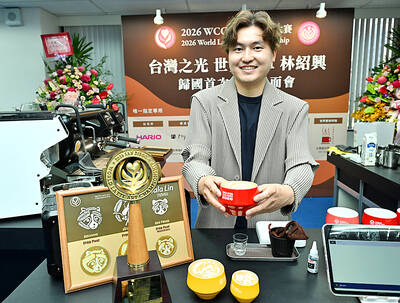
Taiwan’s coffee community has launched a “one-person-one-e-mail” campaign, calling for people to send a protest-e-mail to the World Coffee Championships (WCC) urging it to redesignate Taiwanese competitors as from “Taiwan,” rather than “Chinese Taipei.” The call followed sudden action last week after the WCC changed all references to Taiwanese competitors from “Taiwan” to “Chinese Taipei,” including recent World Latte Art champion Bala (林紹興), who won the World Latte Art Championship in San Diego earlier this month. When Bala received the trophy, he was referred to as representing Taiwan, as well as in the announcement on the WCC’s Web site, until it


 RSS
RSS