


Responding to Chinese Nationalist Party (KMT) Chairman Eric Chu’s (朱立倫) statement that the Democratic Progressive Party (DPP) is failing to develop a DPP-Chinese Communist Party (CCP) relationship, the DPP yesterday reiterated its stance that cross-strait ties should be based on a government-to-government relationship.
“Cross-strait relations are cross-strait relations; neither KMT-CCP relations nor DPP-CCP relations could represent all the people on both sides of the Taiwan Strait,” DPP spokesperson Cheng Yun-peng (鄭運鵬) said. “For a long time, the KMT has made cross-strait relations something between the KMT and the CCP, something that is within the privileged class, and something that is dealt with secretly. The DPP will not follow it and Taiwanese will not accept it.”
The KMT seems to have more influence on cross-strait issues than the government of Taiwan, and even Chu has admitted that such party-to-party exchanges benefit only a few individuals or corporations, he added.
“We therefore would like to call on Chu to refrain from putting his own or the party’s interests before the public’s interests,” Cheng said. “We would like to remind Chu that, without government authorization, no individual or party may proceed to cross-strait negotiations or sign any agreement. Chu must abide by relevant laws, and act only as he should.”
Before departing for a KMT_CCP forum in China yesterday, Chu on Friday said during a press conference that while KMT-CCP exchanges cannot replace regular cross-strait exchanges, they are very important party-to-party relations.
He said that direct DPP-CCP exchanges could also exist, and asked why they do not.
Chu is to participate in the annual KMT-CCP forum in Shanghai, and is to meet with Chinese President and CCP General Secretary Xi Jinping (習近平) tomorrow, making him the first sitting KMT chairman to meet with the head of the CCP since 1949.
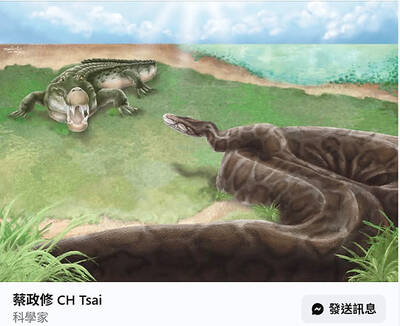
Taiwanese paleontologists have discovered fossil evidence that pythons up to 4m long inhabited Taiwan during the Pleistocene epoch, reporting their findings in the international scientific journal Historical Biology. National Taiwan University (NTU) Institute of Ecology and Evolutionary Biology associate professor Tsai Cheng-hsiu (蔡政修) led the team that discovered the largest snake fossil ever found in Taiwan. The single trunk vertebra was discovered in Tainan at the Chiting Formation, dated to between 400,000 and 800,000 years ago in the Middle Pleistocene, the paper said. The area also produced Taiwan’s first avian fossil, as well as crocodile, mammoth, saber-toothed cat and rhinoceros fossils, it said. Discoveries

INCREASED CAPACITY: The flights on Mondays, Wednesdays, Fridays and Sundays would leave Singapore in the morning and Taipei in the afternoon Singapore Airlines is adding four supplementary flights to Taipei per week until May to meet increased tourist and business travel demand, the carrier said on Friday. The addition would raise the number of weekly flights it operates to Taipei to 18, Singapore Airlines Taiwan general manager Timothy Ouyang (歐陽漢源) said. The airline has recorded a steady rise in tourist and business travel to and from Taipei, and aims to provide more flexible travel arrangements for passengers, said Ouyang, who assumed the post in July last year. From now until Saturday next week, four additional flights would depart from Singapore on Monday, Wednesday, Friday

WATCH FOR HITCHHIKERS: The CDC warned those returning home from Japan to be alert for any contagious diseases that might have come back with them People who have returned from Japan following the World Baseball Classic (WBC) games during the weekend are recommended to watch for symptoms of infectious gastroenteritis, flu and measles for two weeks, the Centers for Disease Control (CDC) said. Flu viruses remain the most common respiratory pathogen in Taiwan in the past four weeks and the influenza B virus accounted for 55.7 percent of the tested cases, exceeding the percentage of influenza A (H3N2) infections and becoming the local dominant strain, CDC Epidemic Intelligence Center Deputy Director Lee Chia-lin (李佳琳) said at a news conference on Tuesday. There were 82,187 hospital visits for

Alumni from Japan’s Kyoto Tachibana Senior High School marching band, widely known as the “Orange Devils,” staged a flash mob performance at the Grand Hotel in Taipei yesterday to thank Taiwan for its support after the Great East Japan Earthquake. The show, performed on the earthquake’s 15th anniversary, drew more than 100 spectators, some of whom arrived two hours before the show to secure a good viewing spot. The 26-member group played selections from “High School Musical,” “Beauty and the Beast,” and their signature piece “Sing Sing Sing” and shouted “I love


 RSS
RSS