


A study advocating an internationally monitored plebiscite to decide the political future of Taiwan appeared this week on an Oxford University Web site.
“Unlike in bygone eras, international law no longer conceives of territories as mere pieces of property to be traded or conquered,” the study says.
Written by New York Law School professor Chen Lung-chu (陳隆志), the study says that human beings “are properly held to be at the center of international law.”
The study comes as Chinese Nationalist Party (KMT) Chairman and New Taipei City Mayor Eric Chu (朱立倫) prepares for talks next week with Chinese President and Chinese Communist Party General Secretary Xi Jinping (習近平).
The idea of a plebiscite to decide the future of Taiwan is anathema to Beijing and a development that could lead to a military attack.
However, Chen argues that Taiwanese have the right to determine their own future.
“The inhabitants of a disputed territory, through collective effort, can develop their distinctive political, economic, social and cultural system,” he said. “This is effective self-determination — self-determination in action. When the international legal status of a territory is in dispute, an internationally monitored plebiscite provides the ideal means of resolving the dispute peacefully.”
Chen’s study appeared under the international law section of the University of Oxford Press Web site.
Asked to comment on the Xi-Chu meeting, the US Department of State said last week that the US encourages Taiwan and China to continue their dialogue.
“We encourage authorities in Beijing and Taipei to continue their constructive dialogue, which has led to significant improvements in the cross-strait relationship,” a spokesperson said.
Polls show that a majority of Taiwanese prefer independence to unification with China.
In the past, the US Department of State has discouraged the idea of a plebiscite for fear that it might trigger Chinese military action.
“In a world of increasing globalization and interdependence, we see a gradual expansion in identifications — more and more, members of the world community identify with the most inclusive community of humankind and a deepening perception of shared humanity,” the study says. “Genuine protection and fulfillment of human dignity values... will be possible only when individuals are enabled to be effective, active, equal participants at different community levels and in different social settings.”
It says that the past 30 years have witnessed a profound and persistent movement of democratization — and Taiwanization — that runs counter to China’s “unfounded claims over the island.”
“Under present conditions, Taiwan’s statehood is best understood in the context of an ongoing process of evolution propelled by the desire and action of the Taiwanese people for self-determination and democracy,” the study says.

FUKUOKA SITUATION: Japanese media reported that the pathogen is expected to be identified by the summer, while the CDC downplayed the idea that it was hMPV A “mysterious cold-like illness” reported in Japan’s Fukuoka Prefecture does not seem to be a new disease, but Japanese authorities have been asked about the situation, the Centers for Disease Control (CDC) said yesterday. The Fukuoka Prefectural Medical Association on Wednesday told a news conference that a “mystery cold” that has become a hot topic on social media is “highly likely to be caused by some kind of viral infection,” Japan’s KBC News reported. “Many people are experiencing symptoms starting with a sore throat, followed by a runny nose, phlegm and a severe cough,” KBC News reported, citing association officials. Health authorities are

Nvidia Corp CEO Jensen Huang (黃仁勳) arrived in Taiwan yesterday ahead of upcoming AI and technology events, saying he plans to meet with clients and Taiwan Semiconductor Manufacturing Co Chairman C.C. Wei (魏哲家) during his visit. After landing at Taipei Songshan Airport, Huang posed for photos with fans and handed out Yakult drinks to reporters and supporters waiting at the scene, saying he has “a lot to do” during the trip. Asked about reports that Nvidia’s planned headquarters site in Taipei’s Beitou Shilin Technology Park could break ground on May 27, Huang said that if the company holds an event, he would

The Ministry of Finance this afternoon announced the winning numbers for the March-April uniform invoice lottery. The winning number for the NT$10 million (US$318,060) special prize is 19531471, and the winning number for the NT$2 million grand prize is 85941329. Three numbers were drawn for the NT$200,000 first prize: 07225810, 20231230 and 83518781. Those with receipts matching the last seven digits of any of the first-prize numbers will win the NT$40,000 second prize, while those matching the last six digits will win the NT$10,000 third prize. Those whose receipts match the last five digits of the first-prize numbers can claim the NT$4,000 fourth prize,
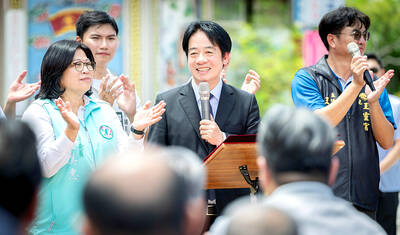
SIX SUBSIDIES: The monthly allowance for older farmers is to increase to NT$10,000, and NT$5,000 is to be given to homemakers under the national pension system, Lai said The government is to implement major welfare policies for disadvantaged groups, including raising the monthly allowance for older farmers to NT$10,000 and providing homemakers with NT$5,000 per month, President William Lai (賴清德) said yesterday. Lai made the remarks during a visit to Wangling Temple in Chiayi County, saying that the planned increases were being introduced amid economic growth and an increase in tax revenue. Touting a policy, in which the government plans to provide a monthly allowance of NT$5,000 for every child under the age of 18 in a bid to address Taiwan’s low birthrate, Lai said that if received for the


 RSS
RSS