


A significant increase in government rewards and subsidies over the past seven years since President Ma Ying-jeou (馬英九) took office in May 2008 has recently been called into question by lawmakers, who said the increased funds could become the Chinese Nationalist Party’s (KMT) most powerful bargaining chip in the campaign for next year’s legislative and presidential elections.
The so-called “government rewards and subsidies” can be allocated to local governments, civic organizations, private schools and individuals, as well for the purposes of compensation, rewards and consolation.
According to budget statistics, the central government’s total budget increased by 16 percent, or NT$273 billion (US$8.72 billion), from NT$1.69 trillion in 2008 to NT$1.96 trillion this year. A larger rise has been observed in its reward and subsidy funding, from NT$701 billion to NT$978.2 billion during the same period, up 40 percent, or NT$277.2 billion.
Meanwhile, the final accounts of the local government bodies between 2011 and 2013 decreased from its peak of NT$496.4 billion to NT$462.8 billion, while the subsidies for organizations and individuals increased from NT$398.6 billion to NT$464.3 billion during the same period, accounting for 45 percent and 50 percent of the total reward and subsidy fund respectively.
The subsidy fund is considered by critics as a “secret purse” of the government, given that former premier Jiang Yi-huah (江宜樺) pledged to allocate more than NT$300 million from the fund for public infrastructure when campaigning for KMT members competing in last year’s nine-in-one local elections.
Jiang’s pledges were rebuffed by some academics as a form of vote-buying at the time.
A Directorate-General of Budget, Accounting and Statistics official, who spoke on condition of anonymity, said there was a link between the increased subsidies and Jiang’s campaign promises.
Taiwan Solidarity Union Legislator Lai Cheng-chang (賴振昌) said in addition to the subsidy fund, the government’s income from a tobacco health and welfare surcharge has become “certain people’s campaign funds.”
“The surcharge was used multiple times to print lunar calendars and a gourmet guidebook for former KMT legislator Hou Tsai-feng (侯彩鳳), which also included photographs of Ma. Health Promotion Administration Director-General Chiou Shu-ti (邱淑媞) also drew from the surcharge to run personal advertisements last year, when she was running for Yilan County commissionership,” Lai said.
A local government official in charge of agriculture, who requested anonymity, said the allocation of the reward and subsidy fund was mostly politically motivated, as evidenced by the fact that most of the local governments that received the subsidies were located on the north side of the Jhuoshuei River (濁水溪) — areas traditionally considered KMT strongholds.
“The government should stipulate a basic or subsidy law to avoid expenditure waste caused by the government’s unrestrained administrative discretion,” Southern Taiwan University of Science and Technology’s associate professor Lo Cheng-chung (羅承宗) said.
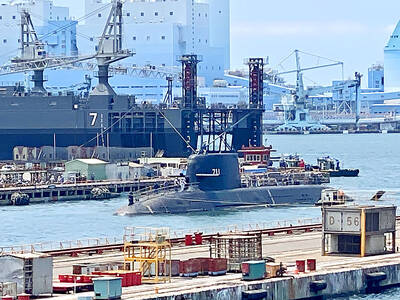
AGING: While Japan has 22 submarines, Taiwan only operates four, two of which were commissioned by the US in 1945 and 1946, and transferred to Taiwan in 1973 Taiwan would need at least 12 submarines to reach modern fleet capabilities, CSBC Corp, Taiwan chairman Chen Cheng-hung (陳政宏) said in an interview broadcast on Friday, citing a US assessment. CSBC is testing the nation’s first indigenous defense submarine, the Hai Kun (海鯤, Narwhal), which is scheduled to be delivered to the navy next month or in July. The Hai Kun has completed torpedo-firing tests and is scheduled to undergo overnight sea trials, Chen said on an SET TV military affairs program. Taiwan would require at least 12 submarines to establish a modern submarine force after assessing the nation’s operational environment and defense
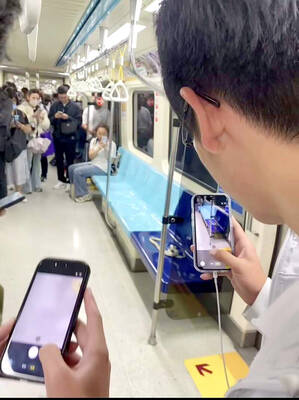
A white king snake that frightened passengers and caused a stir on a Taipei MRT train on Friday evening has been claimed by its owner, who would be fined, Taipei Rapid Transit Corp (TRTC) said yesterday. A person on Threads posted that he thought he was lucky to find an empty row of seats on Friday after boarding a train on the Bannan (Blue) Line, only to spot a white snake with black stripes after sitting down. Startled, he jumped up, he wrote, describing the encounter as “terrifying.” “Taipei’s rat control plan: Release snakes on the metro,” one person wrote in reply, referring
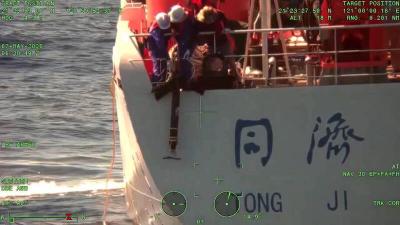
The coast guard today said that it had disrupted "illegal" operations by a Chinese research ship in waters close to the nation and driven it away, part of what Taipei sees a provocative pattern of China's stepped up maritime activities. The coast guard said that it on Thursday last week detected the Chinese ship Tongji (同濟號), which was commissioned only last year, 29 nautical miles (54km) southeast of the southern tip of Taiwan, although just outside restricted waters. The ship was observed lowering ropes into the water, suspected to be the deployment of scientific instruments for "illegal" survey operations, and the coast
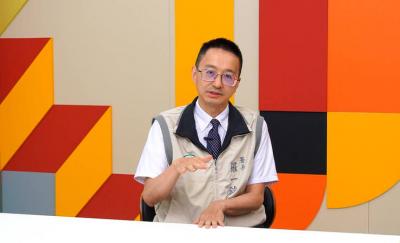
Taiwan’s two cases of hantavirus so far this year are on par with previous years’ case numbers, and the government is coordinating rat extermination work, so there should not be any outbreaks, Centers for Disease Control (CDC) Director-General Philip Lo (羅一鈞) said today in an interview with the Liberty Times (the Taipei Times’ sister newspaper). An increase in rat sightings in Taipei and New Taipei City has raised concerns about the spread of hantavirus, as rats can carry the disease. In January, a man in his 70s who lived in Taipei’s Daan District (大安) tested positive posthumously for hantavirus, Taiwan’s


 RSS
RSS