


Unless Beijing significantly reduces the size and scope of its military threat, Washington will feel compelled to approve major new weapons sales to Taiwan “at various times in the future,” a report from the Carnegie Endowment said.
The lengthy report — Conflict and Cooperation in the Asia-Pacific Region — says that, short of political reconciliation across the Taiwan Strait, Washington will continue to see the need to maintain some of Taiwan’s deterrent capability against a Chinese use of force.
It says that Beijing is pressing Washington to end arms sales, while Taipei is “publicly and privately” requesting more weapons, “especially those likely to provoke Beijing’s ire, such as advanced C/D versions of the F-16 aircraft.”
Written by 10 authors, including Carnegie China expert Michael Swaine and Stimson Center East Asia program director Alan Romberg, the report says it remains unclear if “over time” Beijing will decide that it needs to use force to bring about unification.
“Such a move would likely not be because Taiwan had moved to de jure independence, but because it seemed to be moving to consolidate permanent separate status on a de facto basis,” the report says.
Beijing seems confident it will eventually win sufficient support in Taiwan for some form of unification, the report says.
“But one cannot assume such confidence will be sustained over 25 years, and hence the possibility of use of force cannot be ruled out,” it says.
The report says that “recent tensions and changes in public attitudes” suggest that Taipei is unlikely to push for formal independence or permanent separation unless the US-China relationship becomes “intensely hostile.”
However, major tensions, confrontations and even conflict are still possible, especially over the long term, it says.
“The evolution of cross-strait relations will depend greatly on the tenor of the US-China relationship and the calculations of Beijing in particular,” it says.
The report adds that it is extremely unlikely that Washington will significantly alter its “balanced policy approach” to handling the Taiwan issue.
“This approach is widely viewed by US policymakers as fundamentally sound in principle and is likely to remain so for some time, even as some quarters call for its revision,” it says.
The report says that although not fully united, the Democratic Progressive Party (DPP) is in a better shape than it has been in a long time to defeat the Chinese Nationalist Party (KMT) in next year’s presidential elections.
“At the same time, the DPP will be challenged not only to convince the electorate that it can govern, but also that it can successfully manage cross-strait relations,” it says.
The DPP “failed on both scores in 2012 and Beijing may make it hard to be convincing on the cross-strait dimension in 2016 unless the DPP embraces some form of ‘one China’ framework, which the DPP seems unprepared to do,” the report says.
While there is broad support in Taiwan for cross-strait economic, social and other similar links, any cross-strait dialogue and intensification of contacts that threatens to lead to political integration will continue to confront strong opposition, it says.
“Because Beijing cannot afford to ‘lose’ Taiwan and will accordingly continue to develop and deploy military capabilities of direct relevance to Taiwan, and because the US will therefore continue to acquire and deploy capabilities designed to deter any Chinese use of force, any serious provocations from Taiwan could prove particularly dangerous,” the report says.
“Whether Beijing can trust Washington to maintain controls on Taipei as it did in the Chen Shui-bian (陳水扁) era (thereby obviating the necessity for Beijing to do so through coercive means) will depend a great deal on whether the US government can maintain the delicate balance between deterrence and reassurance toward Beijing that is required to sustain stability in the Taiwan Strait,” the report says.
The report concludes that if the DPP wins next year, the reality of China’s dominant role in regional economics will constrain the DPP in any practical efforts to reduce dependence on Chinese markets or to promote any provocative steps toward separate status.

NATIONAL SECURITY: Authorities are working to confirm the identities of the military personnel involved and investigating possible illegal conduct and regulatory violations Authorities are probing possible national security implications after Kinmen police and immigration officers on Sunday found a Chinese woman allegedly posing as a tourist while engaging in prostitution involving more than 10 military personnel. The woman, surnamed Chen (陳), has since been deported, authorities said, adding that investigators are still working to confirm the identities of those implicated, as the records only listed code names and aliases. The case stemmed from a report received by the Kinmen District Prosecutors’ Office on Friday last week from the Jinhu Precinct of the Kinmen County Police Bureau. On Sunday, police, along with the National Immigration

GLOBALGIVING: ‘ Caving to external pressure is not acceptable for an organization that has cultivated justice reform and human rights for 30 years,’ one NGO said A slew of non-government organizations (NGOs) have withdrawn from the GlobalGiving fundraising platform after it announced it would use “Chinese Taipei” instead of “Taiwan” from next month. The Taiwan Good Rice Association wrote on Facebook on Friday that it was informed on April 28 via a teleconference call of the change, which was made because the platform wanted to operate in China. Taiwan Good Rice is to terminate all cooperative relationships with GlobalGiving in response to the platform’s “unilateral and non-negotiable” decision to remove references to Taiwan, the NGO said. “Taiwan is in the official name of Taiwan Good Rice Association and the
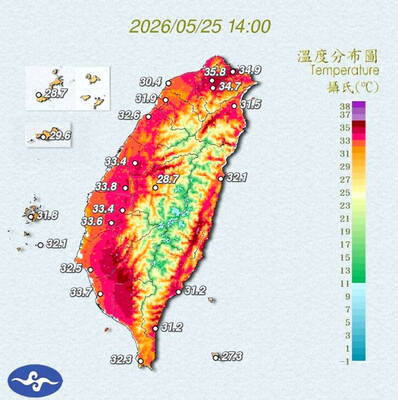
STAY COOL: The HPA recommended that people stay hydrated, use air-conditioning or fans while indoors, wear loose-fitting clothes and walk in the shade while outdoors Employers must implement measures such as installing cooling equipment, and providing drinking water and rest breaks for outdoor workers starting from Monday next week, the Taipei Department of Labor said on Sunday. Employers who fail to comply could face fines of NT$30,000 to NT$300,000 under the Occupational Safety and Health Act (職業安全衛生法), the department said. Businesses in Taipei employing fewer than 100 workers, as well as registered self-employed workers with labor insurance coverage, could receive on-site assessments and guidance from occupational safety consultants to help them apply for central government subsidies to implement or improve heat-protection measures, it said. Under the Ministry of

Chinese Nationalist Party (KMT) Chairwoman Cheng Li-wun (鄭麗文) yesterday briefed her party’s Central Standing Committee regarding her scheduled visit to the US between Monday next week and June 16, saying that her purpose would be to persuade the US that the Republic of China (ROC) Constitution was a “one China” constitution that would foster stable and peaceful cross-strait relations. The ROC Constitution is the most important defense for all Taiwanese citizens, as it upholds our democracy and has contributed to our robust economy, which aligns with international and US interests, she said. “We would not be troublemakers and drag the US under,”


 RSS
RSS