


The Wanpi World Safari Zoo in Tainan’s Syuejia District (學甲) is to end its animal performances today due to mounting pressure from animal protection groups and is seeking to transform itself into a certified facility promoting environmental awareness.
Wanpi World vice president Lee Ying-chun (李英俊) said that, in response to the growing trend of environmental protection, the zoo filed an application with the Tainan Environmental Protection Bureau in 2012, hoping to be certified as a venue for civil servants to receive their annual environmental education.
Under the Environmental Education Act (環境教育法), civil servants are required to complete four hours of environmental education every year.
However, the application was rejected because of the animal shows, Lee said.
Animals used by the zoo for performances have included monkeys, elephants, piglets and macaws.
In the future, the zoo aims to educate people about the natural habitat and behavior of its animals, and introduce infrastructure based on water conservation and energy-saving concepts, he said.
“We hope to improve the environment that our animals live in by achieving an 80 percent similarity between their living conditions and their natural habitat, which will also help to educate young people about how people can live in harmony with nature,” he said.
He said that more people have visited the zoo after learning about the termination of the performances, ostensibly to reminisce over fond memories made there.
He said the zoo would apply for certification again tomorrow.
The attraction opened in 1994 and has enjoyed widespread popularity.
The Environmental and Animal Society of Taiwan (EAST) lauded the zoo’s decision, calling it a “belated liberation of wildlife.”
EAST director Chen Yu-min (陳玉敏) said her organization has protested against the mistreatment of animals at the zoo for more than 10 years.
“We told the president of the zoo in August last year that if he does not respond to the global trend of animal protection, he would be forced to close down his business someday,” she said.
Chen said that the zoo originally agreed to end its animal shows by the end of the Lunar New Year holiday last month, but delayed the plan until today.
“Nevertheless, it is a major move forward,” she said.
Despite the end to animal performances, she said that animals at the zoo live in appalling conditions. For example, nocturnal animals are housed in habitats that are exposed to daylight and arboreal animals do not have trees to live in, she said, adding that many of the animals have exhibited symptoms of depression.
EAST will continue to monitor animal welfare at the zoo, she said.

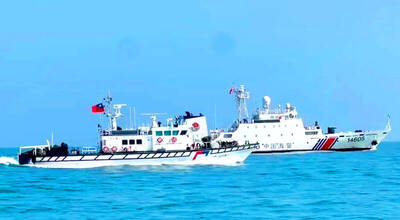
The military has spotted two Chinese warships operating in waters near Penghu County in the Taiwan Strait and sent its own naval and air forces to monitor the vessels, the Ministry of National Defense (MND) said. Beijing sends warships and warplanes into the waters and skies around Taiwan on an almost daily basis, drawing condemnation from Taipei. While the ministry offers daily updates on the locations of Chinese military aircraft, it only rarely gives details of where Chinese warships are operating, generally only when it detects aircraft carriers, as happened last week. A Chinese destroyer and a frigate entered waters to the southwest
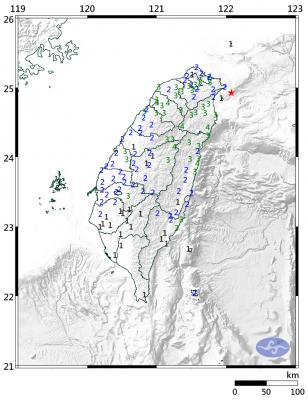
A magnitude 6.1 earthquake struck off the coast of Yilan County at 8:39pm tonight, the Central Weather Administration (CWA) said, with no immediate reports of damage or injuries. The epicenter was 38.7km east-northeast of Yilan County Hall at a focal depth of 98.3km, the CWA’s Seismological Center said. The quake’s maximum intensity, which gauges the actual physical effect of a seismic event, was a level 4 on Taiwan’s 7-tier intensity scale, the center said. That intensity level was recorded in Yilan County’s Nanao Township (南澳), Hsinchu County’s Guansi Township (關西), Nantou County’s Hehuanshan (合歡山) and Hualien County’s Yanliao (鹽寮). An intensity of 3 was

Japanese Prime Minister Sanae Takaichi’s comment last year on Tokyo’s potential reaction to a Taiwan-China conflict has forced Beijing to rewrite its invasion plans, a retired Japanese general said. Takaichi told the Diet on Nov. 7 last year that a Chinese naval blockade or military attack on Taiwan could constitute a “survival-threatening situation” for Japan, potentially allowing Tokyo to exercise its right to collective self-defense. Former Japan Ground Self-Defense Force general Kiyofumi Ogawa said in a recent speech that the remark has been interpreted as meaning Japan could intervene in the early stages of a Taiwan Strait conflict, undermining China’s previous assumptions
Instead of focusing solely on the threat of a full-scale military invasion, the US and its allies must prepare for a potential Chinese “quarantine” of Taiwan enforced through customs inspections, Stanford University Hoover fellow Eyck Freymann said in a Foreign Affairs article published on Wednesday. China could use various “gray zone” tactics in “reconfiguring the regional and ultimately the global economic order without a war,” said Freymann, who is also a nonresident research fellow at the US Naval War College. China might seize control of Taiwan’s links to the outside world by requiring all flights and ships entering or leaving Taiwan


 RSS
RSS