


Dozens of members of Taipei’s New Female Immigrant Care Association yesterday staged a protest outside city hall to demand an apology from Taipei Mayor Ko Wen-je (柯文哲) over his recent off-the-cuff remark describing the foreign spouses of Taiwanese men as “imported foreign brides.”
“I came from China and have been married with a Taiwanese man for 14 years. There are more than 480,000 immigrants in Taiwan. We are human beings, not some products for sale,” association executive secretary Li Xia (李霞) said as she led the protest, which consisted of women like her from China, Vietnam, Indonesia, Myanmar and Thailand.
Li was referring to remarks Ko made during a gender forum on Saturday, when he commented that he was bewildered by the fact that there were more single men than women in the nation, given that “the nation has imported 300,000 foreign brides.”
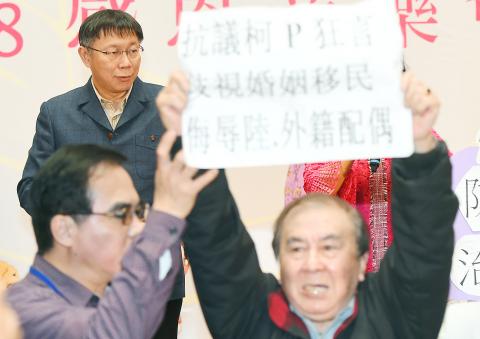
Photo: Chang Chia-ming, Taipei Times
Ko declined to further elaborate on his comments when asked by reporters on the sidelines of the event whether the use of the term “import” was appropriate when describing foreign spouses.
“Today is International Women’s Day, but it is the hardest day for immigrant females in Taiwan. Ko’s remarks were discriminatory against women like us, and those words kept me up all night last night,” Li said yesterday.
“We demand that Ko issue an apology to new immigrant women and urge other women’s rights groups and the Democratic Progressive Party’s (DPP) Women’s Development Committee to join in condemnation of the mayor,” she said.
Chinese Nationalist Party (KMT) Taipei City councilors Lee Yen-hsiu (李彥秀) and Angela Ying (應曉薇) also attended the protest.
Ying urged Ko to acknowledge his mistake, while Lee said that immigrants are also a part of the city, and that the mayor should treat these people with equality rather than discrimination.
Later yesterday, Ko said he did not mean any harm when speaking at the forum and admitted that there was plenty of room for improvement in the language he used.
Asked if he wanted to apologize for his comments, Ko said he said that he had said many things at the forum, but only two words were taken out of context and then put under the magnifying glass.
“I am confused and troubled by this kind of social phenomena,” Ko said.
“If we believe someone does not harbor malice toward a subject, then there is no need to blow it out of proportion,” Ko said, but added that he would correct any mistakes that he made.
Later yesterday, when told that his mother, Ho Jui-ying (何瑞英), also believed that he should apologize for it, Ko said: “I will apologize then.”
Asked to comment in a separate setting, DPP Chairperson Tsai Ing-wen (蔡英文) said that “import” was not the best choice of word to be used in the situation.
“[Ko] should be especially cautious choosing his words,” Tsai said. “However, I think he would be more considerate after we remind him repeatedly.”

UPGRADE: The Kang Ding-class frigate is replacing its Chaparall missiles with Tien Chien II and Hua Yang VLS, which would provide it with long-range, 360° air defense Taiwan plans to produce 1,200 to 1,376 Hai Chien II missiles (海劍二, Sea Sword II) — also known as TC-2N — to serve as the standard air defense system of the navy’s surface combatant fleet, a source said yesterday. Last week, the Hai Chien II, the naval version of the Tien Kung II missile (天劍二, Sky Sword II), completed a live-fire test in waters off the National Chungshan Institute of Science and Technology’s Jiupeng facility (九鵬) in Pingtung County’s Manjhou Township (滿州). The MIM72 Chaparral and other dated air defense missiles that currently arm Taiwanese ships have inadequate range to combat Chinese

REASONS FOR TRAVEL: An assistant professor said that proposed amendments to penalize drivers if they used drugs overseas would not deter people from traveling People who operate a motor vehicle under the influence of marijuana would have their driver’s license revoked, even if they used the substance while overseas, the Ministry of Transportation and Communications said yesterday, citing proposed amendments to the Road Traffic Management and Penalty Act (道路交通管理處罰條例). The amendments would also authorize the government to revoke the licenses of people determined to have used Category 1 or Category 2 narcotics, even if they were not operating a vehicle while under the influence of drugs, as well as ban them from taking the license test for three years, the ministry said. People aged 18 or

HEAVY WEATHER: Typhoon Jangmi is due to crash straight into the Ryukyus as airlines look to shift flights to larger aircraft or cancel flights to Okinawa entirely Taiwan’s international air carriers announced flight adjustments over the weekend as Typhoon Jangmi is forecast to hit the Ryukyu Islands today and tomorrow. The Central Weather Administration (CWA) upgraded Jangmi from a tropical storm to a typhoon at 8am yesterday, with the eye located 580km south of Naha city. It was moving north at 19kph. Today, China Airlines’ CI-120, CI-121, CI-122 and CI-123 flights between Taoyuan and Naha, Okinawa, have been canceled as well as CI-132 and CI-133 between Kaohsiung and Naha. EVA Air’s BR-112, BR-113, BR-186 and BR-185 flights between Taoyuan and Naha are also canceled. Low-cost carrier Tigerair Taiwan canceled IT-230,
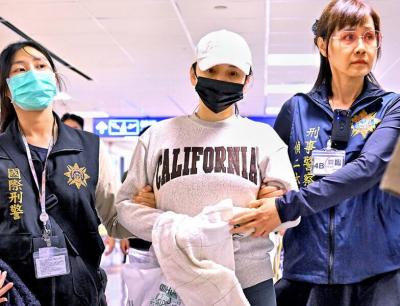
Johanne Liou (劉喬安), a Taiwanese woman who shot to unwanted fame during the Sunflower movement protests in 2014, returned to Taiwan last night after being deported from the US. She is to stand trial in Taiwan for charges involving embezzlement, fraud and drug crimes. The Criminal Investigation Bureau (CIB) said it took her into custody at Taiwan Taoyuan International Airport and would first question her before transferring her to the New Taipei District Prosecutors’ Office. She was arrested upon disembarking a flight from San Francisco that landed shortly before 7pm. Liou absconded to the US in 2019 after jumping bail


 RSS
RSS