


In a bid to appeal to the younger generation, several temples in the nation have invested in the burgeoning market of creative but functional religious products.
Fusing Temple (福興宮) in Yunlin County’s Siluo Township (西螺) was one of the first to launch novel religious items, the temple’s management said.
The temple marketed a “Matsu gift box” in 2005 containing bottles of soybean sauce — a famous local produce — as well as other Matsu-themed products, such as backpacks, mobile phone straps, amulets, musical piggy banks, document folders, designer T-shirts and hats, it said.
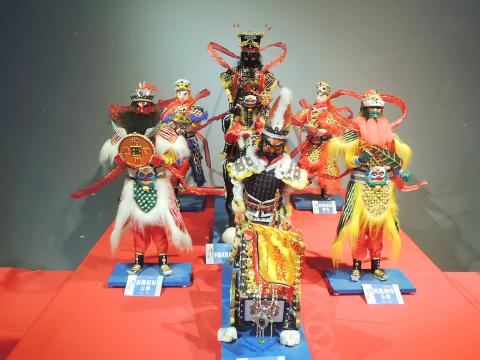
Photo: Lin Kuo-hsien, Taipei Times
Fusing Temple chairman Yang Wen-chung (楊文鍾) said that the aim was not to make a profit, but to create products that integrate the worship of Matsu into local communities, including local businesses and the tourism industry, and bring believers closer to the temple.
Chaotian Temple (朝天宮) in Yunlin County’s Beigang Township (北港) has also launched an array of religious goods, including action figurines of deities, amulets and outfits for sedan chair porters, the temple’s administration said.
The temple also incorporated elements of glove puppetry by introducing glove puppets of Ba Jia Jiang (八家將) and Guan Jiang Shou (官降首) — guardians of the temples of the nether gods, it said.
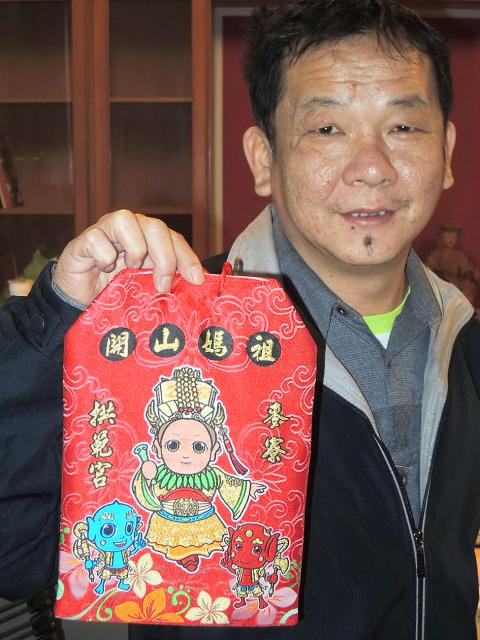
Photo: Lin Kuo-hsien, Taipei Times
Beigang Handicraft Workshop president Tsai Hsiang-jun (蔡享潤) said he was elected the temple’s “censer master” five years ago, and the experience has given him a better insight into local culture and religious affairs. This has helped him develop many creative products that younger people can relate to, including fortune money notebooks, amulet bookmarks and flag-shaped charms.
Creativity and cultural awareness are keys to making a product that everyone can relate to, he added.
Kongfan Temple (拱範宮) in Yunlin County’s Mailiao Township (麥寮) last year launched a multipurpose bag containing rice, salt and stones that purportedly drives evil spirits away, with caricatures of Matsu and her two guardian generals printed on the bag’s cover, the temple’s administration said.
The temple sold more than 2,000 such bags and made more than NT$2 million (US$63,200), it said.
Kongfan Temple chairman Chang Ko-chung (張克中) said that Taiwan’s folk religions are a reflection of the local culture, and people could relate more to religion if it is conveyed through aesthetic images with a touch of humor.
Wude Temple (武德宮), also in Beigang Township, has recruited a group of professionals to develop religious merchandises, including its best-seller action figures of the god of wealth, flag amulets and macaron-shaped traditional offerings, the temple said.
While appealing to people across different ages, these products could be a new way to pass down religion, it said.

The Centers for Disease Control (CDC) yesterday reported the first case of a new COVID-19 subvariant — BA.3.2 — in a 10-year-old Singaporean girl who had a fever upon arrival in Taiwan and tested positive for the disease. The girl left Taiwan on March 20 and the case did not have a direct impact on the local community, it said. The WHO added the BA.3.2 strain to its list of Variants Under Monitoring in December last year, but this was the first imported case of the COVID-19 variant in Taiwan, CDC Deputy Director-General Lin Ming-cheng (林明誠) said. The girl arrived in Taiwan on

South Korea is planning to revise its controversial electronic arrival card, a step Taiwanese officials said prompted them to hold off on planned retaliatory measures, a South Korean media report said yesterday. A Yonhap News Agency report said that the South Korean Ministry of Foreign Affairs is planning to remove the “previous departure place” and “next destination” fields from its e-arrival card system. The plan, reached after interagency consultations, is under review and aims to simplify entry procedures and align the electronic form with the paper version, a South Korean ministry official said. The fields — which appeared only on the electronic form

A bipartisan group of US senators has introduced a bill to enhance cooperation with Taiwan on drone development and to reduce reliance on supply chains linked to China. The proposed Blue Skies for Taiwan Act of 2026 was introduced by Republican US senators Ted Cruz and John Curtis, and Democratic US senators Jeff Merkley and Andy Kim. The legislation seeks to ease constraints on Taiwan-US cooperation in uncrewed aerial systems (UAS), including dependence on China-sourced components, limited access to capital and regulatory barriers under US export controls, a news release issued by Cruz on Wednesday said. The bill would establish a "Blue UAS

The Ministry of Foreign Affairs (MOFA) is suspending retaliation measures against South Korea that were set to take effect tomorrow, after Seoul said it is updating its e-arrival system, MOFA said today. The measures were to be a new round of retaliation after Taiwan on March 1 changed South Korea's designation on government-issued alien resident certificates held by South Korean nationals to "South Korea” from the "Republic of Korea," the country’s official name. The move came after months of protests to Seoul over its listing of Taiwan as "China (Taiwan)" in dropdown menus on its new online immigration entry system. MOFA last week


 RSS
RSS