


Countering criticism leveled at several projects undertaken during his administration, former Taipei mayor Hau Lung-bin (郝龍斌) yesterday accused Taipei Mayor Ko Wen-je (柯文哲) and his team of using “defamatory” tactics to hide their “ignorance” of municipal issues.
“Personally I found [the tactics] unbearable,” Hau, a Chinese Nationalist Party (KMT) member, said on the sidelines of the inauguration ceremony for KMT Chairman Eric Chu (朱立倫) at party headquarters.
Less than one month since Ko, who ran as an independent, was sworn in on Dec. 25, he has repeatedly cast doubt on the competence of the former Hau administration after examining several projects, including the Shezidao (社子島) development project, the Taipei Dome, the Taipei New Horizon (臺北文創) building, the MeHAS City (美河市) residential project, the Taipei Twin Towers (雙子星) and the athletes’ village for the 2017 World University Games.
Hau said the Ko administration had only revealed “half of the information” about these projects and given them a political spin to mislead the public.
The Ko administration should make all information public, which the city government has maintained for public scrutiny, Hau said.
All major development projects carried out under his administration were in strict compliance with statutory procedures and subject to supervision by the city government’s ethics department, he added.
“Absolutely [we] can withstand scrutiny,” he said.
The elections are over and the Ko administration should demonstrate how it can effectively govern the city, not by trampling on the previous administration to hide its ignorance of municipal issues, Hau said.
Hau said that he respected the Ko administration’s efforts to govern the city and wished it all the best, but he could no longer stand the criticism.
Asked whether he thought the Ko administration was on a “political witch-hunt,” Hau said he would leave it to the public to judge.
In response to Hau’s criticism, Ko said: “If you had openly and transparently made all documentation public when you were in office, there would not be any of this controversy.”
Ko said the city government would continue “putting out fires” left by the previous administration.
He has previously promised to open all documents related to corruption cases to inspection by city councilors.
Additional reporting by Abraham Gerber

Yangmingshan National Park authorities yesterday urged visitors to respect public spaces and obey the law after a couple was caught on a camera livestream having sex at the park’s Qingtiangang (擎天崗) earlier in the day. The Shilin Police Precinct in Taipei said it has identified a suspect and his vehicle registration number, and would summon him for questioning. The case would be handled in accordance with public indecency charges, it added. The couple entered the park at about 11pm on Thursday and began fooling around by 1am yesterday, the police said, adding that the two were unaware of the park’s all-day live
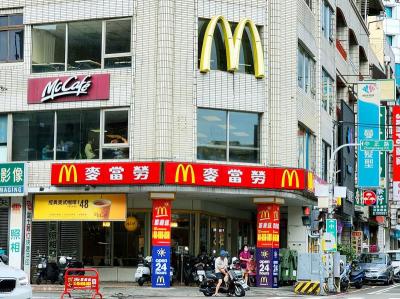
Fast food chain McDonald's is to raise prices by up to NT$5 on some products at its restaurants across Taiwan, starting on Wednesday next week, the company announced today. The prices of all extra value meals and sharing boxes are to increase by NT$5, while breakfast combos and creamy corn soup would go up by NT$3, the company said in a statement. The price of the main items of those meals, if ordered individually, would remain the same. Meanwhile, the price of a medium-sized lemon iced tea and hot cappuccino would rise by NT$3, extra dipping sauces for chicken nuggets would go up
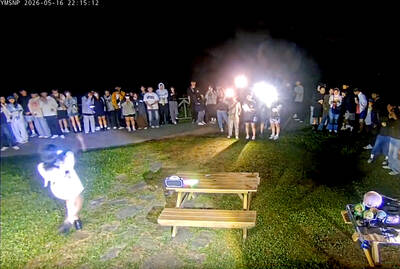
Yangmingshan National Park’s Qingtiangang (擎天崗) nature area has gone viral after a park livestream camera observed a couple in the throes of intimate congress, which was broadcast live on YouTube, drawing large late-night crowds and sparking a backlash over noise, bright lights and disruption to wildlife habitat. The area’s livestream footage appeared to show a couple engaging in sexual activity on a picnic table in the park on Friday last week, with the uncensored footage streamed publicly online. The footage quickly spread across social media, prompting a tide of visitors to travel to the site to “check in” and recreate the

Minister of Digital Affairs Lin Yi-ching (林宜敬) yesterday cited regulatory issues and national security concerns as an expert said that Taiwan is among the few Asian regions without Starlink. Lin made the remarks on Facebook after funP Innovation Group chief executive officer Nathan Chiu (邱繼弘) on Friday said Taiwan and four other countries in Asia — China, North Korea, Afghanistan and Syria — have no access to Starlink. Starlink has become available in 166 countries worldwide, including Ukraine, Malaysia, the Philippines and Vietnam, in the six years since it became commercial, he said. While China and North Korea block Starlink, Syria is not


 RSS
RSS