

New paths in Taoyuan County’s Siao Wulai District (小烏來) are scheduled to be opened this month aimed at making visiting popular tourist attractions in the area easier, the Siao Wulai Scenic Area Administration Office said.
The walkways offer improved access to Chiang Kai-shek’s (蔣介石) former residence in Jiaobanshan (角板山), Lalashan’s (拉拉山) cherry blossoms and the Baling Stargazing Plaza, where visitors can look at the stars or watch the sun come up.
Office director Yeh Tsung-fu (葉宗賦), said the walkways were constructed to address the concerns of visitors over the New Year holidays who complained that there was not a suitable area for watching the sunrise.
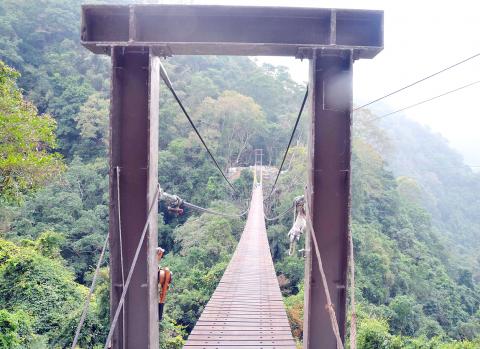
Photo: CNA
Aside from remodeling the Baling Village (巴陵) parking lot in Fusing Township (復興) into the Baling Stargazing Plaza, the office also plans to open a 70m-long rope bridge for visitors at the end of this month.
The bridge passes over Daligan River (大利敢溪) and would present the visitors with a view of the Hsiao Wulai waterfalls, Yeh said.
The area has seen extensive additions since 2011, when the office completed its sky bridge project and the subsequent construction of the Huanyu Gazing Platform, which offers a 360-degree unobstructed view of the area, Yeh said.
The Riverside Green Path and the Shuichun Ancient Trail incorporate an area reserved for children and tourists to bathe in the river during the summer, and tourists can also visit the area where Warriors of the Rainbow: Seediq Bale was filmed.
The area had more than 600,000 visitors last year, which the office attributed to food vendors and members of staff dressing in traditional Atayal clothing, Yeh said, adding that there were more than 326,000 visitors to the sky bridge.
The area saw the most tourists of all the forest scenic areas north of Greater Taichung and was only slightly less popular than major scenic areas such as Nantou County’s Sitou (溪頭) National Forest Recreation Area, Chiayi County’s Alishan National Scenic Area (阿里山) and Pingtung County’s Kenting National Park, Yeh said.
From this month to next month, trees in the Chienshan area (前山) — the region closest to the mountains on Taiwan’s west coast — will begin to blossom in Taoyuan County’s Dongyenshan (東眼山).
The tree blossom season is expected to peak after Lunar New Year’s Day with cherry blossoms in Kavilan Township (卡維蘭) on the east coast, Yeh said.

Ocean Affairs Council (OAC) Minister Kuan Bi-ling (管碧玲) on Wednesday said decommissioned coast guard vessels were given to the Philippines to enhance regional rescue capacity and would not affect Taiwanese fishers’ rights and benefits. Kuan made the remarks after confirmation on Tuesday that a 500-tonne Coast Guard Administration (CGA) patrol and rescue vessel would be given to the Philippine Coast Guard. The donation ceremony was reportedly done in Manila, but whether the vessel — previously numbered “CG123” and named Kinmen (金門) — has been handed over has yet to be confirmed. China’s Taiwan Affairs Office (TAO) on Wednesday criticized the donation for “taking

The Ministry of Finance today announced the winning numbers for the July-August uniform invoice lottery. The winning number for the NT$10 million (US$314,663) special prize is 89996565, while the winning number for the NT$2 million grand prize is 91098182. Three numbers were drawn for the NT$200,000 first prize: 54348835, 44991397 and 06595111. Those with receipts matching the last seven digits of any of the first-prize numbers can claim the NT$40,000 second prize, while those matching the last six digits qualify for the NT$10,000 third prize. Those whose receipts match the last five digits of the first-prize numbers are eligible for the NT$4,000 fourth prize,

The National Police Agency’s Third Special Police Corps yesterday said that from May to July, it intercepted five smuggling operations from China, seizing more than 70,000 counterfeit Beyblades with an estimated infringement value of NT$34.45 million (US$1.08 million). It added that any bootleg unit that reached the local market could present hidden health hazards to players. Beyblades, a line of spinning toy tops used in competitive gaming and developed in Japan by toy company Takara Tomy, have become popular in Taiwan, making them a target for fraudsters. The Third Special Police Corps, dedicated to safeguarding maritime borders and trade lines,
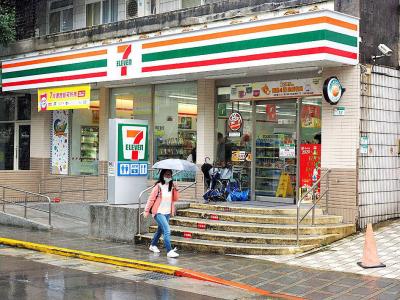
Five customers who made purchases at 7-Eleven stores across Taiwan won the top NT$10 million (US$313,716) special prize in the July-August uniform invoice lottery, including one who spent just NT$27 on photocopying, the convenience store chain said today. The five special prize winners made their purchases at stores in Taoyuan, Taipei, Taichung and Kaohsiung, 7-Eleven operator President Chain Store Corp said. The five winning purchases included NT$29 spent on snacks at a store in Taoyuan's Zhongli District (中壢), NT$27 on photocopying at a store in Taipei's Zhongzheng District (中正), NT$139 on City Cafe coffee and daily necessities at a store in Taipei's


 RSS
RSS