


Liberty Times: What are your thoughts on the results of this election?
Michael Hsiao (蕭新煌): In the past year and half, Taiwan has truly seen a large change in politics, with civic groups and protesters beginning to consolidate democracy at the local level.
In 2000, when the opposition party came to power, many at the time defined it the completion of Taiwan’s democratic transition into a consolidated democracy. However, in reality it was simply a changing of presidents, premiers and other governmental officials, there was no “awakening” or lessons learned.
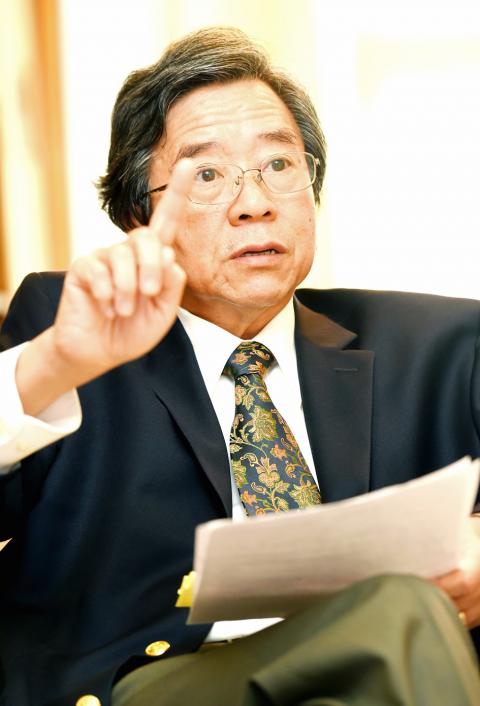
Photo: Chang Chia-ming, Taipei Times
White-clad protesters rallied in August last year [demanding the military reveal the truth about the death of conscript Hung Chung-chiu (洪仲丘) and bring the perpetrators to justice], the Sunflower movement protests happened this March and April [protesting against the government’s opaque handling of the controversial cross-strait service trade agreement], and the food safety scandals in August and September have proven that democracy has not taken deep enough roots in the nation. The management of the democratic system is also a mess — the central government has failed to deliver and is not taking their responsibilities to deliver seriously.
The student protesters and civic groups in the Sunflower movement are most impressive, as their actions emphasize there are problems with the democratic process and representative democracy.
In terms of democracy consolidation, the results of the elections this time far exceeded what was anticipated. It might be strange to say this, because if we are to look from the perspective of a rational voter, the KMT deserved to lose, and lose hard. It had acceded to the Chinese Communist Party’s (CCP) claims at every turn on cross-strait policies, achieved nothing on democratic reforms and paid absolutely no attention to the everyday life of society. Under such circumstances, the party would have been spurned by the public in any country with a democratic system.
Yet, why was there still such trepidation that the KMT might win [in the Nov. 29 elections]? There are several reasons. One is that the Taiwanese people are, after all, gentle and conservative. The second is that voters disassociate central government and local governments. Third, local political factions come into play.
The KMT’s landslide loss in the elections shows that rational voters exist in Taiwan who feel they can no longer be gentle by abstaining.
In the past I had my doubts about netizens and thought they only knew how to click the “like” button while abstaining from actual action, but since the Hung case I have to admit that netizens have their ways to mobilize and it is a new form of social activity.
This election not only saw this new form of social activity in action, but also saw the increased participation of citizens newly-introduced to the power they wield, which is heart-moving for ordinary citizens.
LT: What are the more in-depth reasons that the KMT was defeated in this election?
Hsiao: The KMT lost very heavily in the regions where it was defeated, and even where it won it only came out ahead by a small margin. The main cause of this was the abysmal performance of the central government.
Everyone knows that President Ma Ying-jeou’s (馬英九) attitude toward democracy is problematic — almost anti-democratic, even.
One could say there are no advovates for reform within the party, those who are capable of imagining it are unwilling to propose it. [New Taipei Mayor and KMT vice chairman] Eric Chu’s (朱立倫) tactics were seen through, while Legislative Speaker Wang Jin-pyng (王金平) plays the victim card as long as Ma is in power. Neither former vice president Vincent Siew (蕭萬長), [former KMT Secretary-General] Tseng Yung-chuan (曾永權), or [outgoing Greater Taichung Mayor] Jason Hu (胡志強) are reformers, they simply wish to replace Ma, but are unwilling to promote large-scale reforms.
From the outlook, it seems like the nation is undergoing a quiet revolution, beginning in the cities and counties. From the party’s post-election statement, reactions and setting up of barricades in front of party headquarters — unnecessary and a situation that need not have happened — it seems like the KMT has not yet learned its lesson after losing the elections.
Even if Ma said he has heard the people, it seems that what he heard was quite small and weak. He has demonstrated absolutely no sincerity, even less than Chu.
I believe that the increased number of young people voting in the elections also triggered more women and the elderly to vote. With the inclusion of civic activists, the ordinary citizen and netizens, it is a demonstration of the public’s power.
While such power was made manifest in the elections, at a certain level this is still very limited to the local elections which would not affect the greater plan. However, if the nation begins to slowly acclimatize to such forms of elections, it would be of great help for future elections with far-reaching scope. It is a step towards building up democratic momentum.
It is interesting to note that in this election, the animosity against political families was already at work at the local level. Take the Wu family [Taoyuan County Commissioner John Wu (吳志揚)] in Taoyuan County for example. In the past, no one would have said that [Wu’s DPP opponent] Cheng Wen-tsan (鄭文燦) could win the election. We also saw Chu only start to make a comeback in the third hour of ballot counting.
Both Chu and Wu come from politically established families, and there is no doubt regarding [KMT Taipei mayoral candidate] Sean Lien’s (連勝文) background.
All three are political families that have benefitted from KMT rule in Taiwan. They are not local factions, and they all hoped to chip in and get something while the KMT is on the decline. The voters saw this and thought such actions were problematic — voters are not stupid.
In other terms, the attempted succession from a declining KMT to politically established families — who have benefited from the party, but have failed to prove their worth — is only an exchange of who is in power, and not using that power for reform.
The people are also beginning to foster distrust against corporations that are overtly pro-China.
Meanwhile, the so-called playing of the “construction card” also failed in the elections. Every time I visit Greater Taichung, I always think of it as being a colony, as you see plots of land being walled up for construction. The Taoyuan Aerotropolis Project goes one step further, as it walls up the plots of land with steel barbed wire. Some of these plots of land once belonged to families, then the government expropriated the land for construction use. However, the benefits of the land are enjoyed solely by the corporation that builds on it. The people get nothing.
In this election, we saw [the KMT] lose Taichung and Taoyuan, the two places that have seen the greatest amount of land being expropriated.
LT: How will the election results affect cross-strait affairs?
Hsiao: China, while acknowledging the electoral results, will put a spin on it and say they were only local elections, with the caveat that Taiwan in the future will still have to accept the so-called “1992 consensus.”
I think China’s Taiwan Affairs Office Minister Zhang Zhijun (張志軍) might have anticipated the KMT’s loss of Taipei and Greater Taichung, but had probably not expected the popularity of the KMT to be so low in those cities.
From now on we need to be more vigilant, as China will strengthen its efforts to infiltrate all levels of life in Taiwan. In the past it focused on the KMT, now it will put in a lot of effort on corporations, farmers, intellectuals and other civic groups.
Earlier, I said that Taiwan has been consolidating its democracy over the past five elections. This is because Taiwan’s democracy is new, it is still young, and it is being pitted against an authoritarian opponent that considers its relations with Taiwan as those of wartime, and yet people from the KMT consider China as a business partner. That’s a joke, right? Taiwan is destined to lose if it does not understand the concept that China is its enemy and has no strategic considerations or tactics in its policies.
Instead of seeking a replacement policy for the KMT’s pro-China policies, the DPP should instead solemnly work against [China’s] “unified front” tactic.
The DPP should review cross-strait policies that it feels would be most beneficial to Taiwan. It really is not hard as long as the new policies stick to the basic guidelines of being on equal footing with China during talks, observing democratic procedures and keeping all talks with China transparent and available for public scrutiny.
Translated by staff writer, Jake Chung

Taiwan has received more than US$70 million in royalties as of the end of last year from developing the F-16V jet as countries worldwide purchase or upgrade to this popular model, government and military officials said on Saturday. Taiwan funded the development of the F-16V jet and ended up the sole investor as other countries withdrew from the program. Now the F-16V is increasingly popular and countries must pay Taiwan a percentage in royalties when they purchase new F-16V aircraft or upgrade older F-16 models. The next five years are expected to be the peak for these royalties, with Taiwan potentially earning
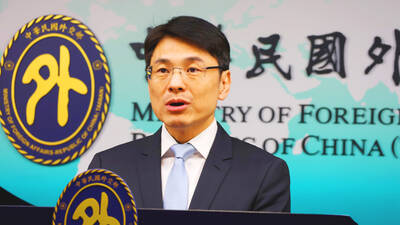
STAY IN YOUR LANE: As the US and Israel attack Iran, the ministry has warned China not to overstep by including Taiwanese citizens in its evacuation orders The Ministry of Foreign Affairs (MOFA) yesterday rebuked a statement by China’s embassy in Israel that it would evacuate Taiwanese holders of Chinese travel documents from Israel amid the latter’s escalating conflict with Iran. Tensions have risen across the Middle East in the wake of US and Israeli airstrikes on Iran beginning Saturday. China subsequently issued an evacuation notice for its citizens. In a news release, the Chinese embassy in Israel said holders of “Taiwan compatriot permits (台胞證)” issued to Taiwanese nationals by Chinese authorities for travel to China — could register for evacuation to Egypt. In Taipei, the ministry yesterday said Taiwan
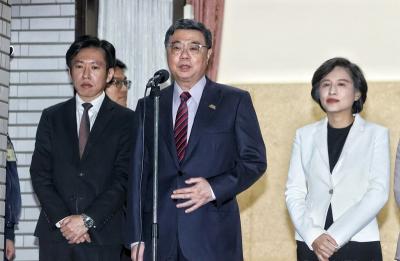
Taiwan is awaiting official notification from the US regarding the status of the Agreement on Reciprocal Trade (ART) after the US Supreme Court ruled US President Donald Trump's global tariffs unconstitutional. Speaking to reporters before a legislative hearing today, Premier Cho Jung-tai (卓榮泰) said that Taiwan's negotiation team remains focused on ensuring that the bilateral trade deal remains intact despite the legal challenge to Trump's tariff policy. "The US has pledged to notify its trade partners once the subsequent administrative and legal processes are finalized, and that certainly includes Taiwan," Cho said when asked about opposition parties’ doubts that the ART was
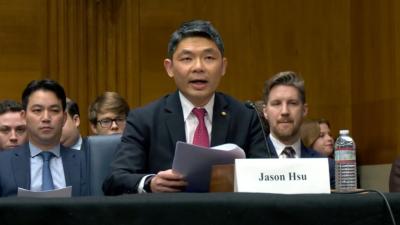
If China chose to invade Taiwan tomorrow, it would only have to sever three undersea fiber-optic cable clusters to cause a data blackout, Jason Hsu (許毓仁), a senior fellow at the Hudson Institute and former Chinese Nationalist Party (KMT) legislator, told a US security panel yesterday. In a Taiwan contingency, cable disruption would be one of the earliest preinvasion actions and the signal that escalation had begun, he said, adding that Taiwan’s current cable repair capabilities are insufficient. The US-China Economic and Security Review Commission (USCC) yesterday held a hearing on US-China Competition Under the Sea, with Hsu speaking on


 RSS
RSS