


The Democratic Progressive Party (DPP) wrapped up its “Super Weekend” yesterday ahead of Saturday’s nine-in-one elections with campaign motorcades and rallies that featured top party members along with its candidates.
Given that the party has set central Taiwan as the key battleground in the elections, DPP Chairperson Tsai Ing-wen (蔡英文), former DPP chairman Frank Hsieh (謝長廷) and former DPP secretary-general Su Jia-chyuan (蘇嘉全) headed in three separate groups to canvass in Greater Taichung, Nantou County and Changhua County, before the three teams joined up in Nantou’s Caotun Township (草屯) for an afternoon rally.
Former DPP chairman Lin I-hsiung (林義雄) also stumped on the streets of Greater Taiching alongside mayoral candidate Lin Chia-lung (林佳龍).
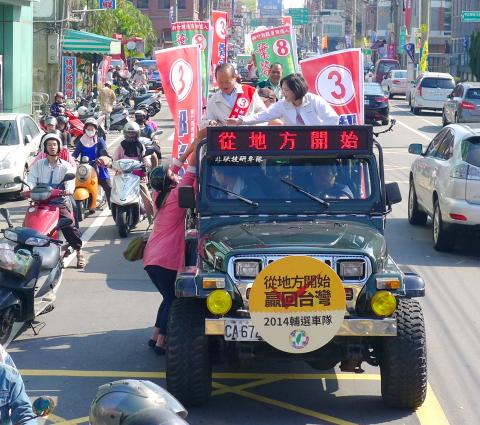
Photo: Wang Chun-chieh, Taipei Times
Lin I-hsiung said Saturday’s elections are not simply about local politics, but about fostering more leadership in the nation.
The administration of President Ma Ying-jeou’s (馬英九) adoption of pro-China policies in recent years has caused some entrepreneurs to back the Chinese Nationalist Party (KMT) to make more money, but this is not beneficial to the nation’s democratic development, he said, referring to Hon Hai Precision Industry Co chairman Terry Gou’s (郭台銘) support for the KMT.
Lin I-hsiung called on voters to vote for DPP candidates to show their dissatisfaction with the Ma administration’s pro-China tendencies and to force change.
Tsai had an especially busy day. In addition to her trip to central Taiwan, she also visited Taoyuan County to campaign for Taoyuan mayoral candidate Cheng Wen-tsan (鄭文燦), made an appearance in Hsinchu County to campaign for independent county commissioner candidate Cheng Yung-chin (鄭永金), stumped in Miaoli County for DPP county commissioner candidate Wu Yi-chen (吳宜臻) and then traveled to Hsinchu City to back DPP mayoral candidate Lin Chih-chien (林智堅).
Last night, Tsai went back to Taoyuan, where she shared a stage with former vice president Annette Lu (呂秀蓮), former vice premier Yeh Chu-lan (葉菊蘭) and attorney Wellington Koo (顧立雄) at a rally for Cheng.
Additional reporting by Tang Tsai-hsin

FUKUOKA SITUATION: Japanese media reported that the pathogen is expected to be identified by the summer, while the CDC downplayed the idea that it was hMPV A “mysterious cold-like illness” reported in Japan’s Fukuoka Prefecture does not seem to be a new disease, but Japanese authorities have been asked about the situation, the Centers for Disease Control (CDC) said yesterday. The Fukuoka Prefectural Medical Association on Wednesday told a news conference that a “mystery cold” that has become a hot topic on social media is “highly likely to be caused by some kind of viral infection,” Japan’s KBC News reported. “Many people are experiencing symptoms starting with a sore throat, followed by a runny nose, phlegm and a severe cough,” KBC News reported, citing association officials. Health authorities are

Nvidia Corp CEO Jensen Huang (黃仁勳) arrived in Taiwan yesterday ahead of upcoming AI and technology events, saying he plans to meet with clients and Taiwan Semiconductor Manufacturing Co Chairman C.C. Wei (魏哲家) during his visit. After landing at Taipei Songshan Airport, Huang posed for photos with fans and handed out Yakult drinks to reporters and supporters waiting at the scene, saying he has “a lot to do” during the trip. Asked about reports that Nvidia’s planned headquarters site in Taipei’s Beitou Shilin Technology Park could break ground on May 27, Huang said that if the company holds an event, he would

The Ministry of Finance this afternoon announced the winning numbers for the March-April uniform invoice lottery. The winning number for the NT$10 million (US$318,060) special prize is 19531471, and the winning number for the NT$2 million grand prize is 85941329. Three numbers were drawn for the NT$200,000 first prize: 07225810, 20231230 and 83518781. Those with receipts matching the last seven digits of any of the first-prize numbers will win the NT$40,000 second prize, while those matching the last six digits will win the NT$10,000 third prize. Those whose receipts match the last five digits of the first-prize numbers can claim the NT$4,000 fourth prize,

SIX SUBSIDIES: The monthly allowance for older farmers is to increase to NT$10,000, and NT$5,000 is to be given to homemakers under the national pension system, Lai said The government is to implement major welfare policies for disadvantaged groups, including raising the monthly allowance for older farmers to NT$10,000 and providing homemakers with NT$5,000 per month, President William Lai (賴清德) said yesterday. Lai made the remarks during a visit to Wangling Temple in Chiayi County, saying that the planned increases were being introduced amid economic growth and an increase in tax revenue. Touting a policy, in which the government plans to provide a monthly allowance of NT$5,000 for every child under the age of 18 in a bid to address Taiwan’s low birthrate, Lai said that if received for the


 RSS
RSS