


The former residence of “Young Marshal” Chang Hsueh-liang (張學良), a key figure in modern Chinese history, was reopened to the public on Saturday after undergoing renovation, with a ribbon-cutting ceremony attended by his relatives in Hsinchu County’s Wufeng Township (五峰).
About 20 documents related to Chang’s daily life when he was in Wufeng, including photographs, newspaper clippings, copies of his manuscripts, letters and a special amnesty decree, have been put on display at the site, which was renovated at a cost of NT$47 million (US$1.55 million).
Chang, the son of warlord Chang Tso-lin (張作霖), played a key role in kidnapping Chiang Kai-shek (蔣介石) in 1936 in an effort to persuade Chiang to go all out against the Japanese troops who had invaded China, in what became known as the “Xian Incident.”
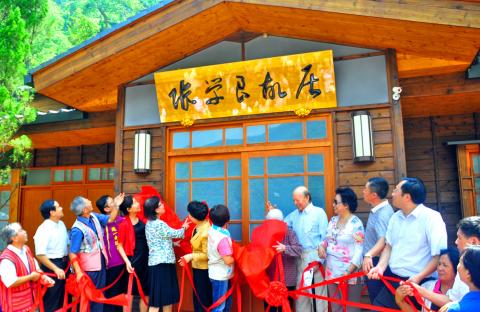
Photo: Tsai Meng-shang, Taipei Times
He wanted Chiang to form an anti-Japanese alliance with his Chinese Communist Party rivals instead of trying to eliminate them.
After negotiations and amid widespread public protests for Chiang to be released, Chang freed Chiang after two weeks.
Although Chiang’s Nationalist troops did later fight with the communists against the Japanese, Chang was court-martialed for insubordination and sentenced to 10 years in prison. Four days later, he was granted amnesty, but placed under “stringent supervision.”
Chang was kept under house arrest for 53 years, with Chiang ensuring that he was moved to Taiwan when the Chinese Nationalist Party government lost the Chinese Civil War and fled to the island in 1949.
Chang was sent to Wufeng, a mountainous township home mostly to Aborigines, where he was held until 1990, three years after martial law was lifted. Chang and his wife, Chao I-ti (趙一荻), moved to Hawaii in 1993, where he died in Honolulu in 2001, a year after his wife.
The Hsinchu County Government invited eight of Chang’s relatives, including his younger sister, Chang Huai-min (張懷敏), to Saturday’s ceremony.
During the ceremony, Chang Huai-min said the tour of Wufeng made her miss her brother. She said her brother was enthusiastic about photography and often took pictures of their relatives when he was in China. However, she had few opportunities to meet him and missed him a lot after she went to teach at Fu Jen Catholic University and National Taiwan Normal University.
The old house was almost destroyed by a typhoon in 1963 and has been restored to its original Japanese architectural style, a county government official said.
The building was first opened to the public in December 2008.

UPGRADE: The Kang Ding-class frigate is replacing its Chaparall missiles with Tien Chien II and Hua Yang VLS, which would provide it with long-range, 360° air defense Taiwan plans to produce 1,200 to 1,376 Hai Chien II missiles (海劍二, Sea Sword II) — also known as TC-2N — to serve as the standard air defense system of the navy’s surface combatant fleet, a source said yesterday. Last week, the Hai Chien II, the naval version of the Tien Kung II missile (天劍二, Sky Sword II), completed a live-fire test in waters off the National Chungshan Institute of Science and Technology’s Jiupeng facility (九鵬) in Pingtung County’s Manjhou Township (滿州). The MIM72 Chaparral and other dated air defense missiles that currently arm Taiwanese ships have inadequate range to combat Chinese

REASONS FOR TRAVEL: An assistant professor said that proposed amendments to penalize drivers if they used drugs overseas would not deter people from traveling People who operate a motor vehicle under the influence of marijuana would have their driver’s license revoked, even if they used the substance while overseas, the Ministry of Transportation and Communications said yesterday, citing proposed amendments to the Road Traffic Management and Penalty Act (道路交通管理處罰條例). The amendments would also authorize the government to revoke the licenses of people determined to have used Category 1 or Category 2 narcotics, even if they were not operating a vehicle while under the influence of drugs, as well as ban them from taking the license test for three years, the ministry said. People aged 18 or

Johanne Liou (劉喬安), a Taiwanese woman who shot to unwanted fame during the Sunflower movement protests in 2014, returned to Taiwan last night after being deported from the US. She is to stand trial in Taiwan for charges involving embezzlement, fraud and drug crimes. The Criminal Investigation Bureau (CIB) said it took her into custody at Taiwan Taoyuan International Airport and would first question her before transferring her to the New Taipei District Prosecutors’ Office. She was arrested upon disembarking a flight from San Francisco that landed shortly before 7pm. Liou absconded to the US in 2019 after jumping bail
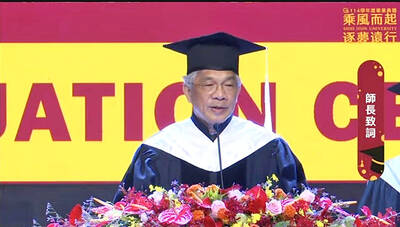
Shih Hsin University President Chen Ching-he (陳清河) yesterday issued a public apology for comments made in his commencement speech last week, stating that he has asked the school to suspend his duties and halt his wages for two months as a show of contrition. At the commencement ceremony on May 30, Chen said, “If you don’t manage your time well, or your own emotions, or your health, then I am telling every one of you — put a quick end to ‘you,’ because the world has no need for ‘you.’” The comments have sparked significant controversy online, and Chen through an open


 RSS
RSS