


The Legislative Yuan on Monday was the target of a withering attack launched by Taipei Forum chairman and chief executive officer Su Chi (蘇起) at a conference in Washington.
Su told the audience that he could be at “huge personal risk” for washing Taiwan’s dirty linen in public, saying that even though the legislature’s shortcomings were an “open secret” at home, plenty of people still want to hide them.
“I may go home and find myself in big trouble,” the former Chinese Nationalist Party (KMT) lawmaker and Mainland Affairs Council chairman said.
Su told the Brookings Institution conference — titled “LY [Legislative Yuan]: Oversight or Overreach?” — that he nevertheless wants to share the truths he has discovered.
Introducing Su, Brookings Center for East Asia Policy Studies director Richard Bush said that the average American had no impression at all about the Taiwanese legislature, “but if he did have an impression, it would probably be a negative one gleaned solely from videos of fist fights in the Legislative Yuan.”
“The negative impression really is too bad because it is important to understand why the LY lacks public confidence and what the consequences of its dysfunction are for public policy and the legitimacy of the political system,” said Bush, a former American Institute in Taiwan chairman.
Su said that the legislature was “woefully” understudied, adding that the support system for lawmakers was “very, very weak” and that it was common knowledge that the Budget Center offers scant help to legislators when they review budgets.
Su provided polling figures to show that the legislature had been held in “low esteem” for years and said lawmakers spend most of their time trying to get re-elected, attending “a funeral in the morning, a wedding for lunch and other events or celebrations, with so little time spent in the LY.”
“Working a crowd or hitting the media is the priority,” he said.
Su said many legislators turn up to legislative sessions only to sign in so a committee quorum can be formed before they “quickly disappear” to attend some outside event.
“It is difficult to keep legislators inside the LY,” he said.
The press has access to all legislative discussions and this results in a tendency to “feed” the media instead of debating issues, he said.
“I hate it, I’m sorry,” Su said.
He said that small minority parties without members on certain committees can still decide bills coming out of those committees.
“It’s ridiculous,” said Su, adding that as a result of the way that parties were able to wield their power, there were some “serious distortions” of influence.
He said that some aspects of the legislature constitute “the darkest corner of Taiwan’s democracy” and make him feel ashamed.
Reforms have been proposed, but they have not been adopted, Su said, adding that ministers were obliged to attend sessions in which they had nothing to do. One minister even wrote a book while sitting in on sessions, Su said.
The legislature’s Ethics Committee exists in name only and rarely meets, he said.
“One time, a well-know legislator set off tear gas in a room and everybody choked, but nothing was done about it,” Su said, referring to an October 2006 incident in which former independent lawmaker Li Ao (李敖) sprayed tear gas at a Procedure Committee meeting.
He finished by saying that lawmakers mostly occupy themselves with non-legislative matters, some committees were perfunctory and other parts of the legislative system were undemocratic.
“It is sad, but I prefer to give you the truth and I will go back home and face the music,” Su said.
Additional reporting by staff writer
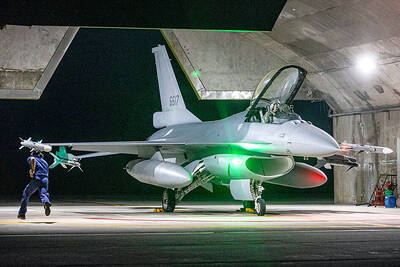
Taiwan has received more than US$70 million in royalties as of the end of last year from developing the F-16V jet as countries worldwide purchase or upgrade to this popular model, government and military officials said on Saturday. Taiwan funded the development of the F-16V jet and ended up the sole investor as other countries withdrew from the program. Now the F-16V is increasingly popular and countries must pay Taiwan a percentage in royalties when they purchase new F-16V aircraft or upgrade older F-16 models. The next five years are expected to be the peak for these royalties, with Taiwan potentially earning
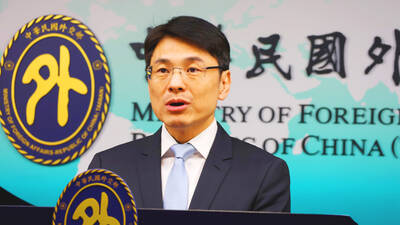
STAY IN YOUR LANE: As the US and Israel attack Iran, the ministry has warned China not to overstep by including Taiwanese citizens in its evacuation orders The Ministry of Foreign Affairs (MOFA) yesterday rebuked a statement by China’s embassy in Israel that it would evacuate Taiwanese holders of Chinese travel documents from Israel amid the latter’s escalating conflict with Iran. Tensions have risen across the Middle East in the wake of US and Israeli airstrikes on Iran beginning Saturday. China subsequently issued an evacuation notice for its citizens. In a news release, the Chinese embassy in Israel said holders of “Taiwan compatriot permits (台胞證)” issued to Taiwanese nationals by Chinese authorities for travel to China — could register for evacuation to Egypt. In Taipei, the ministry yesterday said Taiwan
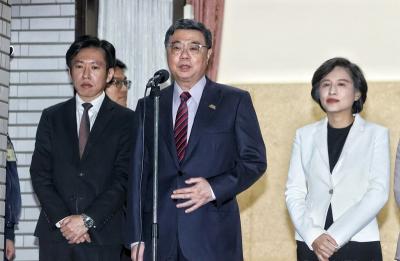
Taiwan is awaiting official notification from the US regarding the status of the Agreement on Reciprocal Trade (ART) after the US Supreme Court ruled US President Donald Trump's global tariffs unconstitutional. Speaking to reporters before a legislative hearing today, Premier Cho Jung-tai (卓榮泰) said that Taiwan's negotiation team remains focused on ensuring that the bilateral trade deal remains intact despite the legal challenge to Trump's tariff policy. "The US has pledged to notify its trade partners once the subsequent administrative and legal processes are finalized, and that certainly includes Taiwan," Cho said when asked about opposition parties’ doubts that the ART was
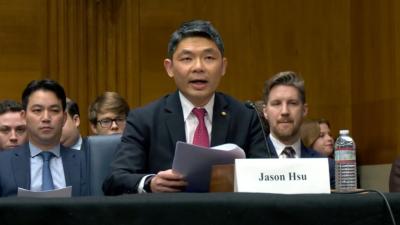
If China chose to invade Taiwan tomorrow, it would only have to sever three undersea fiber-optic cable clusters to cause a data blackout, Jason Hsu (許毓仁), a senior fellow at the Hudson Institute and former Chinese Nationalist Party (KMT) legislator, told a US security panel yesterday. In a Taiwan contingency, cable disruption would be one of the earliest preinvasion actions and the signal that escalation had begun, he said, adding that Taiwan’s current cable repair capabilities are insufficient. The US-China Economic and Security Review Commission (USCC) yesterday held a hearing on US-China Competition Under the Sea, with Hsu speaking on


 RSS
RSS