


Pro-Taiwanese independence activists yesterday demanded that the Mainland Affairs Council vow that Minister Wang Yu-chi (王郁琦) will meet China’s Taiwan Affairs Office (TAO) Director Zhang Zhijun (張志軍) on a state-to-state basis, rather than under the “one China” framework, a policy formulated by Beijing that the said is accepted by President Ma Ying-jeou’s (馬英九) administration.
Ahead of Zhang’s planned arrival today, dozens of students who participated in the Sunflower movement staged a protest outside the council building in Taipei yesterday along with Alliance of Referendum for Taiwan convener Tsay Ting-kuei (蔡丁貴) to voice their concerns that cross-strait political talks may take place during Zhang’s visit.
Chanting: “No sovereignty, No [political] talks,” the protesters demanded that Wang issue a declaration when he meets with his Chinese counterpart this afternoon that clearly states: “Taiwan is a sovereign, independent nation.”
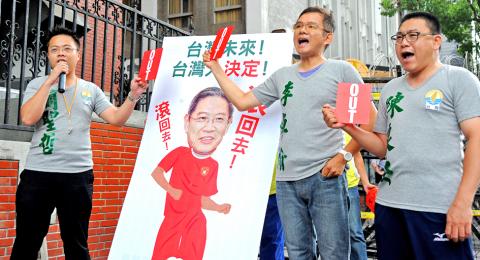
Photo: Liu Hsin-de, Taipei Times
The activists said they do not oppose the idea of holding cross-strait negotiations on economic or political issues, they are only against such talks being held under the “one China” framework.
“Before Wang is able to make the government’s position on Taiwan’s independence and sovereignty clear, he is in no position to meet with Zhang,” National Taiwan University student Lin Yu-lun (林于倫) said.
Lin said that any negotiations the government engages in with any other country, including China, should be based on a state-to-state relationship because Taiwan is an independent nation.
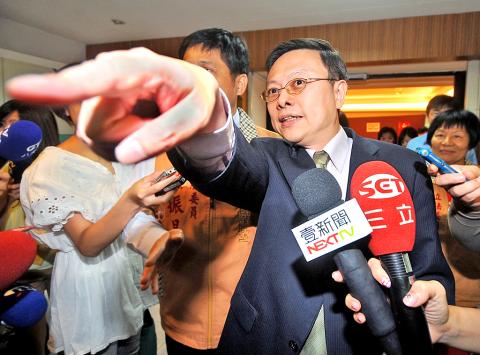
Photo: Fang Pin-chao, Taipei Times
National Taipei University student Lai Pin-yu (賴品妤) urged Wang to set a precondition for his meeting with Zhang stipulating that China first improve its human rights situation.
During Zhang’s four-day trip, he is scheduled to visit Aborigines in New Taipei City’s Wulai District (烏來) and residents of the Siadin Village (小林村) in Greater Kaohsiung devastated by Typhoon Morakot, which Lai said was part of a bid to create an image that he is “man of the people.”
“However, we should first look at how Beijing has treated Tibetans,” she said.
At the protest, the activists’ tried to give a letter of appeal to the council, but it did not send council Chief Secretary Jeff Yang (楊家駿) to receive until the demonstrators tried to burst into the complex.
The activists tried to breach the complex after being frustrated when the mistook Wu Chia-hsin (吳家興), director of the council’s Ethics Department, for a low-ranking official when he came down to listen to their appeal.
When Yang appeared, the protesters peppered him with questions about Taiwanese sovereignty, but he deigned to make any promises, saying only that he would pass the letter of appeal on to Wang.
Meanwhile, Democratic Progress Party (DPP) Department of China Affairs director Chao Tien-lin (趙天麟) yesterday said the party viewed at Zhang’s visit as positive move and that it has no plans to mobilize any protest.
The party issued a three-point statement on the trip which said that it encourages cross-strait interactions on the conditions that Taiwan’s sovereignty is respected, and that fairness and democracy are upheld.
The statement’s first point is that any political dealings that take place during these interactions must be done transparently and the agendas of all relevant meetings made public.
Second, the nation’s future should be decided by its 23 million citizens and no one else and Ma must not ignore that fact.
Third, since Zhang hopes to learn about Taiwan and communicate with Taiwanese of all social ranks, especially average citizens, the DPP said it hoped he would “listen to them with his heart.”

Taiwan has received more than US$70 million in royalties as of the end of last year from developing the F-16V jet as countries worldwide purchase or upgrade to this popular model, government and military officials said on Saturday. Taiwan funded the development of the F-16V jet and ended up the sole investor as other countries withdrew from the program. Now the F-16V is increasingly popular and countries must pay Taiwan a percentage in royalties when they purchase new F-16V aircraft or upgrade older F-16 models. The next five years are expected to be the peak for these royalties, with Taiwan potentially earning
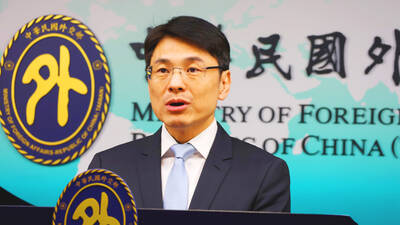
STAY IN YOUR LANE: As the US and Israel attack Iran, the ministry has warned China not to overstep by including Taiwanese citizens in its evacuation orders The Ministry of Foreign Affairs (MOFA) yesterday rebuked a statement by China’s embassy in Israel that it would evacuate Taiwanese holders of Chinese travel documents from Israel amid the latter’s escalating conflict with Iran. Tensions have risen across the Middle East in the wake of US and Israeli airstrikes on Iran beginning Saturday. China subsequently issued an evacuation notice for its citizens. In a news release, the Chinese embassy in Israel said holders of “Taiwan compatriot permits (台胞證)” issued to Taiwanese nationals by Chinese authorities for travel to China — could register for evacuation to Egypt. In Taipei, the ministry yesterday said Taiwan
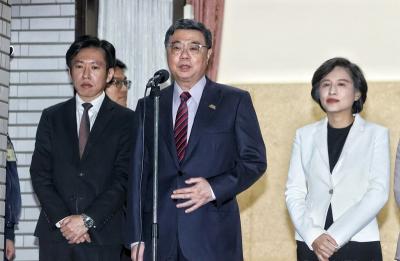
Taiwan is awaiting official notification from the US regarding the status of the Agreement on Reciprocal Trade (ART) after the US Supreme Court ruled US President Donald Trump's global tariffs unconstitutional. Speaking to reporters before a legislative hearing today, Premier Cho Jung-tai (卓榮泰) said that Taiwan's negotiation team remains focused on ensuring that the bilateral trade deal remains intact despite the legal challenge to Trump's tariff policy. "The US has pledged to notify its trade partners once the subsequent administrative and legal processes are finalized, and that certainly includes Taiwan," Cho said when asked about opposition parties’ doubts that the ART was
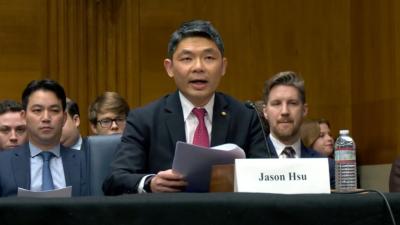
If China chose to invade Taiwan tomorrow, it would only have to sever three undersea fiber-optic cable clusters to cause a data blackout, Jason Hsu (許毓仁), a senior fellow at the Hudson Institute and former Chinese Nationalist Party (KMT) legislator, told a US security panel yesterday. In a Taiwan contingency, cable disruption would be one of the earliest preinvasion actions and the signal that escalation had begun, he said, adding that Taiwan’s current cable repair capabilities are insufficient. The US-China Economic and Security Review Commission (USCC) yesterday held a hearing on US-China Competition Under the Sea, with Hsu speaking on


 RSS
RSS