


China is pursuing a policy of “gunboat diplomacy” in the East and South China seas that is destabilizing the Asia-Pacific region, the Center for a New American Security says in a report.
Although Taiwan has maintained some maritime claims that are identical to China’s, the lengthy report — entitled Tailored Coercion and released on March 21 — says that Taipei has pursued policies that are distinct from Beijing’s and not at cross purposes with Washington.
Taiwan is praised in the report for its East China Sea peace initiative, for signing a fisheries agreement with Japan and for “energetically” denouncing China’s declaration of an air defense identification zone in the East China Sea.
“In short, Japan and Taiwan — as well as the US as their ally — are growing increasingly concerned over Chinese coercive action in the East China Sea and are taking steps to counter it,” the report says. “Japan and Taiwan are seeking to bolster defense both independently and together.”
China’s behavior has been “uniquely escalatory and revisionist,” the report says.
It added that Beijing’s assertiveness is the product of overlapping trends including triumphalism in the wake of the 2008 Olympics and the global financial crisis. The report also points to Chinese nationalism, enhanced Chinese military and maritime capabilities, bureaucratic politics and internal sources of instability as reasons for its actions.
Chinese actions have often been premeditated and highly provocative and form “a troubling and destabilizing” pattern of behavior, it says.
“China is seeking to revise the situation in Asia through a variety of means that are designed to exert maximum influence without crossing the military threshold,” it says.
As the US rebalances to Asia, it will need to revise its forward-deployed presence, enhance its own military capabilities and help improve the ability of regional countries to “more independently monitor, deter and repel Chinese coercion,” the report says.
The report adds that as China seeks to exercise further influence over its periphery and challenge US dominance it is increasingly using coercive diplomacy.
“China has been doing this with its maritime neighbors, from Japan to Taiwan to the four Southeast Asian nations that also have competing claims in the South China Sea (Brunei, Malaysia, Philippines and Vietnam),” the report says, adding that this more focused form of coercive diplomacy — “which might have been referred to in the past as naval coercion or gunboat diplomacy” — appears to be most coercive and least diplomatic with states where Beijing wants to isolate its antagonists.
“Allies will have to do more to promote their own security, but must also be engaged to forge a common approach for discouraging bad behavior and countering maritime coercion,” the report says.

LOUD AND PROUD Taiwan might have taken a drubbing against Australia and Japan, but you might not know it from the enthusiasm and numbers of the fans Taiwan might not be expected to win the World Baseball Classic (WBC) but their fans are making their presence felt in Tokyo, with tens of thousands decked out in the team’s blue, blowing horns and singing songs. Taiwanese fans have packed out the Tokyo Dome for all three of their games so far and even threatened to drown out home team supporters when their team played Japan on Friday. They blew trumpets, chanted for their favorite players and had their own cheerleading squad who dance on a stage during the game. The team struggled to match that exuberance on the field, with
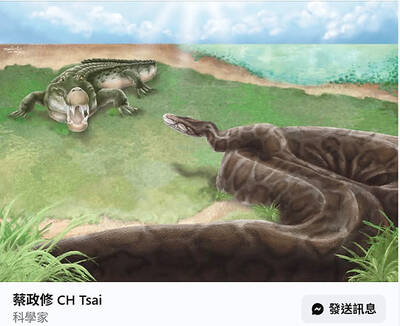
Taiwanese paleontologists have discovered fossil evidence that pythons up to 4m long inhabited Taiwan during the Pleistocene epoch, reporting their findings in the international scientific journal Historical Biology. National Taiwan University (NTU) Institute of Ecology and Evolutionary Biology associate professor Tsai Cheng-hsiu (蔡政修) led the team that discovered the largest snake fossil ever found in Taiwan. The single trunk vertebra was discovered in Tainan at the Chiting Formation, dated to between 400,000 and 800,000 years ago in the Middle Pleistocene, the paper said. The area also produced Taiwan’s first avian fossil, as well as crocodile, mammoth, saber-toothed cat and rhinoceros fossils, it said. Discoveries

Taiwanese paleontologists have discovered fossil evidence that pythons up to 4m long inhabited Taiwan during the Pleistocene epoch, reporting their findings in the international scientific journal Historical Biology. National Taiwan University (NTU) Institute of Ecology and Evolutionary Biology associate professor Tsai Cheng-hsiu (蔡政修) led the team that discovered the largest snake fossil ever found in Taiwan. A single trunk vertebra was discovered in Tainan at the Chiting Formation, dated to between 800,000 to 400,000 years ago in the Middle Pleistocene, the paper said. The area also produced Taiwan’s first avian fossil, as well as crocodile, mammoth, sabre-toothed cat and rhinoceros fossils, it said. Discoveries

Whether Japan would help defend Taiwan in case of a cross-strait conflict would depend on the US and the extent to which Japan would be allowed to act under the US-Japan Security Treaty, former Japanese minister of defense Satoshi Morimoto said. As China has not given up on the idea of invading Taiwan by force, to what extent Japan could support US military action would hinge on Washington’s intention and its negotiation with Tokyo, Morimoto said in an interview with the Liberty Times (sister paper of the Taipei Times) yesterday. There has to be sufficient mutual recognition of how Japan could provide


 RSS
RSS