


Former American Institute in Taiwan chairman Richard Bush yesterday praised President Ma Ying-jeou (馬英九) for “trying very hard” to resolve the political gridlock over the controversial cross-strait service trade agreement.
Bush, currently director of the Brookings Institution’s Center for East Asia Policy Studies, made the remarks during a meeting with Ma at the Presidential Office.
“I read your press conference on Sunday and I thought it was quite eloquent and quite conciliatory. I hope it provides a platform for resolving the issue and I think you are trying very hard,” Bush said.
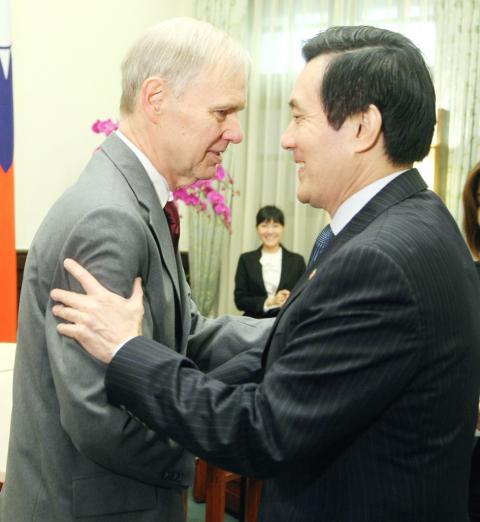
Photo: CNA
Ma has held two international press conferences — one on March 23 and another on Saturday — to clarify the controversies surrounding the trade agreement since hundreds of students stormed and occupied the Legislative Yuan on March 18 to protest the agreement.
The student activists have demanded that the Executive Yuan withdraw the trade agreement from the legislature and suspend its legislative review until a legal mechanism to supervise cross-strait agreements is established. They have also demanded the holding of a citizens’ constitutional conference with representatives from all walks of life to ensure the public’s full and active participation in major national issues.
During yesterday’s meeting, Ma said that long-term occupation of the legislature was not a viable solution to the dispute over the trade agreement.
“To solve this issue, one must have not only an enthusiastic heart, but also a calm mind,” Ma said.
Ma said he was open to dialogue with the students and people from all sectors of society because he believed the issue could only be addressed when lawmakers are allowed to get back to work and to review and vote on the agreement item-by-item.
The president also reiterated that the trade agreement could not be retracted, saying that doing so would compromise Taiwan’s international credibility, impede the development of the service industry and hinder the nation’s chance of joining regional economic groups.
“It could also lead to a further rise in unemployment, particularly among youth,” Ma said.
With regard to the students’ ongoing occupation of the legislature and their brief seizure of the Executive Yuan on March 23, Ma said such behavior would not be tolerated in any democratic nation and that the perpetrators should be dealt with according to the law.
“Although the Republic of China’s legal system is designed to respect and protect peaceful rallies and protests, those who interfere with public functions or willfully damage and forcibly occupy public properties should be subject to the law,” Ma said.

LOUD AND PROUD Taiwan might have taken a drubbing against Australia and Japan, but you might not know it from the enthusiasm and numbers of the fans Taiwan might not be expected to win the World Baseball Classic (WBC) but their fans are making their presence felt in Tokyo, with tens of thousands decked out in the team’s blue, blowing horns and singing songs. Taiwanese fans have packed out the Tokyo Dome for all three of their games so far and even threatened to drown out home team supporters when their team played Japan on Friday. They blew trumpets, chanted for their favorite players and had their own cheerleading squad who dance on a stage during the game. The team struggled to match that exuberance on the field, with
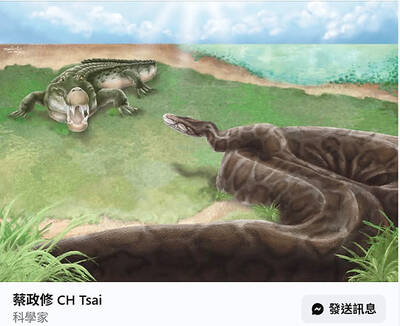
Taiwanese paleontologists have discovered fossil evidence that pythons up to 4m long inhabited Taiwan during the Pleistocene epoch, reporting their findings in the international scientific journal Historical Biology. National Taiwan University (NTU) Institute of Ecology and Evolutionary Biology associate professor Tsai Cheng-hsiu (蔡政修) led the team that discovered the largest snake fossil ever found in Taiwan. The single trunk vertebra was discovered in Tainan at the Chiting Formation, dated to between 400,000 and 800,000 years ago in the Middle Pleistocene, the paper said. The area also produced Taiwan’s first avian fossil, as well as crocodile, mammoth, saber-toothed cat and rhinoceros fossils, it said. Discoveries

Taiwanese paleontologists have discovered fossil evidence that pythons up to 4m long inhabited Taiwan during the Pleistocene epoch, reporting their findings in the international scientific journal Historical Biology. National Taiwan University (NTU) Institute of Ecology and Evolutionary Biology associate professor Tsai Cheng-hsiu (蔡政修) led the team that discovered the largest snake fossil ever found in Taiwan. A single trunk vertebra was discovered in Tainan at the Chiting Formation, dated to between 800,000 to 400,000 years ago in the Middle Pleistocene, the paper said. The area also produced Taiwan’s first avian fossil, as well as crocodile, mammoth, sabre-toothed cat and rhinoceros fossils, it said. Discoveries
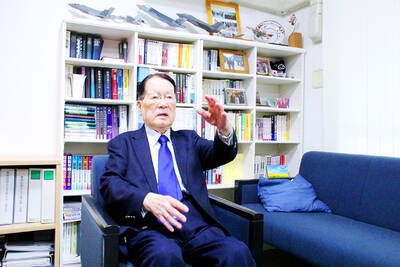
Whether Japan would help defend Taiwan in case of a cross-strait conflict would depend on the US and the extent to which Japan would be allowed to act under the US-Japan Security Treaty, former Japanese minister of defense Satoshi Morimoto said. As China has not given up on the idea of invading Taiwan by force, to what extent Japan could support US military action would hinge on Washington’s intention and its negotiation with Tokyo, Morimoto said in an interview with the Liberty Times (sister paper of the Taipei Times) yesterday. There has to be sufficient mutual recognition of how Japan could provide


 RSS
RSS