

Premier Jiang Yi-huah (江宜樺) yesterday brushed aside concerns voiced by protesters about the cross-strait service trade agreement as he demanded that Cabinet members push ahead with the pact, saying it will bring the nation more advantages than disadvantages.
“Not only do its advantages outweigh the disadvantages, it is also crucial to the future of our economic development, which is what a responsible person must bravely do,” Jiang said in his address at the weekly Cabinet meeting as the protests that began on Tuesday outside and inside the Legislative Yuan continued.
Jiang made three demands of Cabinet members.
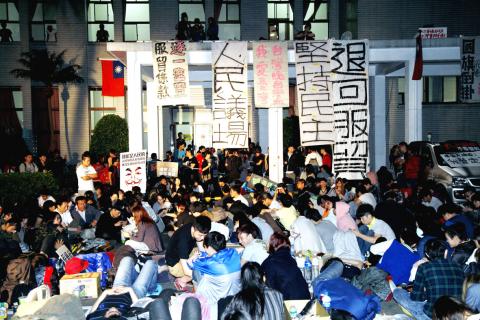
Photo: David Chang, EPA
The “first and foremost priority for” each government agency is to have the trade pact endorsed by the legislature before its current session ends in June, he said.
He urged the necessary agencies to communicate more effectively with the public to boost the support base for the trade pact to beyond the current 60 percent.
He asked the National Police Agency to take the appropriate measures necessary to assist the Legislative Yuan in a rapid resumption of order in the complex, without provoking serious clashes with protesters or inconveniencing lawmakers.
Given the controversy over the trade pact, each government agency must remain steadfast, showing the public how the government is continuing to work on policies to benefit the nation and its people, and show them the direction the nation is taking, Jiang said.
The concerns voiced by the protesters that the negotiations leading to the trade pact were opaque and the pact’s terms of trade would hurt the interests of Taiwan were “unnecessary,” he said.
The protesters’ perceptions of the pact were based on “groundless rumors” and “defamation,” Jiang said, blaming “certain media” for their “incorrect” coverage of how the pact would affect the country.
The government has completed all the preparations to liberalize the sectors covered under the pact since it was signed in June last year, Jiang said.
The policies and measures needed to assist local industries, such as laundries, hair salons, beauty centers and Chinese medicine dealers in upgrading their quality so they can become more competitive are ready for implementation, he said.
After months of effort, the associations of those industries that might suffer adverse effects after the pact is implemented have gradually come around to support the agreement, Jiang said.
The “certain political and social groups” behind the protesters should not try to use the situation for their own political gains because it would only damage the nation’s democratic system.
Meanwhile, Chinese Nationalist Party (KMT) caucus whip Lin Hung-chih (林鴻池) said the protesters’ occupation of the legislature’s chamber was apparently “instigated” by the Democratic Progressive Party (DPP) and other “ill-intentioned people” and that the KMT would never give in to their ultimatum.
“Democratic politics means that people make rational appeals by legal means. Democracy without the rule of law is nothing but chaos,” Lin said.
The presence of several DPP lawmakers inside and outside the legislature and the repeated calls by senior members of the party for the public to join the siege of the Legislative Yuan proved that the DPP was responsible for inciting the students to seize the chamber.
“The student occupation is tantamount to trampling on [the dignity of] the legislature and the people of Taiwan,” Lin said.
The DPP should not sacrifice the public’s general interest for its own self-interests, he said.
The protesters have issued an ultimatum, demanding that President Ma Ying-jeou’s (馬英九) administration respond to their demands by noon today.
The demands include the suspension of all interaction with China until the legislature passes a law to monitor cross-strait agreements and the reversal of KMT Legislator Chang Ching-chung’s (張慶忠) decision on Monday during the service trade pact review meeting to send the agreement directly to a second reading without a clause-by-clause review.
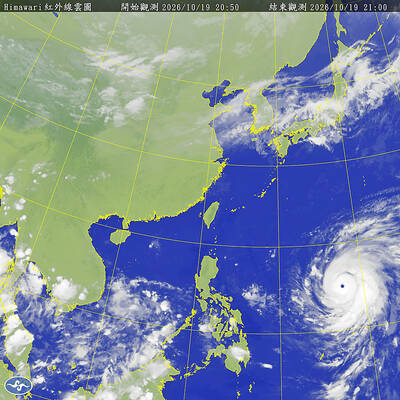
Typhoon Champi is forecast to turn northward earlier than previously expected, sparing Taiwan a direct hit but still bringing heavy rain to the north of the country on Friday and Saturday, the Central Weather Administration (CWA) said yesterday. Typhoon Champi had strengthened and increased in size over the past 12 hours, and as of yesterday afternoon, was packing sustained winds of 198kph near its center, CWA forecaster Cheng Chieh-jen (鄭傑仁) said. However, due to the weakening of a Pacific high-pressure system the storm is now expected to turn northward earlier than initially forecast, likely around Japan’s Ishigaki Island, Cheng said. As Champi brushes

MAYORAL RACE: Su Chiao-hui made gains by persuading undecided voters and winning over voters in KMT-leaning districts, a pollster said Legislator Su Chiao-hui (蘇巧慧), the Democratic Progressive Party’s (DPP) candidate for New Taipei City mayor, has a 13.1 percentage point lead over her Chinese Nationalist Party (KMT) rival Lee Shu-chuan (李四川), a poll released yesterday showed. The poll, commissioned by the Taipei Trust in Democracy Association, showed that 43.1 percent of respondents said they would vote for Su, up 7.9 percentage points from a poll conducted in late August, while support for Lee was at 30 percent, down 4.7 percentage points. It showed that 48.6 percent of respondents thought Su would make a suitable mayor, compared with 35.9 percent for Lee. Independent candidate
A Chinese People's Liberation Army (PLA) Navy aircraft carrier group was being monitored after entering the western Pacific, the Ministry of National Defense said today, after Beijing yesterday criticized Taiwan for using a water cannon against a Chinese fishing boat near the Pratas Islands (Dongsha Islands, 東沙群島). A Chinese naval task group led by the aircraft carrier Liaoning (遼寧) yesterday sailed to the western Pacific for training, Chinese state-run Xinhua news agency quoted the PLA Navy as saying. “The drill is part of the annual routine training plan aimed at testing and improving the troops’ combat readiness and enhancing their ability to
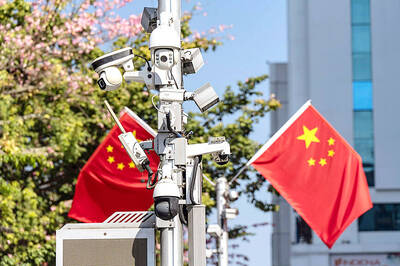
Pulled aside onto the balcony of an empty hotel room by Chinese state security officers, a Taiwanese tourist on a trip to Tibet described facing an unnerving barrage of questions about his military background and political loyalties. The man surnamed Lin (林) reported his experience in a viral post on Threads before accepting an interview with the Central News Agency (CNA) yesterday. Lin, who works as a nurse, told CNA that he knew some Taiwanese had run afoul of Chinese law enforcement, but he thought he would be safe, as he did not post much about his personal political views online. It came


 RSS
RSS