


The Chinese Nationalist Party (KMT) is pulling out all the stops in an attempt to ratify the cross-strait service trade agreement by the end of this legislative session, with President Ma Ying-jeou (馬英九), who also serves as KMT chairman, calling on the party to step up promotional efforts and on its legislators to attend the Legislative Yuan voting procedures.
The legislative committees held a joint review of the pact on Wednesday and on Thursday, but no progress was made, with scuffles erupting in the legislature over the issue.
More confrontations are expected when the legislature tries to continue the review in the coming week.
KMT officials said the agreement is important for the nation’s integration into both regional and international trade blocs, adding that all local party branches have been urged through e-mail, social networking sites and post to increase their advocacy efforts.
“We expect all local party headquarter branches to hold seminars or events to promote the agreement as per President Ma’s recent instructions,” party officials said.
KMT spokesperson Yin Wei (殷瑋) said the Democratic Progressive Party’s (DPP) opposition to an important policy for Taiwan’s economic development was a clear indicator of where the KMT and the DPP differ in diplomatic and economic policies.
“The DPP is blocking the passage of an agreement beneficial to Taiwan’s competitiveness,” Yin said, adding that the KMT would make the point clear in flyers for the year-end elections.
Meanwhile, Taiwan Solidarity Union (TSU) Chairman Huang Kun-huei (黃昆輝) said yesterday that his party has held more than 600 events in the past to let members of the public know how deeply detrimental the agreement could be for Taiwan.
“We are planning to hold another 600 to make sure we reach every township in the country,” Huang said.
In a speech delivered at the World Federation of Taiwanese Associations (WFTA) meeting held in Taipei yesterday, Huang criticized the Ma administration for signing the agreement before making its details public.
The decision to allow Taiwanese businesspeople to go to China has already caused a drain of funding, technology and talent harming Taiwan’s business sector, Huang said.
“The controversial agreement, if ratified, would further open the Taiwanese market to China and allow the mass invasion of Chinese products and industry,” Huang said, adding that the damage to Taiwan’s business sector would be even worse.
In a speech delivered at the same occasion, DPP Chairman Su Tseng-chang (蘇貞昌) said the Ma administration’s decision to pursue the agreement was rash and lacked assessment of overall impact, adding that the entire process had also been extremely murky and opaque.
Su also criticized the Ma administration’s decisions in national defense and foreign diplomacy, accusing the KMT government of abandoning national defense and causing confusion among the nation’s allies with its pro-Chinese rhetoric.
Additional reporting by CNA


Kenting National Park service technician Yang Jien-fon (楊政峰) won a silver award in World Grand Prix Photography Awards Spring Season for his photograph of two male rat snakes intertwined in combat. Yang’s colleagues at Kenting National Park said he is a master of nature photography who has been held back by his job in civil service. The awards accept entries in all four seasons across six categories: architectural and urban photography, black-and-white and fine art photography, commercial and fashion photography, documentary and people photography, nature and experimental photography, and mobile photography. Awards are ranked according to scores and divided into platinum, gold and

More than half of the bamboo vipers captured in Tainan in the past few years were found in the city’s Sinhua District (新化), while other districts had smaller catches or none at all. Every year, Tainan captures about 6,000 snakes which have made their way into people’s homes. Of the six major venomous snakes in Taiwan, the cobra, the many-banded krait, the brown-spotted pit viper and the bamboo viper are the most frequently captured. The high concentration of bamboo vipers captured in Sinhua District is puzzling. Tainan Agriculture Bureau Forestry and Nature Conservation Division head Chu Chien-ming (朱健明) earlier this week said that the
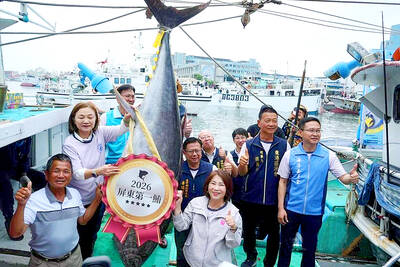
The first bluefin tuna of the season, brought to shore in Pingtung County and weighing 190kg, was yesterday auctioned for NT$10,600 (US$333.5) per kilogram, setting a record high for the local market. The auction was held at the fish market in Donggang Fishing Harbor, where the Siaoliouciou Island-registered fishing vessel Fu Yu Ching No. 2 delivered the “Pingtung First Tuna” it had caught for bidding. Bidding was intense, and the tuna was ultimately jointly purchased by a local restaurant and a local company for NT$10,600 per kilogram — NT$300 ,more than last year — for a total of NT$2.014 million. The 67-year-old skipper
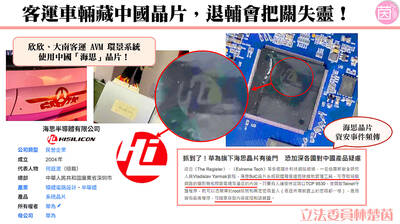
BREACH OF CONTRACT: The bus operators would seek compensation and have demanded that the manufacturer replace the chips with ones that meet regulations Two bus operators found to be using buses with China-made chips are to demand that the original manufacturers replace the systems and provide compensation for breach of contract, the Veterans Affairs Council said yesterday. Democratic Progressive Party Legislator Michelle Lin (林楚茵) yesterday said that Da Nan Bus Co and Shin-Shin Bus Co Ltd have fielded a total of 82 buses that are using Chinese chips. The bus models were made by Tron-E, while the systems provider was CYE Electronics, Lin said. Lin alleged that the buses were using chips manufactured by Huawei subsidiary HiSilicon Co, which presents a national security risk if the


 RSS
RSS