


Three college students have launched a campaign to find shells for homeless hermit crabs, calling on the public to protect the crabs by upholding a principle of “three noes” — no picking up shells on the beach, no keeping hermit crabs as pets and no buying or selling the animal.
Su Pin-yun (蘇品勻), Huang Li (黃莉) and Lin Wei (林慰) are seniors at National Chiao Tung University’s Department of Communication and Technology.
The students have jointly set up five shell-collecting stations nationwide to manage donated shells, as part of their effort to solve what they call a long-term “housing crisis” faced by the crustacean.
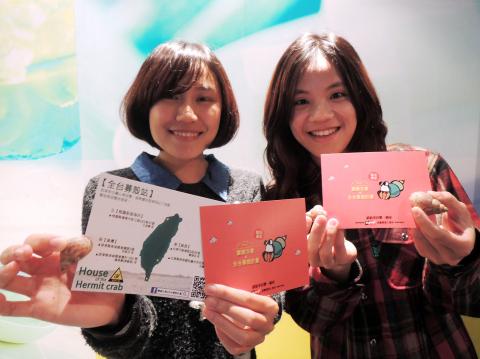
Photo: Hung Mei-hsiu, Taipei Times
Su and Huang said they decided to launch the campaign after they heard of the fast-decreasing number of shells on Taiwan’s beaches, which has deprived hermit crabs of a chance to grow properly and live.
“We want to contribute to society … and hope that the campaign can galvanize a collective effort to help these homeless hard-shelled animals find new homes,” the two college students said.
The trio said the most suitable homes for hermit crabs are the shells of Taiwanese babylon, urging diners at restaurants to preserve their shells and deliver them to the shell stations.
Su said their Facebook page, “Crab your attention, join the nationwide shell-collecting campaign” (蟹謝注意之全台募殼計畫), had prompted like-minded people from Taoyuan, Pingtung and Taitung counties to set up their own shell-collecting stations.
“With the assistance of a bed-and-breakfast in Taitung, we have collected quite a large number of shells so far,” Huang said.
She said if the campaign went well, they plan to organize a “shell-returning” event in Greater Taitung and Pingtung in July to provide homeless, wandering hermit crabs a warm home.

Considering that most countries issue more than five denominations of banknotes, the central bank has decided to redesign all five denominations, the bank said as it prepares for the first major overhaul of the banknotes in more than 24 years. Central bank Governor Yang Chin-lung (楊金龍) is expected to report to the Legislative Yuan today on the bank’s operations and the redesign’s progress. The bank in a report sent to the legislature ahead of today’s meeting said it had commissioned a survey on the public’s preferences. Survey results showed that NT$100 and NT$1,000 banknotes are the most commonly used, while NT$200 and NT$2,000

The Centers for Disease Control (CDC) yesterday reported the first case of a new COVID-19 subvariant — BA.3.2 — in a 10-year-old Singaporean girl who had a fever upon arrival in Taiwan and tested positive for the disease. The girl left Taiwan on March 20 and the case did not have a direct impact on the local community, it said. The WHO added the BA.3.2 strain to its list of Variants Under Monitoring in December last year, but this was the first imported case of the COVID-19 variant in Taiwan, CDC Deputy Director-General Lin Ming-cheng (林明誠) said. The girl arrived in Taiwan on

ANNUAL EVENT: Two massive Pokemon balloons are to be set up in Daan Park, with an event zone operating from 10am to 6pm This year’s Taipei Floral Picnic is to be held at Daan Park today and tomorrow, featuring an exclusive Pokemon Go event, a themed food market, a coffee rave picnic area and stage performances, the Taipei Department of Information and Tourism said yesterday. Two massive Pokemon balloons are to be set up in the park as attractions, with an exclusive event zone operating from 10am to 6pm, it said. Participants who complete designated tasks on-site would have a chance to receive limited-edition souvenirs, it added. People could also try the newly launched game Pokemon Pokopia in the trial area, the department said. Three PokeStops are

South Korea is planning to revise its controversial electronic arrival card, a step Taiwanese officials said prompted them to hold off on planned retaliatory measures, a South Korean media report said yesterday. A Yonhap News Agency report said that the South Korean Ministry of Foreign Affairs is planning to remove the “previous departure place” and “next destination” fields from its e-arrival card system. The plan, reached after interagency consultations, is under review and aims to simplify entry procedures and align the electronic form with the paper version, a South Korean ministry official said. The fields — which appeared only on the electronic form


 RSS
RSS