

The Democratic Progressive Party (DPP) yesterday filed a complaint with the Control Yuan over what it said was the Ministry of Education’s (MOE) administrative errors in its recent effort to change high-school history textbook outlines.
The ministry approved the adjusted outlines on Monday night despite strong public outcry over its perceived attempts at “de-Taiwanization and sinicization.”
DPP deputy secretary-general Lee Chun-yi (李俊毅), spokesperson Lin Chun-hsien (林俊憲), Department of Social Development director Kuo Wen-pin (郭文彬) and lawyer Huang Di-ying (黃帝穎) submitted the document, which listed five complaints about ministry administrative errors, to the Control Yuan yesterday afternoon.
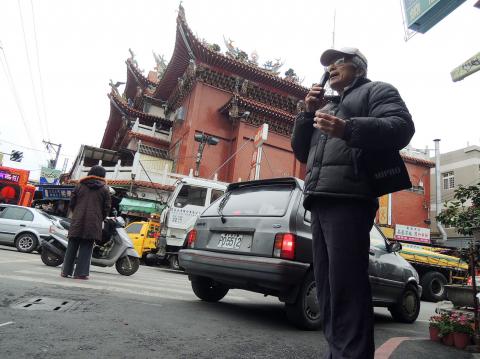
Photo: Yen Hung-chun, Taipei Times
“The MOE violated administrative procedures, the principles of neutrality and professionalism and the principle of a bottom-up consultation, and the changes were unnecessary and inconsistent with the historical facts,” Lin said.
The opaque process of the “adjustment” violated democratic principles and infringed upon the rights of students, teachers and parents, Lin added.
The ministry used “minor adjustment” as an excuse for what later became almost an overhaul of the high-school history curriculum, which betrayed historical facts, the spokesperson said, adding that the move was “political brainwashing” for the purpose of spreading a “Greater China perspective.”
Considering that Minister of Education Chiang Wei-ling (蔣偉寧) has refused to communicate with and offer an explanation to the public, the DPP caucus will “declare war with the ministry in the Legislative Yuan,” Lin said.
Lee accused Chiang of involving himself in the adjustment as a “political tool for the Ma Ying-jeou (馬英九) administration” and demanded that the watchdog impeach Chiang.
Control Yuan member Ma Yi-kung (馬以工) received the complaint, saying that it would be assigned for investigation, but added that the DPP was required to back up its complaint with more information.
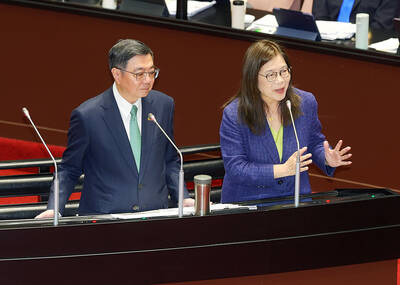
The donation of offshore patrol vessel Kinmen to the Philippines includes provisions that protect Taiwanese fishers and facilitate security cooperation across the First Island Chain, officials said yesterday. The comment was made during the Cabinet’s comprehensive administrative report at the legislature after Chinese Nationalist Party (KMT) Legislator Hsu Yu-chen (許宇甄) expressed concerns about the decision to give a ship to a country whose coast guard had in 2013 fired on a Taiwanese trawler and killed its captain without provocation. The Cabinet should lay out the safeguards that have been established to prevent the Philippine government from using the Kinmen to harass, expel
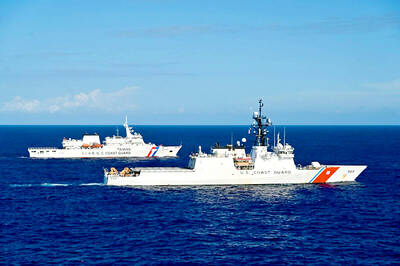
GROWING TIES: The CGA is planning a goodwill mission to the Philippines, in what would be the first time since 1975 a Taiwanese paramilitary vessel has visited the country The Coast Guard Administration (CGA) plans to significantly expand its participation in international security cooperative frameworks and its operational capabilities, a budget proposal for next year showed. The budget indicates a transformation of the CGA from a maritime law enforcement arm into a national defense and intelligence gathering entity capable of tackling larger regional security matters. The proposal showed that personnel from the coast guard’s Intelligence Division and Special Action Support Center are to participate in high-level national security talks with the US. As the CGA has dealt with China’s rising “gray zone” threats around Taiwan, it has become a valuable asset to
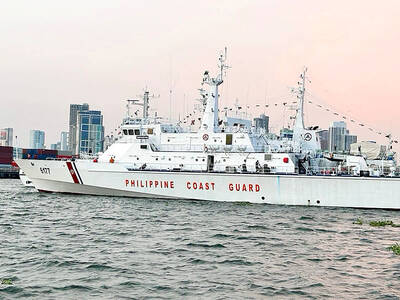
A patrol vessel donated by the Coast Guard Administration (CGA) to the Philippines was commissioned into the Philippine Coast Guard (PCG) on Friday, a Philippine non-governmental organization said. The CGA on Sept. 16 confirmed media reports that Taiwan had donated a retired 500-tonne patrol vessel to the Philippines. The Manila-based We Protect Our Seas (WPS) foundation, which served as an intermediary in the transfer, said that the vessel was formerly the CGA’s 500-tonne petrol vessel Kinmen (CG123). The WPS, in a statement issued on Friday, said the vessel, renamed as the BRP Sarangani, had been commissioned into the PCG the
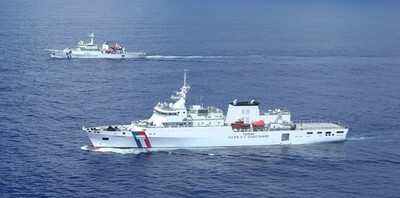
The Coast Guard Administration (CGA) today said that two of its patrol vessels have docked at Palau's Malakal Harbor as part of an expedition exercise and diplomatic visit, during which a senior official is expected to meet with the Palauan president. The two vessels, the 4,000-tonne-class Chiayi (嘉義) and the 1,000-tonne-class Penghu (澎湖), set sail for Palau from Taiwan last week and arrived at Malakal Harbor yesterday, the CGA's Fleet Branch said in a statement. The journey marked the second time the CGA has dispatched a "Friendship Fleet" to another country, after it sent its first-ever goodwill fleet, comprising the Hualien (花蓮)


 RSS
RSS