


US President Barack Obama barely mentioned foreign policy in his 65-minute State of the Union address on Tuesday and dealt with the Asian-Pacific region in less than a sentence.
He said the US should “continue to focus” on the Asia-Pacific, but offered no new policies or plans, or even a comment on the state of play of his much-heralded “rebalancing” to the region.
The annual speech, delivered before both houses of the US Congress, is generally considered to be one of the best opportunities for the White House to explain its priorities for the year ahead to the US public.
In a briefing of the foreign press given a few hours before the speech, American University history professor Allan Lichtman said that foreign policy would definitely take a backseat to domestic policy at a time of economic and employment problems at home.
“Truth is, Americans don’t give a darn about foreign policy,” he said.
He correctly predicted that the “pivot to Asia” would not be mentioned.
“I think the pivot to Asia is real — Obama knows how important relations with China and Japan, and other parts of Asia are,” Lichtman said.
The president was unlikely to discuss Asia, he said, “but you shouldn’t read anything into that.”
Obama did briefly talk about problems with Iran and its nuclear program, and he spent a minute or two on Syria, Israel and Afghanistan. However, he put forward no new foreign policy ideas.
The Brookings Institution released a memo it sent to the president last week (when the speech was being prepared) in which academics, including former American Institute in Taiwan chairman Richard Bush, recommended that the White House announce the launch of a concerted diplomatic effort to mitigate the risks of conflict between Asian powers in the South China Sea and East China Sea. It also recommended that Obama “personally engage” Chinese President Xi Jinping (習近平) to emphasize there would be “serious consequences” if China pursued its interests through military means.
A group of foreign policy experts who have formed an organization called “Foreign Policy Initiative” released a list of five issues they hoped Obama would address in his State of the Union speech.
They said it was “essential” that Obama make clear to China that the US would stand firm with its Asian allies and partners “in the face of Beijing’s bullying.”
A Wall Street Journal — NBC News poll issued just before the speech showed that the nation was “increasingly worried” about Obama’s abilities, dissatisfied with the economy and fearful for the country’s future.
“Since the rise of modern polling in the 1930s, only George W. Bush has begun his sixth year in the White House on rockier ground than Mr Obama,” the Wall Street Journal said.
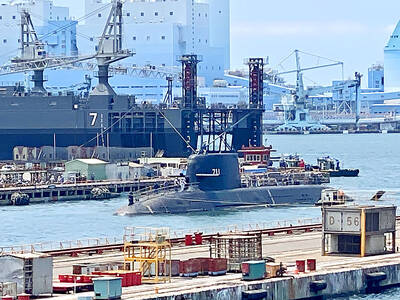
AGING: While Japan has 22 submarines, Taiwan only operates four, two of which were commissioned by the US in 1945 and 1946, and transferred to Taiwan in 1973 Taiwan would need at least 12 submarines to reach modern fleet capabilities, CSBC Corp, Taiwan chairman Chen Cheng-hung (陳政宏) said in an interview broadcast on Friday, citing a US assessment. CSBC is testing the nation’s first indigenous defense submarine, the Hai Kun (海鯤, Narwhal), which is scheduled to be delivered to the navy next month or in July. The Hai Kun has completed torpedo-firing tests and is scheduled to undergo overnight sea trials, Chen said on an SET TV military affairs program. Taiwan would require at least 12 submarines to establish a modern submarine force after assessing the nation’s operational environment and defense
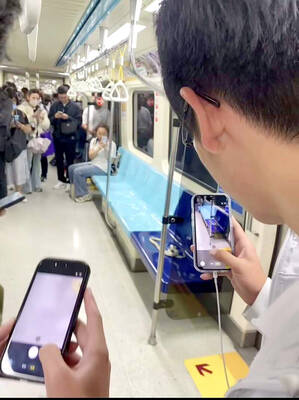
A white king snake that frightened passengers and caused a stir on a Taipei MRT train on Friday evening has been claimed by its owner, who would be fined, Taipei Rapid Transit Corp (TRTC) said yesterday. A person on Threads posted that he thought he was lucky to find an empty row of seats on Friday after boarding a train on the Bannan (Blue) Line, only to spot a white snake with black stripes after sitting down. Startled, he jumped up, he wrote, describing the encounter as “terrifying.” “Taipei’s rat control plan: Release snakes on the metro,” one person wrote in reply, referring
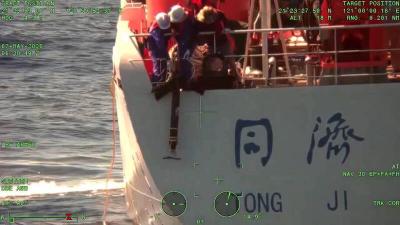
The coast guard today said that it had disrupted "illegal" operations by a Chinese research ship in waters close to the nation and driven it away, part of what Taipei sees a provocative pattern of China's stepped up maritime activities. The coast guard said that it on Thursday last week detected the Chinese ship Tongji (同濟號), which was commissioned only last year, 29 nautical miles (54km) southeast of the southern tip of Taiwan, although just outside restricted waters. The ship was observed lowering ropes into the water, suspected to be the deployment of scientific instruments for "illegal" survey operations, and the coast
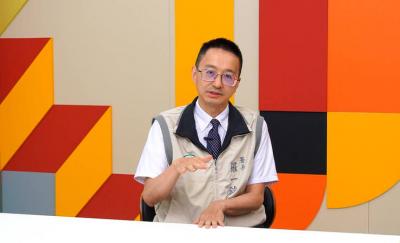
Taiwan’s two cases of hantavirus so far this year are on par with previous years’ case numbers, and the government is coordinating rat extermination work, so there should not be any outbreaks, Centers for Disease Control (CDC) Director-General Philip Lo (羅一鈞) said today in an interview with the Liberty Times (the Taipei Times’ sister newspaper). An increase in rat sightings in Taipei and New Taipei City has raised concerns about the spread of hantavirus, as rats can carry the disease. In January, a man in his 70s who lived in Taipei’s Daan District (大安) tested positive posthumously for hantavirus, Taiwan’s


 RSS
RSS