


Former Democratic Progressive Party (DPP) chairperson Tsai Ing-wen (蔡英文) yesterday called for the party to make necessary changes so that the DPP would be able to embrace — and be accepted by — the emerging force of Taiwan’s civil society in the new year and beyond.
“We have to understand that it has come down to whether civil society will accept the DPP, rather than how the DPP is supposed to ‘lead’ civil society. Only with that in mind, and only with sincerity, can the DPP foster the public’s trust,” Tsai said in a press release issued by her office, in which she listed her new year’s resolution.
Tsai said that this year, the DPP would have to make choices on at least two important issues: its relations with civil society, which was the main driver of social and political change last year; and the party’s traditional political thinking and practices that somehow have prevented it from connecting with the public and the rapidly changing society.
Both issues would likely have profound impacts on the DPP’s future and the nation’s democratic development, she said.
The former presidential candidate appeared to be concerned with the disconnect between the DPP and civil society, as well as the public’s growing lack of trust in the party.
When civil groups took the leading role in social movements through street protests, the DPP should have begun re-examining its relations with the groups, which have always been the party’s close allies in the political arena, and deciding whether there is a new role for the party to play, she said.
One of the conventional practices under the principle of party politics was recruiting the best talent as members and making them candidates in the elections, Tsai said.
“With the unique political party structure and social atmosphere in Taiwan, the questions the DPP must answer are whether the old model is its only option and whether the party should be inclusive and tolerant so that it can collaborate with other opposition forces to break the Chinese Nationalist Party’s (KMT) domination of the political-economic structure,” she said.
Tsai appeared to be referring to the DPP’s current dilemma surrounding National Taiwan University Hospital physician Ko Wen-je (柯文哲), who wished to run in the Taipei mayoral election as an independent, but is mulling joining the DPP to consolidate pan-green camp voter support.
The DPP has insisted on nominating its own candidate for the election and has been reluctant to support Ko, who has been leading all other pan-green camp aspirants in most opinion polls, if Ko stayed as an independent.
“Insistence on dealing with the current social atmosphere with old-school thinking would be counterproductive. Without a complete change this year, the DPP will weed itself out of Taiwan’s political map,” Tsai said.

Taiwan has received more than US$70 million in royalties as of the end of last year from developing the F-16V jet as countries worldwide purchase or upgrade to this popular model, government and military officials said on Saturday. Taiwan funded the development of the F-16V jet and ended up the sole investor as other countries withdrew from the program. Now the F-16V is increasingly popular and countries must pay Taiwan a percentage in royalties when they purchase new F-16V aircraft or upgrade older F-16 models. The next five years are expected to be the peak for these royalties, with Taiwan potentially earning
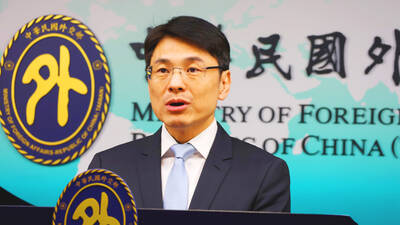
STAY IN YOUR LANE: As the US and Israel attack Iran, the ministry has warned China not to overstep by including Taiwanese citizens in its evacuation orders The Ministry of Foreign Affairs (MOFA) yesterday rebuked a statement by China’s embassy in Israel that it would evacuate Taiwanese holders of Chinese travel documents from Israel amid the latter’s escalating conflict with Iran. Tensions have risen across the Middle East in the wake of US and Israeli airstrikes on Iran beginning Saturday. China subsequently issued an evacuation notice for its citizens. In a news release, the Chinese embassy in Israel said holders of “Taiwan compatriot permits (台胞證)” issued to Taiwanese nationals by Chinese authorities for travel to China — could register for evacuation to Egypt. In Taipei, the ministry yesterday said Taiwan
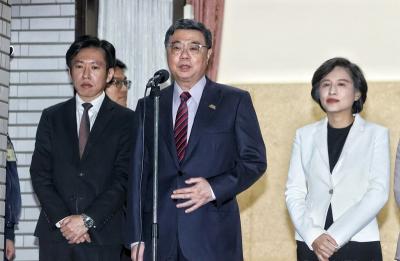
Taiwan is awaiting official notification from the US regarding the status of the Agreement on Reciprocal Trade (ART) after the US Supreme Court ruled US President Donald Trump's global tariffs unconstitutional. Speaking to reporters before a legislative hearing today, Premier Cho Jung-tai (卓榮泰) said that Taiwan's negotiation team remains focused on ensuring that the bilateral trade deal remains intact despite the legal challenge to Trump's tariff policy. "The US has pledged to notify its trade partners once the subsequent administrative and legal processes are finalized, and that certainly includes Taiwan," Cho said when asked about opposition parties’ doubts that the ART was
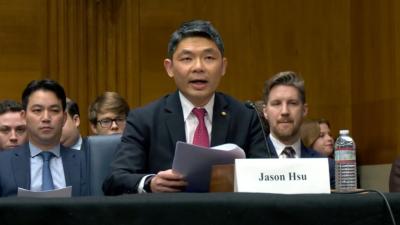
If China chose to invade Taiwan tomorrow, it would only have to sever three undersea fiber-optic cable clusters to cause a data blackout, Jason Hsu (許毓仁), a senior fellow at the Hudson Institute and former Chinese Nationalist Party (KMT) legislator, told a US security panel yesterday. In a Taiwan contingency, cable disruption would be one of the earliest preinvasion actions and the signal that escalation had begun, he said, adding that Taiwan’s current cable repair capabilities are insufficient. The US-China Economic and Security Review Commission (USCC) yesterday held a hearing on US-China Competition Under the Sea, with Hsu speaking on


 RSS
RSS