


A mailman in Yunlin County recently earned praise for his persistence and dedication to the job, by successfully forwarding an air express letter from Japan to its destination, even though the intended recipient had changed her name and moved more than 20 years ago.
Mail packages stamped with “address unknown” and “no such person” are usually the bane of postal workers, as well as a source of frustration for the letter writers who receive their mail back stamped: “Return to sender.”
However, for Weng Cheng-hsien (翁鎮賢), such letters are seen as a challenge to his skills in completing the delivery.
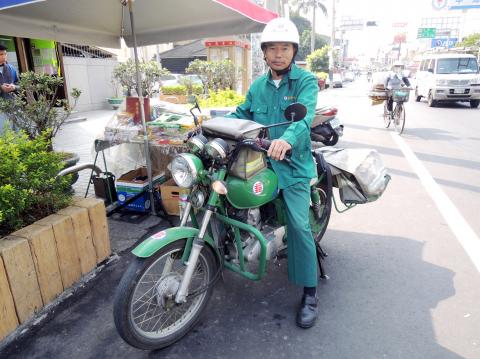
Photo: Liao Shu-ling, Taipei Times
In October, a letter from Japan was to test his skills.
The letter was addressed to a Ms Chang Mei-yueh (張美月), at No. 33 Singnan Borough (興南), Huwei Town.
However, at the address, Weng found only a chicken farm. He asked the neighbors, but no one knew anyone by the name of Chang Mei-yueh.
After completing his round of deliveries for the day, Weng headed back to the area after work in search of clues.
He eventually found a man in his 90s who vaguely recalled someone by that name from a long time ago and was able to direct Weng to where the woman’s father still lived.
Weng visited the father, who confirmed that Chang Mei-yueh was his daughter.
Using the father’s home telephone, Weng called Chang and learned she had changed her name and moved to Sanchong (三重) in New Taipei City (新北市) more than 20 years ago.
However, Chang said she would refuse the letter on the grounds that she did not know anyone in Japan.
Returning to the post office, Weng had a sinking feeling. He looked again at the letter and could not dismiss the feeling that it must be important, since the sender had spent NT$400 (US$13.50) on express postage.
Weng said he was determined to finish the job and would not stamp the letter “Return to sender.”
Three days later, Weng visited the father again and telephoned Chang for her address, so he could have the letter delivered. Eventually, Chang relented and agreed to accept the letter.
It later turned out that the mail came from a Taiwanese woman, surnamed Tseng (曾), who had married a Japanese and because a naturalized Japanese citizen.
She had been a friend of Chang’s when they lived in Huwei as youngsters.
The two friends had had no contact for more than 40 years, and the letter gave them an opportunity to reconnect.
After forwarding the letter, Weng did not think much about his contribution, saying simply: “I was just doing my job.”
He learned that the letter linked the two friends separated only when the Huwei Post Office later received a thank-you letter from Japan.
In the letter, Tseng wrote that after finding her old friend, she now plans to make a trip to Huwei to visit friends and relatives during the upcoming Lunar New Year holiday.
Tseng added that she will also pay a visit to the post office to thank Weng in person.
Locals were reminded of the 2008 Taiwanese box-office romantic hit Cape No. 7 (海角七號) — in which the characters solve the mystery of letters sent from Japan to an old Japanese-colonial address in Taiwan, shortly after World War II.
“Now we have a real Cape No. 7 story in Huwei Town,” they said.
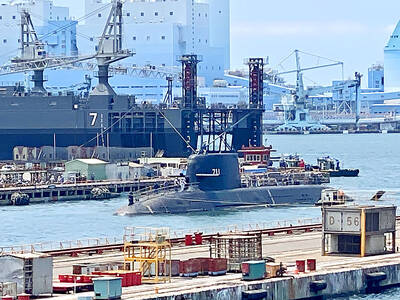
AGING: While Japan has 22 submarines, Taiwan only operates four, two of which were commissioned by the US in 1945 and 1946, and transferred to Taiwan in 1973 Taiwan would need at least 12 submarines to reach modern fleet capabilities, CSBC Corp, Taiwan chairman Chen Cheng-hung (陳政宏) said in an interview broadcast on Friday, citing a US assessment. CSBC is testing the nation’s first indigenous defense submarine, the Hai Kun (海鯤, Narwhal), which is scheduled to be delivered to the navy next month or in July. The Hai Kun has completed torpedo-firing tests and is scheduled to undergo overnight sea trials, Chen said on an SET TV military affairs program. Taiwan would require at least 12 submarines to establish a modern submarine force after assessing the nation’s operational environment and defense

A white king snake that frightened passengers and caused a stir on a Taipei MRT train on Friday evening has been claimed by its owner, who would be fined, Taipei Rapid Transit Corp (TRTC) said yesterday. A person on Threads posted that he thought he was lucky to find an empty row of seats on Friday after boarding a train on the Bannan (Blue) Line, only to spot a white snake with black stripes after sitting down. Startled, he jumped up, he wrote, describing the encounter as “terrifying.” “Taipei’s rat control plan: Release snakes on the metro,” one person wrote in reply, referring
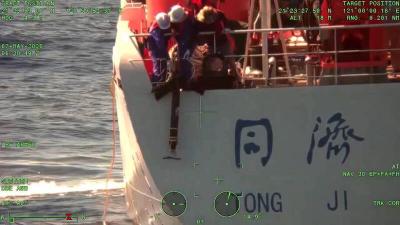
The coast guard today said that it had disrupted "illegal" operations by a Chinese research ship in waters close to the nation and driven it away, part of what Taipei sees a provocative pattern of China's stepped up maritime activities. The coast guard said that it on Thursday last week detected the Chinese ship Tongji (同濟號), which was commissioned only last year, 29 nautical miles (54km) southeast of the southern tip of Taiwan, although just outside restricted waters. The ship was observed lowering ropes into the water, suspected to be the deployment of scientific instruments for "illegal" survey operations, and the coast
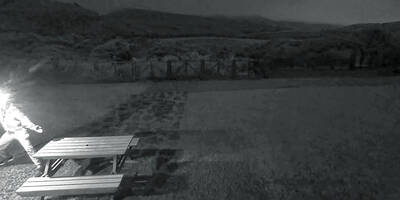
Yangmingshan National Park authorities yesterday urged visitors to respect public spaces and obey the law after a couple was caught on a camera livestream having sex at the park’s Qingtiangang (擎天崗) earlier in the day. The Shilin Police Precinct in Taipei said it has identified a suspect and his vehicle registration number, and would summon him for questioning. The case would be handled in accordance with public indecency charges, it added. The couple entered the park at about 11pm on Thursday and began fooling around by 1am yesterday, the police said, adding that the two were unaware of the park’s all-day live


 RSS
RSS