


Former Academia Sinica president Lee Yuan-tseh (李遠哲) yesterday added his voice to criticism of President Ma Ying-jeou’s (馬英九) actions against Legislative Yuan Speaker Wan Jin-pyng (王金平), saying it was disappointing to see Ma’s features “constantly distorted by hate.”
On Aug. 30 Special Investigation Division (SID) Prosecutor-General Huang Shih-ming (黃世銘) informed Ma of alleged influence peddling involving Wang, Democratic Progressive Party (DPP) caucus convener Ker Chien-ming (柯建銘), former minister of justice Tseng Yung-fu (曾勇夫), High Prosecutors’ Office Head Prosecutor Chen Shou-huang (陳守煌) and High Prosecutors’ Office prosecutor Lin Shiow-tao (林秀濤).
Speaking at a seminar organized by Taiwan Brain Trust yesterday, Lee said the judiciary system needed reform.
Ma’s handling of the current crisis was not appropriate, Lee said.
The situation involved two different investigations, one in which Ker was sentenced to six months in prison for breach of trust and violating the Business Accounting Act (商業會計法), and the other where Ker was suspected of having accepted bribes and peddling influence in a 2010 High Court judges’ bribery case.
The Taipei District Court gave the SID, then looking into the bribery case, permission to wiretap Ker in 2010. The case was closed and the wiretap approval rescinded on Sept. 5 when the SID confirmed that Ker had not been involved in the judges’ bribery case.
The Supreme Court handed back the breach of trust case for retrial earlier this year, recommending Ker be found “not guilty,” but during the wiretap period the SID recorded a conversation between Wang and Ker in which Ker said he hoped the prosecutors would not continue litigation, and Wang replied that Tseng would take care of it.
Tseng tendered his resignation on Saturday.
On Monday Ma accused Wang of peddling his influence and said he had brought “shame on Taiwan’s judiciary and democratic history.” Yesterday he added that “Wang was no longer fit to carry on as Legislative Speaker.”
Commenting on Ma’s “uncharacteristically” tough line and active participation in the matter, Lee said, “I hope that our president can maintain his customary smile, and take us to a greater future, instead of wearing a face distorted by hate all the time.”
Lee also said that the Taiwanese public still believed in what Ma can achieve and still had hope, but also added that Ma’s recent record was very disappointing.
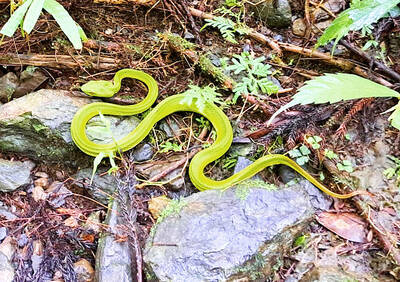
More than half of the bamboo vipers captured in Tainan in the past few years were found in the city’s Sinhua District (新化), while other districts had smaller catches or none at all. Every year, Tainan captures about 6,000 snakes which have made their way into people’s homes. Of the six major venomous snakes in Taiwan, the cobra, the many-banded krait, the brown-spotted pit viper and the bamboo viper are the most frequently captured. The high concentration of bamboo vipers captured in Sinhua District is puzzling. Tainan Agriculture Bureau Forestry and Nature Conservation Division head Chu Chien-ming (朱健明) earlier this week said that the
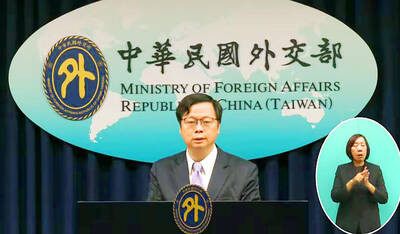
NAMING SPAT: The foreign ministry called on Denmark to propose an acceptable solution to the erroneous nationality used for Taiwanese on residence permits Taiwan has revoked some privileges for Danish diplomatic staff over a Danish permit that lists “Taiwan” as “China,” Eric Huang (黃鈞耀), head of the Ministry of Foreign Affairs’ Department of European Affairs, told a news conference in Taipei yesterday. Reporters asked Huang whether the Danish government had responded to the ministry’s request that it correct the nationality on Danish residence permits of Taiwanese, which has been listed as “China” since 2024. Taiwan’s representative office in Denmark continues to communicate with the Danish government, and the ministry has revoked some privileges previously granted to Danish representatives in Taiwan and would continue to review
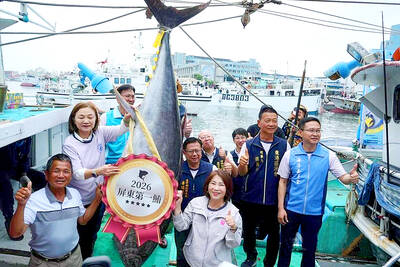
The first bluefin tuna of the season, brought to shore in Pingtung County and weighing 190kg, was yesterday auctioned for NT$10,600 (US$333.5) per kilogram, setting a record high for the local market. The auction was held at the fish market in Donggang Fishing Harbor, where the Siaoliouciou Island-registered fishing vessel Fu Yu Ching No. 2 delivered the “Pingtung First Tuna” it had caught for bidding. Bidding was intense, and the tuna was ultimately jointly purchased by a local restaurant and a local company for NT$10,600 per kilogram — NT$300 ,more than last year — for a total of NT$2.014 million. The 67-year-old skipper
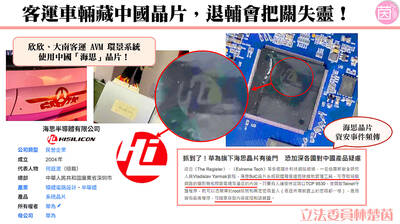
BREACH OF CONTRACT: The bus operators would seek compensation and have demanded that the manufacturer replace the chips with ones that meet regulations Two bus operators found to be using buses with China-made chips are to demand that the original manufacturers replace the systems and provide compensation for breach of contract, the Veterans Affairs Council said yesterday. Democratic Progressive Party Legislator Michelle Lin (林楚茵) yesterday said that Da Nan Bus Co and Shin-Shin Bus Co Ltd have fielded a total of 82 buses that are using Chinese chips. The bus models were made by Tron-E, while the systems provider was CYE Electronics, Lin said. Lin alleged that the buses were using chips manufactured by Huawei subsidiary HiSilicon Co, which presents a national security risk if the


 RSS
RSS