


Netizens have taken to Facebook to take part in an online campaign of “turning themselves in,” venting their anger after remarks by Minister of the Interior Lee Hong-yuan (李鴻源) that the supporters of four Dapu families could face legal action after allegedly damaging government property and violating the Assembly and Parade Act (集會遊行法).
Using Facebook’s new hashtag feature, the campaign, dubbed “Wanted: Tens of thousands to turn themselves in (萬人自首招募中),” has elicited passionate responses not only from people who attended the rally, but also among netizens who are upset with what they regard as the government’s arbitrary policymaking.
The campaign came in the wake of an overnight rally against the forced demolition of houses in Dapu Borough (大埔) in Miaoli County’s Jhunan Township (竹南) staged by the Taiwan Rural Front (TRF) on Sunday last week and Monday.
The protesters rallied in front of the Presidential Office in Taipei before staging an overnight sit-in outside the ministry calling for amendments to the Land Expropriation Act (土地徵收條例).
Lee on Wednesday said the protesters could face legal action for leaving thousands of protest stickers and graffiti on the walls of the ministry’s building, as well as spray painting a mural on the ground outside the entrance.
“I was too pissed off to go to bed after hearing Lee say that he planned to sue the TRF and the protesters, so I posted a message on Facebook to vent my anger,” a 40-year-old woman surnamed Su (蘇) said.
Her post unexpectedly gave rise to the wide-reaching online campaign after a young netizen included it with a hashtag.
The campaign was followed by a nearly identical campaign, called “Needed: Tens of thousands to turn themselves in (#萬人自首募集中).”
Another netizen, who identified herself as Chen Hung-ying (陳虹穎), also launched a similar campaign on Facebook, but removed the words “turn themselves in,” saying they implied that the protesters had committed a crime, whereas they had not broken any laws or engaged in any form of violence during the rally.
Su said she was impressed by the creativity and ingenious ways campaigners added a pinch of humor to serious social events.
“I am also touched by [young people’s] efforts and courage to step forward and make their voices heard, when they could just stay home and sit in front of their computers playing online games,” she added.
Yang Yu-fang (楊宇帆), a young pineapple farmer who wrote a letter to President Ma Ying-jeou (馬英九) in September last year asking him to save the nation’s agricultural industry, also voiced his support for the protesters.
“My body was working at a farmland at an elevation of 3,000m to make a living on Sunday [last week], but my spirit was there with those protesters, throwing pineapples at the government and at the brainless ‘jellyfish,’” Yang said, alluding to a mocking nickname given to Ma by the nation’s netizens, who said the president and the jellyfish have three things in common: “They are brainless, spineless and have venomous tentacles.”


Kenting National Park service technician Yang Jien-fon (楊政峰) won a silver award in World Grand Prix Photography Awards Spring Season for his photograph of two male rat snakes intertwined in combat. Yang’s colleagues at Kenting National Park said he is a master of nature photography who has been held back by his job in civil service. The awards accept entries in all four seasons across six categories: architectural and urban photography, black-and-white and fine art photography, commercial and fashion photography, documentary and people photography, nature and experimental photography, and mobile photography. Awards are ranked according to scores and divided into platinum, gold and
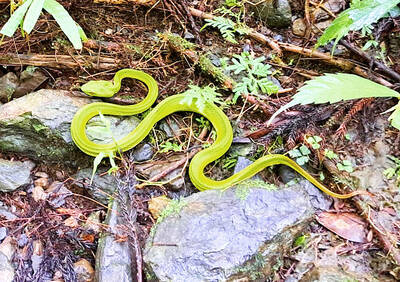
More than half of the bamboo vipers captured in Tainan in the past few years were found in the city’s Sinhua District (新化), while other districts had smaller catches or none at all. Every year, Tainan captures about 6,000 snakes which have made their way into people’s homes. Of the six major venomous snakes in Taiwan, the cobra, the many-banded krait, the brown-spotted pit viper and the bamboo viper are the most frequently captured. The high concentration of bamboo vipers captured in Sinhua District is puzzling. Tainan Agriculture Bureau Forestry and Nature Conservation Division head Chu Chien-ming (朱健明) earlier this week said that the
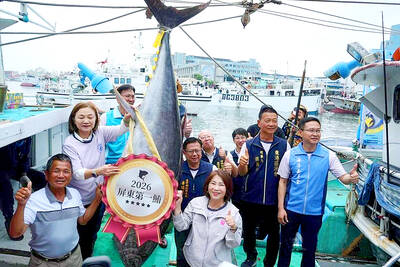
The first bluefin tuna of the season, brought to shore in Pingtung County and weighing 190kg, was yesterday auctioned for NT$10,600 (US$333.5) per kilogram, setting a record high for the local market. The auction was held at the fish market in Donggang Fishing Harbor, where the Siaoliouciou Island-registered fishing vessel Fu Yu Ching No. 2 delivered the “Pingtung First Tuna” it had caught for bidding. Bidding was intense, and the tuna was ultimately jointly purchased by a local restaurant and a local company for NT$10,600 per kilogram — NT$300 ,more than last year — for a total of NT$2.014 million. The 67-year-old skipper
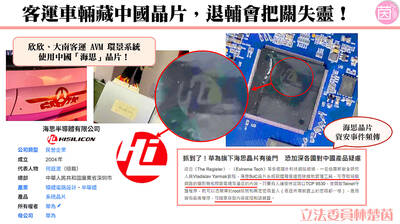
BREACH OF CONTRACT: The bus operators would seek compensation and have demanded that the manufacturer replace the chips with ones that meet regulations Two bus operators found to be using buses with China-made chips are to demand that the original manufacturers replace the systems and provide compensation for breach of contract, the Veterans Affairs Council said yesterday. Democratic Progressive Party Legislator Michelle Lin (林楚茵) yesterday said that Da Nan Bus Co and Shin-Shin Bus Co Ltd have fielded a total of 82 buses that are using Chinese chips. The bus models were made by Tron-E, while the systems provider was CYE Electronics, Lin said. Lin alleged that the buses were using chips manufactured by Huawei subsidiary HiSilicon Co, which presents a national security risk if the


 RSS
RSS