

The Hoklo (commonly known as Taiwanese) version of the theme song from the movie adaptation of Victor Hugo’s Les Miserables used at a rally in Taiwan has infringed on Warner Music Group’s copyright on the song, the company’s music production arm, Warner-Chappell Production Music, said on Thursday.
The song, titled Do you Hear the People Sing?, was adapted into Hoklo by a doctor at Mackay Memorial Hospital in Hsinchu’s department of psychology, Wu Yi-cheng (吳易澄), and musician Wang Hsi-wen (王希文).
It was used during a mass protest on Aug. 3 by about 200,000 people demanding that the military reveal the truth about the death of an army corporal who allegedly died from abuse while doing his military service. The protesters also called for the government to push for better protection of human rights in the military.
Wu said he had tried to ask Warner/Chappell for the rights to use the song, but did not get a reply.
Kang-khioh Tai-gi Bun-kau Ki-kim-hoe Foundation director-general Chen Feng-hui (陳豐惠) said the foundation helped with the Romanization of Wu’s lyrics.
He added that although the foundation had originally posted the sheet music for the song on its Web site earlier this month, it took it down after only one day, but left the music on the site.
After receiving a telephone call from Warner-Chappell on Thursday warning of copyright infringement, the foundation responded by immediately deleting the file from its servers, Chen said.
The foundation added that, after receiving the warning, it would not continue spreading the song.
The foundation received the legal notice on Friday, Chen said, adding that the foundation and its lawyers would decide on how to respond to the notice.
According to Warner-Chappell’s lawyer in Taiwan, Hsu Tse-yu (徐則鈺), his company was only handing the notification to the foundation on behalf of Alain Boublil Music Ltd, the original publisher of the song in 1980.
Commenting on the issue, a spokesman for Citizen 1985, surnamed Liu (柳), said that Warner-Chappell’s warning was directed at Wu and Wang, and should have nothing to do with Citizen 1985.
Liu added that the group had paid Warner-Chappell for the rights to use the song on Aug. 3, adding that the group had legally been allowed and entitled to play the music that day.
Meanwhile, according to the Intellectual Property Office’s copyright division chief Chang Yu-ying (張玉英), the case can be divided into two parts — the changing of the music and publishing it online.
Under Articles 44 through 65 of the Copyright Act (著作權法), the principle was that though modification of music or lyrics must first be consented to by the original copyright owner, if such consent cannot be obtained, then the modification should be judged by the standard of whether it was “usage within reason,” she said.
As far as altering the music was concerned, since the music was used on the day of the rally, it could be judged under Article 55 of the act that it was used in the public interest and was within the parameters of “usage within reason.”
As for spreading the music online, the matter had to be judged as to whether it was being used for commercial gain or in an attempt to profit from its distribution, Chang said.
She added that it could also be judged as to whether such distribution has violated the copyright by how the distribution has actually impacted the original copyright owner.
Additional reporting by Rachel Lin, Lin Shih-ping and Chang Yi-ling
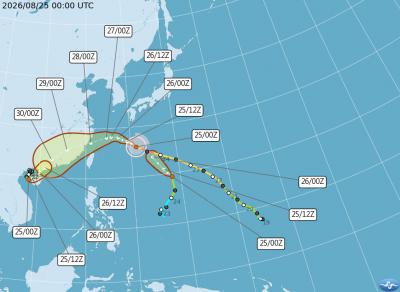
Typhoon Saudel has shown signs of weakening but is still expected to affect Taiwan when it comes closest to the nation on Friday, the Central Weather Administration (CWA) said today. The radius of Saudel shrank to about 220km as of 8am today from 250km a day earlier, and its maximum sustained winds were down to 155kph from 184kph previously, the weather agency said. As of 8am, Typhoon Saudel was 980km east of Taipei, moving west-northwest at 18kph, it said. Under the influence of a Pacific high pressure system, the storm is moving northward, meaning it is less likely to make landfall in Taiwan,

Minister of Sports Lee Yang (李洋) today said the Chinese Taipei Basketball Association (CTBA) has been urged not to undermine Taiwan’s credibility in international competitions, after a Taiwanese team advanced to the semi-finals of the 45th William Jones Cup over the Philippines last week due to a controversial new rule guaranteeing a semi-final place to the host team. The Republic of China Blue team advanced to the semi-finals after winning just one game in the group round due to a “host guarantee” spot, overtaking the Philippines, who held a 5-1 record ahead of the semi-finals. The Blue team finished the tournament
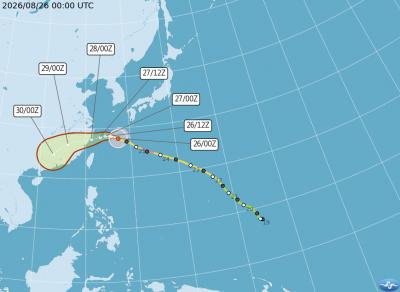
A sea warning for Typhoon Saudel, which has shifted to a more northerly track as it nears Taiwan, is expected early tomorrow, the Central Weather Administration (CWA) said today. As of this morning, Saudel was about 650km east-northeast of Taipei, moving west-northwest at 12kph with maximum sustained winds of 162kph, CWA data showed. Although Saudel remains a moderate typhoon, it has weakened and is expected to weaken further as it nears Taiwan due to unfavorable atmospheric and ocean conditions, CWA forecaster Lin Po-tung (林伯東) said. The storm is forecast to make its closest approach to Taiwan tomorrow and on Friday, Lin added. According to

SEA WARNING EXPECTED: As atmospheric conditions are unfavorable for its development, the storm’s intensity is continuing to weaken, a CWA official said Typhoon Saudel is continuing to weaken and shift its path northward, with a sea warning expected to be issued this evening, the Central Weather Administration (CWA) said yesterday. The agency did not rule out issuing a land warning for outlying Lienchiang County (Matsu) tomorrow morning, although all storm warnings could be lifted by Friday night. Saudel is expected to be closest to Taiwan from tomorrow night to Friday, bringing localized heavy rain to northern and southern Taiwan, as well as central mountainous areas, the agency said. As of 2pm yesterday, the center of moderate Typhoon Saudel was about 890km east-northeast


 RSS
RSS