


On Father’s Day yesterday, several male environmental group members, academics, directors, artists and writers announced the creation of the Anti-Nuclear Fathers Front to urge all fathers to take action to provide an environment safe from nuclear disasters for their children.
The front is to be headed by Taiwan Environmental Protection Union (TEPU) founding chairman Shih Hsin-min (施信民), former Academia Sinica president Lee Yuan-tseh (李遠哲), directors Yang Ya-che (楊雅吉吉), Wei Te-sheng (魏德聖) and Ma Chih-hsiang (馬志翔), and writers Giddens Ko (柯景騰) — also known as Jiu Ba-dao (九把刀) — Hsiao Yeh (小野) and Kevin Tsai (蔡康永).
Following the example of a group of mothers who established the Mom Loves Taiwan association to monitor the safety of the Fourth Nuclear Power Plant in New Taipei City’s (新北市) Gongliao District (貢寮), earlier this year, the group of fathers and men who want to have children, said they want to encourage fathers to also stand out and promise their children a better homeland free of nuclear power.
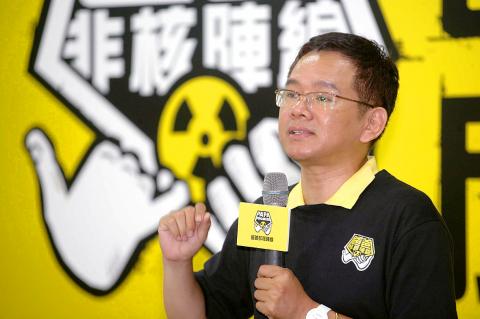
Photo: CNA
“Safe nuclear power is a myth,” said Nuclear-Free Homeland Alliance executive director Lee Cho-han (李卓翰), who is to be the convener of the front.
This is particularly true in Taiwan, as it sits on a belt of seismic activity and does not have an adequate capacity to develop nuclear power or weather a nuclear disaster, he said.
Moreover, the Fourth Nuclear Power Plant has been issued a correction by the Control Yuan for malpractice and corruption, and it is not even built yet, Lee Cho-han said.
The Gongliao plant is not in an environmentally appropriate place and has poor construction quality, so the government needs to abort it, or else the nation’s parents will stop the project by voting in the planned referendum to decide the plant’s fate, he added.
Giddens Ko’s father, Ko Yu-bin (柯毓彬), brought his grandchildren to the group’s launch, where he said that the Fourth Nuclear Power Plant is like a malignant tumor growing on Taiwan’s beautiful land that had to be removed to provide a good environment for children.
Also at the launc was The Chairman (董事長樂團) band member Lin Da-chun (林大鈞), who said: “I used to live freely, enjoying the freedom of living in the moment, but now that I have my own children, I am responsible for considering what the environment will be like in the future, for their sake.”
“The government should see the public as their children who they have to protect, rather than gambling with people’s lives and property,” Lin said. “The people will take this issue to heart and act on it, so the government should just abolish the plant now.”
“Fathers have a responsibility to take care of their family, so we hope this duty and promise can be applied to the fight against nuclear power,” Lee Cho-chan added.
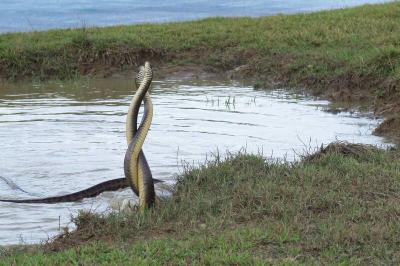
Kenting National Park service technician Yang Jien-fon (楊政峰) won a silver award in World Grand Prix Photography Awards Spring Season for his photograph of two male rat snakes intertwined in combat. Yang’s colleagues at Kenting National Park said he is a master of nature photography who has been held back by his job in civil service. The awards accept entries in all four seasons across six categories: architectural and urban photography, black-and-white and fine art photography, commercial and fashion photography, documentary and people photography, nature and experimental photography, and mobile photography. Awards are ranked according to scores and divided into platinum, gold and

The Chinese Nationalist Party (KMT) caucus yesterday said it opposes the introduction of migrant workers from India until a mechanism is in place to prevent workers from absconding. Minister of Labor Hung Sun-han (洪申翰) on Thursday told the Legislative Yuan that the first group of migrant workers from India could be introduced as early as this year, as part of a government program. The caucus’ opposition to the policy is based on the assessment that “the risk is too high,” KMT caucus secretary-general Lin Pei-hsiang (林沛祥) said. Taiwan has a serious and long-standing problem of migrant workers absconding from their contracts, indicating that
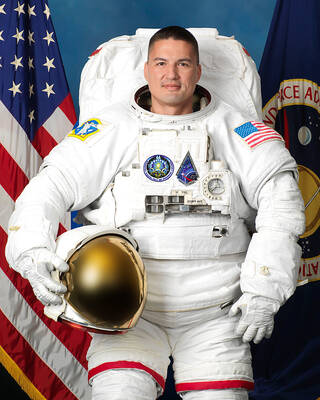
SPACE VETERAN: Kjell N. Lindgren, who helps lead NASA’s human spaceflight missions, has been on two expeditions on the ISS and has spent 311 days in space Taiwan-born US astronaut Kjell N. Lindgren is to visit Taiwan to promote technological partnerships through one of the programs organized by the US for its 250th national anniversary. Lindgren would be in Taiwan from Tuesday to Saturday next week as part of the US Bureau of Educational and Cultural Affairs’ US Speaker Program, organized to celebrate the 250th anniversary of the signing of the Declaration of Independence, the American Institute in Taiwan (AIT) said in a statement yesterday. Lindgren plans to engage with key leaders across the nation “to advance cutting-edge technological partnerships and inspire the next generation of scientists and engineers,”

TRADE-OFF: Beijing seeks to trade a bowl of tempura for a Chinese delicacy, an official said, while another said its promises were attempts to interfere in the polls The government must carefully consider the national security implications of building a bridge connecting Kinmen County and Xiamen, China, the Public Construction Commission (PCC) said yesterday. PCC Commissioner Derek Chen (陳金德), who is also a minister without portfolio, made the remarks in a meeting of the legislature’s Transportation Committee, after Democratic Progressive Party Legislator Hsu Fu-kuei (徐富癸) asked about China’s proposal of new infrastructure projects to further connect Kinmen and Lienchiang (Matsu) counties with Xiamen. China unveiled the bridge plan, along with nine other policies for Taiwan, on Sunday, the last day of Chinese Nationalist Party (KMT) Chairwoman Cheng Li-wun’s (鄭麗文) visit


 RSS
RSS