

A 17-year-old male was diagnosed with Japanese encephalitis (JE) earlier this month, making it the nation’s second confirmed case of the viral disease this year, the Centers for Disease Control (CDC) said yesterday.
The teen exhibited symptoms, including fever, headaches and vomiting on May 31, and later experienced reduced consciousness and a stiff neck, the agency said, adding that his illness was confirmed to be Japanese encephalitis after he was hospitalized on June 1.
The young man has recovered and the three people living with him have not developed any suspicious symptoms, the CDC said.
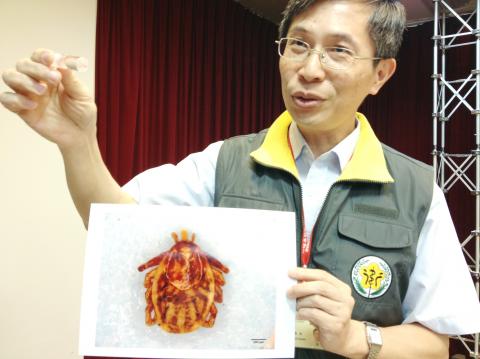
Photo: Chiu I-chun, Taipei Times
“The patient was exposed to risk factors by living close to pig farms and paddy fields, as pigs act as amplifiers of the virus, infecting mosquitoes that take blood from them while remaining healthy, and wading birds carry the virus,” CDC physician Philip Yi-chun Lo (羅一鈞) said.
According to the CDC’s disease surveillance data, the transmission season of the virus ranges from May to October and reach its peak in June and July.
A mass vaccination program that started in 1968 has significantly reduced the number of infections, leaving about 20 to 30 cases with zero to two deaths a year in recent years, which is a big improvement from the 273 cases of infection and 206 deaths a year before the vaccination program, the CDC said.
“The 17-year-old patient actually completed the four-dose JE vaccine in 2003,” Lo said, adding that “the vaccine was not 100 percent effective.”
“Still, since most of those who were immunized are protected from the virus, it is still highly recommended that people be vaccinated,” Lo said.
In other news, the CDC said a second case of a human hard-bodied tick bite from Dermacentor taiwanesis has been reported, adding that the first case in recorded history was only confirmed two years ago.
A woman and her daughter from New Taipei City’s (新北市) Shuangsi District (雙溪) found small bug bites along the hairlines and on the insides of their arms and thighs early last month, the agency said.
“The bite marks grew bigger and became itchy and red, and the woman found a bug moving at the site of a bite. She used tweezers to pull the bug out and sought medical attention in early June,” CDC researcher Wang Hsi-chieh (王錫杰) said.
“The size of the bug brought to health authorities by the woman was about 0.14cm. The CDC has preliminarily confirmed the bug to be a nymph tick of Dermacentor taiwanesis, at the third stage of the tick’s four-stage life cycle,” he said.
This species of hard ticks mainly live in forests, which correspond with the woman’s living environment, Wang said.
Adult ticks mainly feed on large animals such as wild boars and Formosan black bears, while rodents or other small mammals are the common feeding hosts of nymph ticks, Wang said.
The agency said the blood sample from the woman has tested negative for Lyme disease, which can be caused by tick bites and can leave the infected with chronic neurological problems if untreated. It said it would conduct further tests to see whether the tick is pathogenic.

The donation of offshore patrol vessel Kinmen to the Philippines includes provisions that protect Taiwanese fishers and facilitate security cooperation across the First Island Chain, officials said yesterday. The comment was made during the Cabinet’s comprehensive administrative report at the legislature after Chinese Nationalist Party (KMT) Legislator Hsu Yu-chen (許宇甄) expressed concerns about the decision to give a ship to a country whose coast guard had in 2013 fired on a Taiwanese trawler and killed its captain without provocation. The Cabinet should lay out the safeguards that have been established to prevent the Philippine government from using the Kinmen to harass, expel

GROWING TIES: The CGA is planning a goodwill mission to the Philippines, in what would be the first time since 1975 a Taiwanese paramilitary vessel has visited the country The Coast Guard Administration (CGA) plans to significantly expand its participation in international security cooperative frameworks and its operational capabilities, a budget proposal for next year showed. The budget indicates a transformation of the CGA from a maritime law enforcement arm into a national defense and intelligence gathering entity capable of tackling larger regional security matters. The proposal showed that personnel from the coast guard’s Intelligence Division and Special Action Support Center are to participate in high-level national security talks with the US. As the CGA has dealt with China’s rising “gray zone” threats around Taiwan, it has become a valuable asset to

‘FRIENDSHIP FLEET’: A CGA official is scheduled to meet with the president of the Pacific nation, while one of the ships is to host a banquet and National Day event Two Coast Guard Administration (CGA) patrol vessels have docked at Malakal Harbor in Palau as part of an expedition exercise and diplomatic visit, during which a senior official is expected to meet with Palauan President Surangel Whipps Jr, the agency said yesterday. The two vessels, the 4,000-tonne-class Chiayi and the 1,000-tonne-class Penghu, set sail for Palau from Taiwan last week and arrived on Tuesday at Malakal Harbor, the CGA’s Fleet Branch said in a statement. The journey marks the second time the CGA has dispatched a “friendship fleet” to another country, after it sent its first-ever goodwill fleet, comprising the Hualien and
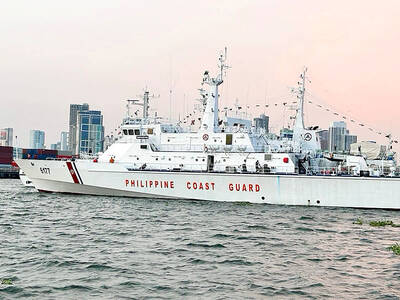
A patrol vessel donated by the Coast Guard Administration (CGA) to the Philippines was commissioned into the Philippine Coast Guard (PCG) on Friday, a Philippine non-governmental organization said. The CGA on Sept. 16 confirmed media reports that Taiwan had donated a retired 500-tonne patrol vessel to the Philippines. The Manila-based We Protect Our Seas (WPS) foundation, which served as an intermediary in the transfer, said that the vessel was formerly the CGA’s 500-tonne petrol vessel Kinmen (CG123). The WPS, in a statement issued on Friday, said the vessel, renamed as the BRP Sarangani, had been commissioned into the PCG the


 RSS
RSS