


President Ma Ying-jeou’s (馬英九) recent elaborations on the issue of Taiwan’s statehood, given the complex nature of the legal status of the Republic of China (ROC), was likely “international legal suicide” and a deception of the people of Taiwan, academics said in a forum last week.
Ma appears to have been self-conflicting and inconsistent in his interpretation of the cross-strait framework, Brad Roth, a professor of political science and law at Wayne State University in Michigan, told a forum organized by Taiwan Thinktank.
The president said that the relationship between Taiwan and China “is not one between states, but a special relationship for which the model of recognition under conventional international law is not applicable,” but sought to promote his initiative of “mutual non-recognition of sovereignty and mutual non-denial of authority to govern” under the “one China” framework.
“However, if cross-strait relations are not subject to international law, they could only be internal affairs of the People’s Republic of China’s [PRC],” Roth said.
He added that the Taipei government might be recognized either as representing an undivided China or as representing Taiwan, but there is no third option.
According to Roth, the PRC’s interpretation of “one China” is that Taiwan lacks any international legal protection, and that threats and use of force across the Taiwan Strait represents matters “essentially within the domestic jurisdiction.”
While Ma’s policies has relaxed bilateral tensions, his insistence on the “one China” framework could come at a price — a signal to the international community that Taiwan is no longer in need of its protection against potential PRC predation, he said.
“To return to the idea that Taipei is a contestant government of an undivided China is to commit a kind of international legal suicide,” he said.
Bold moves, such as constitutional reforms that overtly assert Taiwan independence, are not likely to affect the determinants of Taiwan’s legal status, Roth said, adding that it would better suit Taiwan to build on international legal consciousness of its non-subjugation to the PRC.
On Taiwan’s normalization as a state, academics debated on Australian academic James Crawford’s opinion that Taiwan is not a state because it “still has not unequivocally assert its separation from China and is not recognized as a state distinct from China.”
Taiwan New Century Foundation chairman Chen Lung-chu (陳隆志) said he aligned himself with the declaratory theory on the creation of states and added that Taiwan could be an exception because it had evolved through the years.
It was what Chen called an evolution theory, which explained how Taiwan had transformed itself from the Martial Law era to the present as a sovereign and democratic, yet “abnormal” country.
The people of Taiwan’s collective effort as a nation has been a compelling case and a strong testimony to the international community, he said, adding that the bid for UN membership under the name Taiwan in 2007 was a formal declaration of self-determination, a universal right protected by the UN Charter.
Former deputy foreign minister Michael Kau (高英茂) said there are legal and political aspects to Taiwan’s status and statehood, but he felt that eventually political intervention would be needed to settle the matter, citing the cases of Bosnia, Kosovo and East Timor.
Taiwan’s independence or its normalization as a country is pure political aspiration, which has presented a dilemma while Taiwan has been very careful about not crossing China’s “red line,” Kau said.
The irony is that China is so powerful that the international community might be hesitant to offer Taiwan any support, he said.
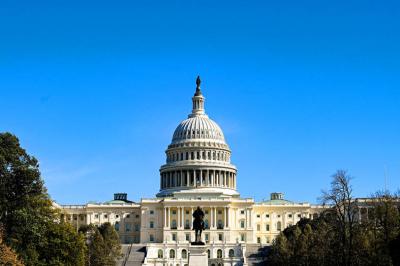
The US House of Representatives yesterday passed the PROTECT Taiwan Act, which stipulates that Washington would exclude China from participating in major global financial organizations if its actions directly threaten Taiwan’s security. The bill, proposed by Republican US Representative Frank Lucas, passed with 395 votes in favor and two against. It stipulates that if China’s actions pose any threat to Taiwan’s security, economic or social systems, the US would, “to the maximum extent practicable,” exclude China from international financial institutions, including the G20, the Bank for International Settlements and the Financial Stability Board. The bill makes it clear that China

Taiwan’s Li Yu-hsiang performs in the men’s singles figure skating short program at the Milano-Cortina Winter Olympics, in Milan, Italy, on Tuesday. Li finished 24th with a score of 72.41 to advance to Saturday’s free skate portion of the event. He is the first Taiwanese to qualify for the free skate of men’s singles figure skating at the Olympics since David Liu in 1992.
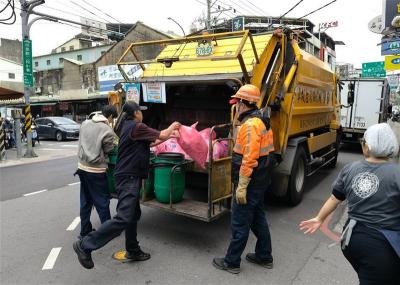
Garbage and recycling schedules are to vary from Saturday through Sunday next week over the Lunar New Year holiday period. The following collection information is from the governments of the six special municipalities. Taipei Regular service: Sunday to Monday next week. No service: Tuesday to Thursday next week. Extra service: Friday next week. Regular service resumes: Saturday next week. New Taipei City Extra service: Sunday. Adjusted collection time: Monday next week — garbage collection is to begin in the morning and end at 6pm. No service: Tuesday to Thursday next week. Regular service resumes: Friday next week. Note: Garbage can be dropped off at 70
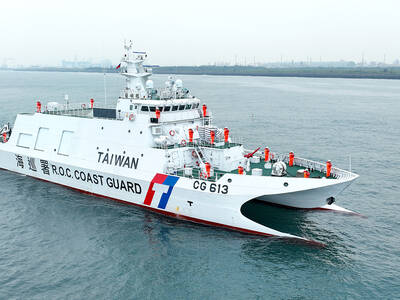
The Coast Guard Administration (CGA) yesterday held a ceremony marking the delivery of its 11th Anping-class offshore patrol vessel Lanyu (蘭嶼艦), saying it would boost Taiwan’s ability to respond to Beijing’s “gray zone” tactics. Ocean Affairs Council Deputy Minister Chang Chung-Lung (張忠龍) presided over the CGA event in the Port of Kaoshiung. Representatives of the National Security Council also attended the event. Designed for long-range and protracted patrol operations at sea, the Lanyu is a 65.4m-long and 14.8m-wide ship with a top speed of 44 knots (81.5kph) and a cruising range of 2,000 nautical miles (3704km). The vessel is equipped with a


 RSS
RSS