


The abrupt transfer of former president Chen Shui-bian (陳水扁) from a hospital in Taipei to a prison hospital in Greater Taichung disrupted the legislative session yesterday, with Democratic Progressive Party (DPP) and Taiwan Solidarity Union (TSU) lawmakers occupying the floor to boycott the meeting.
Chinese Nationalist Party (KMT) lawmakers had planned to request a vote in an attempt to push through the government-backed proposal to stage a national referendum on the fate of the controversial Fourth Nuclear Power Plant in New Taipei City’s (新北市) Gongliao District (貢寮) at the session.
The DPP planned to propose an immediate halt to the construction of the plant, a motion the TSU and the People First Party supported.
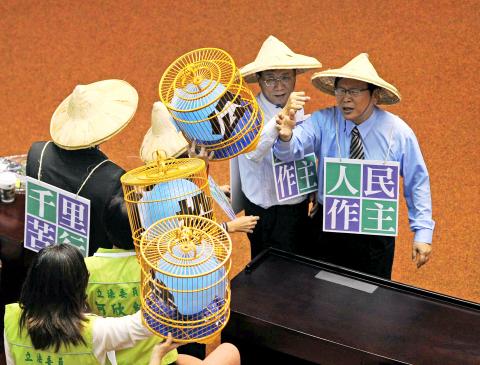
Photo: CNA
At 3pm, Legislative Speaker Wang Jin-pyng (王金平) announced that the session was adjourned until Tuesday next week.
Lawmakers engaged in a fierce exchange of words over the relocation of Chen Shui-bian and several KMT lawmakers’ mockery of former DPP chairman Lin I-hsiung (林義雄), who previously led several round-the-island walks campaigning for a referendum on the nuclear plant.
With douli, or bamboo hats, on their heads and placards bearing slogans used in Lin’s campaign meant to resemble the clothing of Lin and his followers in the campaign, KMT lawmakers Wu Yu-jen (吳育仁), Yen Kuan-hen (顏寬恒), and six others took a short walk on the floor.
KMT Legislator Alex Tsai (蔡正元), in the same costume, sat on the ground, mimicking Lin, who staged various sit-in demonstrations in front of the front gate of the legislature to push for the enactment of a referendum act.
While they were performing the imitation, some DPP lawmakers became irritated, with some shouting words such as “shameless” and “nasty.”
DPP lawmakers placed several placards in bird cages with the name of the Referendum Act (公民投票法) in Chinese characters to highlight the flaws in the legislation, one of which was the required turnout of at least half of the electorate for a national referendum to be considered valid.
“The KMT should offer Lin I-hsiung an apology. When the bird-caged Referendum Act was passed, he launched a campaign demanding the KMT make revisions to the law. Now the KMT ridicules him in such a disrespectful manner. It’s disgraceful,” DPP Legislator Tuan Yi-kang (段宜康) said.
KMT legislative caucus whip Lai Shyh-bao (賴士葆) was trying to remind the DPP not to forget the spirit and ideals advocated by Lin.
Not long after Premier Jiang Yi-huah (江宜樺) proposed the referendum, Lin has voiced opposition to the plan, which he called a “prank.”
Lin said that the referendum proposal was “full of political calculations,” and “a cheap trick and a prank that plays the public for fools.”
The Referendum Act laid down “unreasonable and strict” regulations that made the passage of referendums “almost impossible,” Lin said.

Taipei and Kaohsiung have extended an open invitation to Japanese pop star Ayumi Hamasaki after Chinese authorities abruptly canceled her scheduled concert in Shanghai. Hamasaki, 47, had been slated to perform on Saturday before organizers pulled the show at the last minute, citing “force majeure,” a move widely viewed as retaliation for Japanese Prime Minister Sanae Takaichi’s recent remark that a Chinese attack on Taiwan could draw a military response from Tokyo. Taipei Mayor Chiang Wan-an (蔣萬安) yesterday said the city “very much welcomes” Hamasaki’s return and would continue to “surprise” her. Hamasaki, who has a large global fan base, including
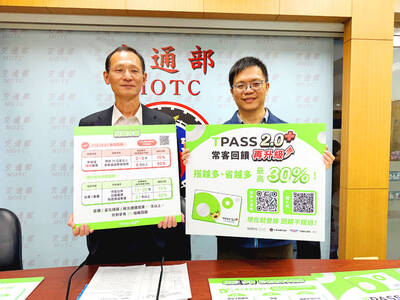
Starting next month, people who signed up for the TPass 2.0 program can receive a 15 percent rebate for trips on mid to long-distance freeway buses or on buses headed to the east coast twice every month, the Highway Bureau said. Bureau Director-General Lin Fu-shan (林福山) said the government started TPass 2.0 to offer rebates to frequent riders of public transportation, or people who use city buses, highway buses, trains or MRTs at least 11 times per month. As of Nov. 12, 265,000 people have registered for TPass 2.0, and about 16.56 million trips between February and September qualified for
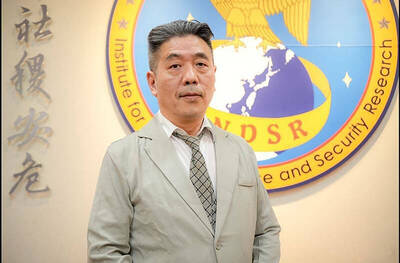
The year 2027 is regarded as the year China would likely gain the capability to invade Taiwan, not the year it would launch an invasion, Taiwanese defense experts said yesterday. The experts made the remarks after President William Lai (賴清德) told a news conference on Wednesday that his administration would introduce a NT$1.25 trillion (US$39.8 billion) special defense budget bill to boost Taiwan’s overall defense posture over the next eight years. Lai said that Beijing aims for military unification of Taiwan by 2027. The Presidential Office later clarified that what Lai meant was that China’s goal is to “prepare for military unification
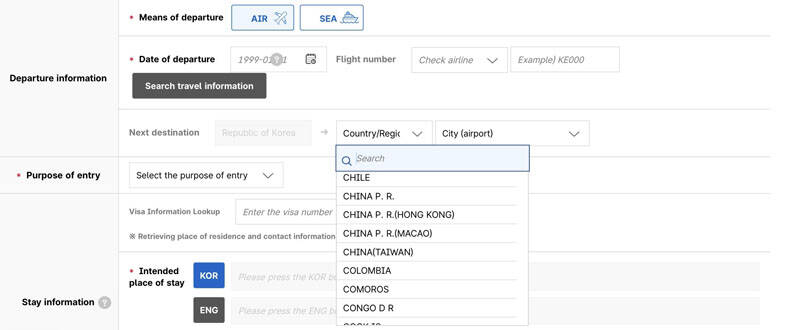
‘REGRETTABLE’: Travelers reported that Seoul’s online arrival card system lists Taiwan as ‘China (Taiwan),’ the Ministry of Foreign Affairs said The Ministry of Foreign Affairs yesterday urged South Korea to correct the way Taiwan is listed in its newly launched e-Arrival card system, saying the current designation downgrades the nation’s status. South Korea rolled out the online system on Feb. 24 to gradually replace paper arrival cards, which it plans to phase out by next year. Travelers must complete the electronic form up to 72 hours before entering the country. The ministry said it has received multiple complaints from Taiwanese travelers saying that the system lists Taiwan as “China (Taiwan)” in dropdown menus for both “place of departure” and “next


 RSS
RSS