


The public should beware of venomous snakes during tomb-sweeping or other outdoor activities, because spring has arrived and snakes are coming out of hibernation, the Centers for Disease Control (CDC) said yesterday.
There are 16 species of poisonous snakes in the nation, six of which are capable of severely wounding or even killing humans, said Jean-Jay Mao (毛俊傑), an assistant professor in the Department of Forestry and Natural Resources at National Ilan University.
“The six dangerous snakes are the Taiwanese krait, the Taiwan cobra, the Siamese Russell’s viper, the Taiwan habus, or pointed-scale pit viper, the Taiwan bamboo viper, and the hundred pacer, or Chinese moccasin,” Mao said.
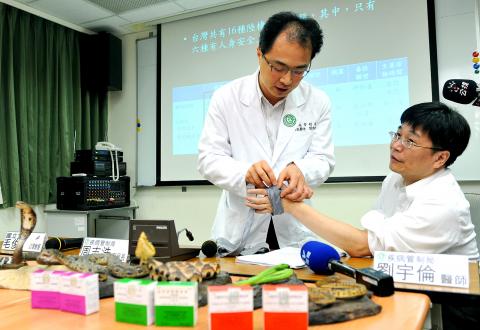
Photo: Chien Jung-fong, Taipei Times
“The venom of the first two contains hemorrhagic toxins, the venom of the last three contains neurotoxins and the Russell’s vipers’ venom contains both types of toxins,” he added.
People who plan to go to mountainous areas should wear long-sleeved shirts, pants and boots for protection against snake bites, he said.
“Carrying a stick to probe an area before stepping into it is necessary and effective. People should also avoid putting their hands or feet into crevasses, holes or bushes without caution, and should carry a torch if they venture into places with little light,” Mao said.
Liu Yu-lun (劉宇倫), a disease prevention physician working at the CDC, offered instructions on the steps to follow if bitten by a snake.
“The first thing is to stay calm and try to remember the distinguishing marks of the snake, such as its shape, color and other features,” Liu said.
“Apply an elastic bandage or the like 5cm to 10cm from the bite. Keep the affected limb lower than the heart. Take off all metallic products from the bitten extremity. Do not try to suck the venom out of the snakebite, and take the victim to hospital immediately,” he added.
According to CDC statistics, about 1,000 people in Taiwan fall victim to snakebites every year, mostly by the Taiwan bamboo viper, the Taiwan habus and the Taiwan cobra.
The center said that the mortality rate from snakebites is very low in Taiwan, and with a large amount of antivenom in storage, the rate is expected to be less than 1 percent.

Yangmingshan National Park authorities yesterday urged visitors to respect public spaces and obey the law after a couple was caught on a camera livestream having sex at the park’s Qingtiangang (擎天崗) earlier in the day. The Shilin Police Precinct in Taipei said it has identified a suspect and his vehicle registration number, and would summon him for questioning. The case would be handled in accordance with public indecency charges, it added. The couple entered the park at about 11pm on Thursday and began fooling around by 1am yesterday, the police said, adding that the two were unaware of the park’s all-day live

Fast food chain McDonald's is to raise prices by up to NT$5 on some products at its restaurants across Taiwan, starting on Wednesday next week, the company announced today. The prices of all extra value meals and sharing boxes are to increase by NT$5, while breakfast combos and creamy corn soup would go up by NT$3, the company said in a statement. The price of the main items of those meals, if ordered individually, would remain the same. Meanwhile, the price of a medium-sized lemon iced tea and hot cappuccino would rise by NT$3, extra dipping sauces for chicken nuggets would go up
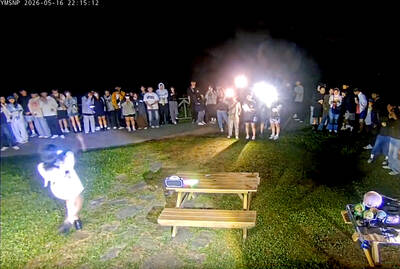
Yangmingshan National Park’s Qingtiangang (擎天崗) nature area has gone viral after a park livestream camera observed a couple in the throes of intimate congress, which was broadcast live on YouTube, drawing large late-night crowds and sparking a backlash over noise, bright lights and disruption to wildlife habitat. The area’s livestream footage appeared to show a couple engaging in sexual activity on a picnic table in the park on Friday last week, with the uncensored footage streamed publicly online. The footage quickly spread across social media, prompting a tide of visitors to travel to the site to “check in” and recreate the

Minister of Digital Affairs Lin Yi-ching (林宜敬) yesterday cited regulatory issues and national security concerns as an expert said that Taiwan is among the few Asian regions without Starlink. Lin made the remarks on Facebook after funP Innovation Group chief executive officer Nathan Chiu (邱繼弘) on Friday said Taiwan and four other countries in Asia — China, North Korea, Afghanistan and Syria — have no access to Starlink. Starlink has become available in 166 countries worldwide, including Ukraine, Malaysia, the Philippines and Vietnam, in the six years since it became commercial, he said. While China and North Korea block Starlink, Syria is not


 RSS
RSS