


Listing nine major problems at the Fourth Nuclear Power Plant, Democratic Progressive Party (DPP) lawmakers said the government should address safety issues before rushing into a referendum on the fate of the plant.
DPP Legislator Lin Chia-lung (林佳龍) said that the party has found at least nine safety flaws at the plant that could result in nuclear accidents if they are not resolved.
Three of the most serious flaws found are: poor welding on more than 50 percent of a reactor’s pressure vessel; the touch panel in the control room reflects light and may be touched off accidentally during emergencies; and a digital control system that integrates 13 separate systems and links more than 40,000 signals into one system.
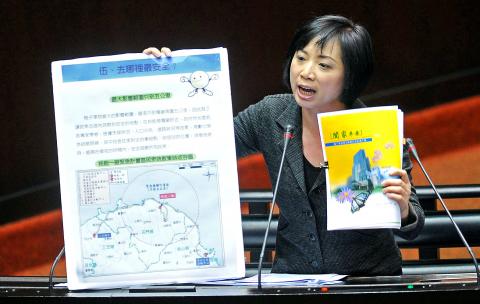
Photo: Liu Hsin-de, Taipei Times
Moreover, the signal lights in the plant’s control room use three colors — purple, blue and white — unlike the easier-to-read red and green lights at Japan’s nuclear plants, Lin said, adding that people tend to act on instinct during emergencies and the three-color signals are too complicated.
The other flaws are: seriously damaged emergency standby generators; temperatures could exceed the dry well’s capacity, causing a radiation leak; more than 1,400 substandard ground wires; walls containing penetration pipes are not thick enough and the aperture does not close properly, which may cause radiation to leak into the nearby water catchment area; and tests of the reactor’s internal pump so far have only reached 10 percent of the required testing time, Lin said.
In addition, the planned emergency evacuation sites are located near the coast, so residents would have nowhere to go in the event of an accident caused by a tsunami.
“Taiwan Power Co [Taipower] knows about the problems and is concealing them, the Atomic Energy Council [AEC] is neglecting its duty [to monitor nuclear safety] because it has identified some of the flaws and even asked [Taipower] to make improvements, but it did not enforce them,” he said.
DPP Legislator Gao Jyh-peng (高志鵬) said the party would ask officials from the Ministry of Economic Affairs, AEC and Taipower to report on the problems to the legislative committees, form examination groups in the committees to visit the plant and propose freezing Taipower’s promotional budget.
“Based on the principle of a fair battle, we propose freezing [Taipower’s] budget for promoting nuclear power to the public,” he said.
Taipower spokesman Roger Lee (李鴻洲) yesterday said that four of the nine problems cited do not exist and that the other five have been resolved or are being addressed.
A spokesman for the Fourth Nuclear Power Plant in New Taipei City’s (新北市) Gongliao District (貢寮) acknowledged the problem with the touch panels and said local manufacturers have been asked to install screens on them to stop any glare.
The AEC has also instructed Taipower, which operates the nation’s nuclear plants, to implement a number of additional tsunami, flood and earthquake safety measures, the spokesman said.
These include expanding the emergency planning zones around the plant from the current 5km radius to 8km.
Additional reporting by CNA

Considering that most countries issue more than five denominations of banknotes, the central bank has decided to redesign all five denominations, the bank said as it prepares for the first major overhaul of the banknotes in more than 24 years. Central bank Governor Yang Chin-lung (楊金龍) is expected to report to the Legislative Yuan today on the bank’s operations and the redesign’s progress. The bank in a report sent to the legislature ahead of today’s meeting said it had commissioned a survey on the public’s preferences. Survey results showed that NT$100 and NT$1,000 banknotes are the most commonly used, while NT$200 and NT$2,000

The Centers for Disease Control (CDC) yesterday reported the first case of a new COVID-19 subvariant — BA.3.2 — in a 10-year-old Singaporean girl who had a fever upon arrival in Taiwan and tested positive for the disease. The girl left Taiwan on March 20 and the case did not have a direct impact on the local community, it said. The WHO added the BA.3.2 strain to its list of Variants Under Monitoring in December last year, but this was the first imported case of the COVID-19 variant in Taiwan, CDC Deputy Director-General Lin Ming-cheng (林明誠) said. The girl arrived in Taiwan on

ANNUAL EVENT: Two massive Pokemon balloons are to be set up in Daan Park, with an event zone operating from 10am to 6pm This year’s Taipei Floral Picnic is to be held at Daan Park today and tomorrow, featuring an exclusive Pokemon Go event, a themed food market, a coffee rave picnic area and stage performances, the Taipei Department of Information and Tourism said yesterday. Two massive Pokemon balloons are to be set up in the park as attractions, with an exclusive event zone operating from 10am to 6pm, it said. Participants who complete designated tasks on-site would have a chance to receive limited-edition souvenirs, it added. People could also try the newly launched game Pokemon Pokopia in the trial area, the department said. Three PokeStops are

South Korea is planning to revise its controversial electronic arrival card, a step Taiwanese officials said prompted them to hold off on planned retaliatory measures, a South Korean media report said yesterday. A Yonhap News Agency report said that the South Korean Ministry of Foreign Affairs is planning to remove the “previous departure place” and “next destination” fields from its e-arrival card system. The plan, reached after interagency consultations, is under review and aims to simplify entry procedures and align the electronic form with the paper version, a South Korean ministry official said. The fields — which appeared only on the electronic form


 RSS
RSS