


Although head of the Tibetan government-in-exile Lobsang Sangay repeatedly said that his administration would not challenge China’s sovereignty over Tibet amid a rising number of self-immolations by Tibetans, Tibetan Youth Congress (TYC) secretary-general Tenzin Norsang reaffirmed the group’s stance that only independence would be a solution to the issue.
Since 2009, as many as 70 Tibetans have set themselves aflame — one in exile and 69 living on the Tibetan Plateau — to protest against the Chinese occupation of Tibet and calling for independence, religious freedom and the return of the Tibetan spiritual leader the Dalai Lama. The latest of these cases took place on Thursday as the 18th Chinese Communist Party Congress opened in Beijing.
“I would like to say that no matter how mighty you [China] are, you are powerless, you are powerless to stop the Tibetans’ struggle for freedom and you are powerless to stop the self-immolations for the cause of Tibetan independence,” Tenzin Norsang told a news conference in Taipei yesterday.
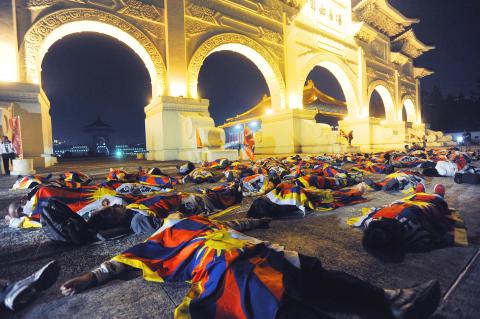
Photo: Wang Yi-sung, Taipei Times
Tenzin Norsang is in Taiwan for a two-day Rangzen Conference in Taiwan organized by the TYC, scheduled to start today.
The Rangzen Conference in Taiwan is being held to prepare for next year’s International Rangzen Conference to commemorate the 100th anniversary of the Declaration of Tibetan Independence by the 13th Dalai Lama in 1913.
Rangzen is the Tibetan word for “independence.”
A short video showing clips of self-immolations, shot with hidden cameras or cellphones, was shown during the press conference.
China has accused the Dalai Lama and exiled Tibetans of being behind the self-immolations, and labeled Tibetans who set themselves alight as “terrorists,” “thieves,” “insane” and “disenchanted spouses,” but Tenzin Norsang denied these accusations.
He said that all the Tibetans who have self-immolated were self-inspired and he holds the Chinese Communist Party responsible for what happens in Tibet.
He added that only independence for Tibet could end such tragedies and the suffering of Tibetans.
Regional Tibetan Youth Congress Taiwan president Tenzin Chompel expressed his worries about seeking peace through talks with China.
“The TYC supports independence for Tibet and we insist that only restoration of Tibet’s independence could protect our freedom,” Tenzin Chompel said.
“Negotiations with China are no use, because negotiations or agreements are China’s means of deception. Just look at what happened to the 17 Point Agreement — we Tibetans would not be fooled by China again,” he added.
The 17 Point Agreement refers to an agreement signed between China and Tibet after China invaded Tibet in the 1950s, in which the Chinese government promised to grant Tibetans a high degree of autonomy, while also protecting the Tibetan religion, language and culture.
Later in the evening, about 70 supporters — Taiwanese and Tibetans alike — of the Tibetan cause lay down in Liberty Square in Taipei, covering themselves with Tibetan national flags to remember those who have self-immolated.
The act was followed by a candlelit vigil and a prayer session for those who have sacrificed themselves for the Tibetan cause.

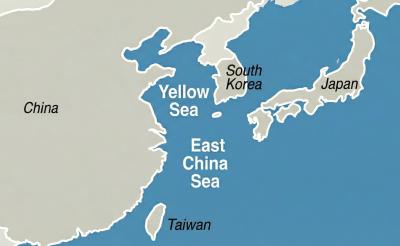
China has reserved offshore airspace in the Yellow Sea and East China Sea from March 27 to May 6, issuing alerts usually used to warn of military exercises, although no such exercises have been announced, the Wall Street Journal (WSJ) reported yesterday. Reserving such a large area for 40 days without explanation is an “unusual step,” as military exercises normally only last a few days, the paper said. These alerts, known as Notice to Air Missions (Notams), “are intended to inform pilots and aviation authorities of temporary airspace hazards or restrictions,” the article said. The airspace reserved in the alert is
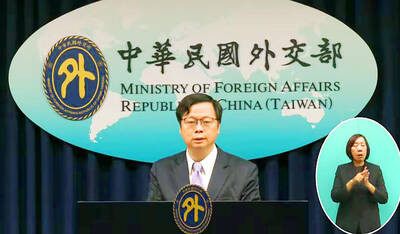
NAMING SPAT: The foreign ministry called on Denmark to propose an acceptable solution to the erroneous nationality used for Taiwanese on residence permits Taiwan has revoked some privileges for Danish diplomatic staff over a Danish permit that lists “Taiwan” as “China,” Eric Huang (黃鈞耀), head of the Ministry of Foreign Affairs’ Department of European Affairs, told a news conference in Taipei yesterday. Reporters asked Huang whether the Danish government had responded to the ministry’s request that it correct the nationality on Danish residence permits of Taiwanese, which has been listed as “China” since 2024. Taiwan’s representative office in Denmark continues to communicate with the Danish government, and the ministry has revoked some privileges previously granted to Danish representatives in Taiwan and would continue to review
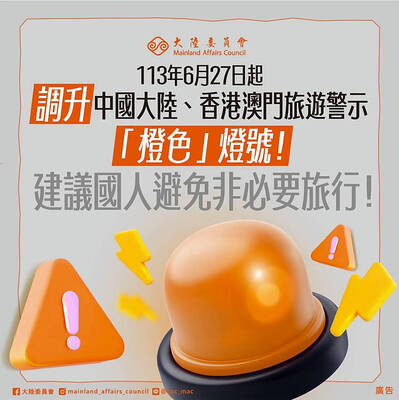
More than 6,000 Taiwanese students have participated in exchange programs in China over the past two years, despite the Mainland Affairs Council’s (MAC) “orange light” travel advisory, government records showed. The MAC’s publicly available registry showed that Taiwanese college and university students who went on exchange programs across the Strait numbered 3,592 and 2,966 people respectively. The National Immigration Agency data revealed that 2,296 and 2,551 Chinese students visited Taiwan for study in the same two years. A review of the Web sites of publicly-run universities and colleges showed that Taiwanese higher education institutions continued to recruit students for Chinese educational programs without

China has reserved offshore airspace over the Yellow Sea and East China Sea from March 27 to May 6, issuing alerts that are usually used to warn of military exercises, although no such exercises have been announced, the Wall Street Journal (WSJ) reported on Sunday. Reserving such a large area for 40 days without explanation is an “unusual step,” as military exercises normally only last a few days, the paper said. The alerts, known as notice to air missions (NOTAMs), “are intended to inform pilots and aviation authorities of temporary airspace hazards or restrictions,” the article said. The airspace reserved in the alert


 RSS
RSS