


Feeling dismayed about the way retired war dogs are treated in the military, a veterinarian has launched a campaign with animal rights advocates to promote the adoption the dogs.
A veterinarian by profession, Kung Chien-chia (龔建嘉), who served in a unit that takes care of war dogs during his compulsory military service, was shocked to see the poor living conditions of the highly trained dogs.
“There are a total of 24 war dogs, including 18 that are still in active service, and six that have reached the age of eight and retired,” Kung said in a blog post. “They live in an old building built more than 40 years ago that is humid and dark inside, and their cages are made of wooden planks, steel wires, and concrete — this is what they call ‘home’ for their entire lives.”
Kung said he was constantly worried that the dog houses would flood during typhoons, that snakes would get into the cages, or that dogs who got sick would not be treated due to lack of funding.
Kung said he then thought of a way to save the dogs, especially the retired ones, and starting working on having them adopted.
He found people who wanted to adopt the dogs and went to his superiors with the adoption plan, but was turned down.
“The worst of it is that the dogs have to stay there their entire lives, even after they retire, because war dogs, like guns or other equipment, are military property and so cannot be taken outside,” Kung said.
Kung’s efforts drew the attention of the Life Conservationist Association (LCA) and Democratic Progressive Party Legislator Hsiao Bi-khim (蕭美琴).
“It’s actually quite shocking for me to learn how the military treats war dogs,” LCA secretariat director Lin Yi-shan (林憶珊) said. “We urge the Ministry of National Defense to increase the budget for war dogs, improve living conditions for ones on active duty and allow retired war dogs to be adopted.”
Lin said the annual budget for the 24 war dogs — including costs for food, medical needs and facility maintenance — is NT$500,000, which is not sufficient.
“As for adoption, I don’t understand why sniffer dogs can be adopted after they retire and war dogs cannot,” Lin said.
Hsiao proposed a resolution in the legislature’s Foreign and National Defense Committee last month asking the ministry to improve living conditions for war dogs and to allow for their adoption.
The motion was unanimously passed and the ministry responded by proposing a plan to repair the dog houses by the end of the year.
However, the ministry said it needs to look further into the issue of adoption before it makes a decision on the matter.
“Government agencies should be extra cautious when it comes to dealing with animals,” Hsiao said. “The ministry should pay more attention to war dogs, even after they retire. They should not run around in military camps like strays.”

Taiwan has received more than US$70 million in royalties as of the end of last year from developing the F-16V jet as countries worldwide purchase or upgrade to this popular model, government and military officials said on Saturday. Taiwan funded the development of the F-16V jet and ended up the sole investor as other countries withdrew from the program. Now the F-16V is increasingly popular and countries must pay Taiwan a percentage in royalties when they purchase new F-16V aircraft or upgrade older F-16 models. The next five years are expected to be the peak for these royalties, with Taiwan potentially earning
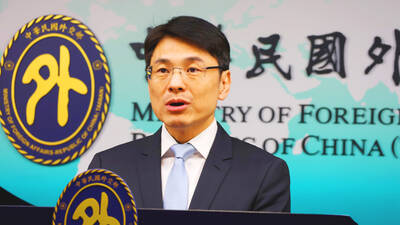
STAY IN YOUR LANE: As the US and Israel attack Iran, the ministry has warned China not to overstep by including Taiwanese citizens in its evacuation orders The Ministry of Foreign Affairs (MOFA) yesterday rebuked a statement by China’s embassy in Israel that it would evacuate Taiwanese holders of Chinese travel documents from Israel amid the latter’s escalating conflict with Iran. Tensions have risen across the Middle East in the wake of US and Israeli airstrikes on Iran beginning Saturday. China subsequently issued an evacuation notice for its citizens. In a news release, the Chinese embassy in Israel said holders of “Taiwan compatriot permits (台胞證)” issued to Taiwanese nationals by Chinese authorities for travel to China — could register for evacuation to Egypt. In Taipei, the ministry yesterday said Taiwan

Taiwan is awaiting official notification from the US regarding the status of the Agreement on Reciprocal Trade (ART) after the US Supreme Court ruled US President Donald Trump's global tariffs unconstitutional. Speaking to reporters before a legislative hearing today, Premier Cho Jung-tai (卓榮泰) said that Taiwan's negotiation team remains focused on ensuring that the bilateral trade deal remains intact despite the legal challenge to Trump's tariff policy. "The US has pledged to notify its trade partners once the subsequent administrative and legal processes are finalized, and that certainly includes Taiwan," Cho said when asked about opposition parties’ doubts that the ART was
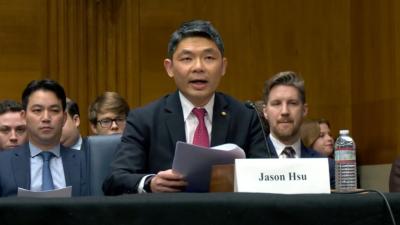
If China chose to invade Taiwan tomorrow, it would only have to sever three undersea fiber-optic cable clusters to cause a data blackout, Jason Hsu (許毓仁), a senior fellow at the Hudson Institute and former Chinese Nationalist Party (KMT) legislator, told a US security panel yesterday. In a Taiwan contingency, cable disruption would be one of the earliest preinvasion actions and the signal that escalation had begun, he said, adding that Taiwan’s current cable repair capabilities are insufficient. The US-China Economic and Security Review Commission (USCC) yesterday held a hearing on US-China Competition Under the Sea, with Hsu speaking on


 RSS
RSS