


Former Democratic Progressive Party (DPP) chairperson Tsai Ing-wen (蔡英文) said yesterday that people should not read too much into the visit to China by former premier Frank Hsieh (謝長廷), nor view it as having considerable political significance.
The focus should be on “mutual understanding through exchanges” and Taiwanese society should use a broad perspective to evaluate Hsieh’s visit while taking it in their stride, Tsai said when asked about Hsieh’s visit.
According to Tsai, given that Hsieh is one of the DPP’s founding members and thus the highest-ranking DPP member to have visited China to date, his journey would inevitably come under public scrutiny.
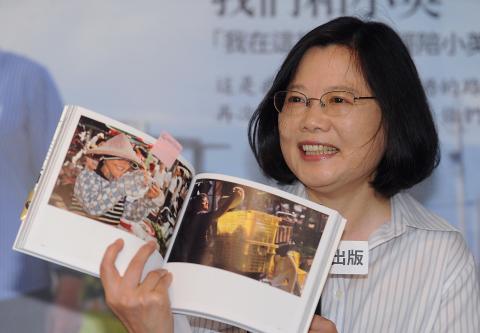
Photo: Liu Hnsi-de, Taipei Times
However, she added, the greatest outcome from Hsieh’s visit was for China to understand that “we can continue interaction with the country.”
The point of the visit is to achieve a mutual understanding with each other through interaction, she added.
The visit is an action in progress, with each meeting and interaction made in the hope that mutual understanding can be boosted, Tsai said, adding that there was no need to read too much into one visit.
When asked if Hsieh’s comment “traveling across the world is only for the courageous; the cowardly find it hard to even take the first step” was a subtle way to urge the party to re-evaulate its China policies, Tsai said that Hsieh most likely did not mean it in such a way.
It took courage for him to take that step forward, of that it is certain, Tsai said, adding that she hoped both the DPP and wider Taiwanese society would not attach too much political meaning to the trip.
Asked if she has any plans to visit China, Tsai said she “has no such plans at present.”
Separately yesterday, former president Lee Teng-hui (李登輝) said anyone can visit China, but the most important thing is to ask why.
“Anyone can go, whether its for business or for socializing, the path is open, but the purpose and the attitude of the trip is the most important issue,” Lee said, adding that while, in terms of Taiwan-China relations, China was not an enemy both sides are still separate entities.
“They are China, we are Taiwan, we’re different, and Taiwan is an independent and sovereign entity,” Lee said.
“We have opened ourselves up too much, so much so that we don’t have a Taiwan — we don’t have any manpower, industry, or technology left. This is inevitable because the person in power does not know how to stand firm in his position and protect his people and how to ‘safely’ invest in China,” he added.
When asked by the media if Hsieh would be subjected to China’s tactics of a “united front” (統戰) during his trip, Lee said that as long as Hsieh stands firm in his own political stance, he would not be influenced.
Additional reporting by Rachel Lin and CNA
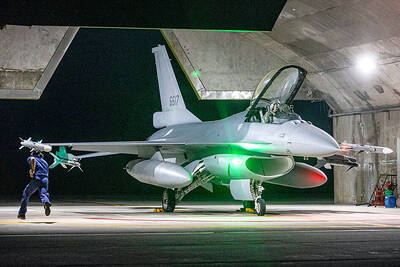
Taiwan has received more than US$70 million in royalties as of the end of last year from developing the F-16V jet as countries worldwide purchase or upgrade to this popular model, government and military officials said on Saturday. Taiwan funded the development of the F-16V jet and ended up the sole investor as other countries withdrew from the program. Now the F-16V is increasingly popular and countries must pay Taiwan a percentage in royalties when they purchase new F-16V aircraft or upgrade older F-16 models. The next five years are expected to be the peak for these royalties, with Taiwan potentially earning
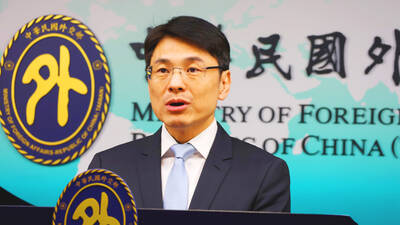
STAY IN YOUR LANE: As the US and Israel attack Iran, the ministry has warned China not to overstep by including Taiwanese citizens in its evacuation orders The Ministry of Foreign Affairs (MOFA) yesterday rebuked a statement by China’s embassy in Israel that it would evacuate Taiwanese holders of Chinese travel documents from Israel amid the latter’s escalating conflict with Iran. Tensions have risen across the Middle East in the wake of US and Israeli airstrikes on Iran beginning Saturday. China subsequently issued an evacuation notice for its citizens. In a news release, the Chinese embassy in Israel said holders of “Taiwan compatriot permits (台胞證)” issued to Taiwanese nationals by Chinese authorities for travel to China — could register for evacuation to Egypt. In Taipei, the ministry yesterday said Taiwan
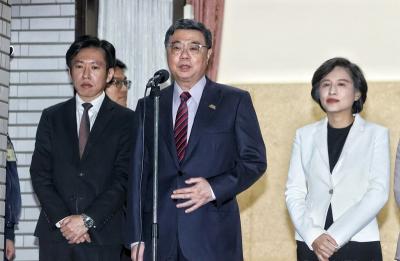
Taiwan is awaiting official notification from the US regarding the status of the Agreement on Reciprocal Trade (ART) after the US Supreme Court ruled US President Donald Trump's global tariffs unconstitutional. Speaking to reporters before a legislative hearing today, Premier Cho Jung-tai (卓榮泰) said that Taiwan's negotiation team remains focused on ensuring that the bilateral trade deal remains intact despite the legal challenge to Trump's tariff policy. "The US has pledged to notify its trade partners once the subsequent administrative and legal processes are finalized, and that certainly includes Taiwan," Cho said when asked about opposition parties’ doubts that the ART was
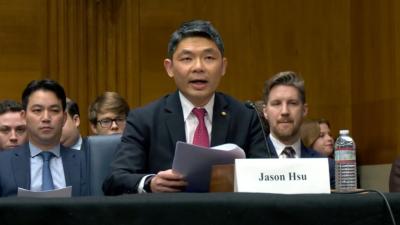
If China chose to invade Taiwan tomorrow, it would only have to sever three undersea fiber-optic cable clusters to cause a data blackout, Jason Hsu (許毓仁), a senior fellow at the Hudson Institute and former Chinese Nationalist Party (KMT) legislator, told a US security panel yesterday. In a Taiwan contingency, cable disruption would be one of the earliest preinvasion actions and the signal that escalation had begun, he said, adding that Taiwan’s current cable repair capabilities are insufficient. The US-China Economic and Security Review Commission (USCC) yesterday held a hearing on US-China Competition Under the Sea, with Hsu speaking on


 RSS
RSS