


The latest reshuffle of top officials in charge of US and China affairs was another example of “inbreeding” in the administration of President Ma Ying-jeou (馬英九), the opposition said yesterday, adding that the inexperienced officials’ ability to handle external relations was questionable.
National Security Council adviser Wang Yu-chi (王郁琦) and former Chinese Nationalist Party (KMT) secretary-general King Pu-tsung (金溥聰) were tapped for the jobs because of their close relationship with Ma, not for their experience and expertise, the Democratic Progressive Party (DPP) and the Taiwan Solidarity Union (TSU) said.
In a partial Cabinet reshuffle announced on Wednesday, Wang will take over as Mainland Affairs Council minister, while King will become Taiwan’s -representative to the US.
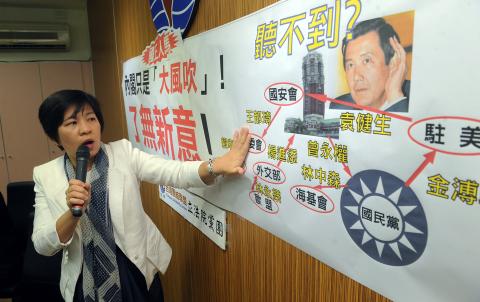
Photo: Lo Pei-der, Taipei Times
“It was definitely surprising,” DPP Policy Research Committee executive director Joseph Wu (吳釗燮) — who held both positions under the former DPP administration — said in response to a media inquiry about the reshuffle.
Wu served as council chairman between 2004 and 2007 and representative to the US between 2007 and 2008.
He said inexperience would be the primary concern for the two in handling Taiwan’s most important external relations.
King is not a professional diplomat, the criteria Ma had set for diplomatic appointments when he was inaugurated in 2008, Wu said, adding that King also lacked the coordination and communication skills that would be crucial in dealing with US government agencies, the US Congress and the overseas Taiwanese community.
Incoming minister of foreign affairs David Lin (林永樂), who replaced Timothy Yang (楊進添), will likely be sandwiched between King and new National Security Council secretary-general Jason Yuan (袁健生), both known for their aggressiveness, Wu said.
The appointment of Wang, along with Lin Join-sane (林中森) as Straits Exchange Foundation chairman, means that Taiwan will face complicated cross-strait affairs and negotiations with a pair of officials who have no previous experience on China, he said.
“They are not familiar with Chinese affairs or the Chinese officials they have to deal with. And vice versa ... It is a huge risk,” Wu said.
Naming his confidants to the positions signaled Ma’s intention to gain “complete control” over cross-strait affairs and foreign relations, DPP caucus whip Ker Chien-ming (柯建銘) said.
“Most of all, it could be the prelude to Ma’s pursuit of a peace agreement with China as part of his presidential legacy, which would be a dangerous move that could jeopardize Taiwan’s sovereignty,” Ker said.
The DPP has launched a campaign calling for a complete reshuffle of the Cabinet to “save Taiwan’s economy,” ahead of tomorrow’s vote of no confidence against the Cabinet in the legislature.
TSU caucus whip Huang Wen-ling (黃文玲) said the appointments once again shows that Ma makes personnel decisions “inside his inner circle” of trusted aides who share his ideology.
The TSU said that Minister of Economic Affairs Shih Yen-hsiang (施顏祥), Council for Economic Planning and Development Minister Yiin Chii-ming (尹啟銘) and Council of Labor Affairs Minister Jennifer Wang (王如玄) should be replaced for their poor performance.

Yangmingshan National Park authorities yesterday urged visitors to respect public spaces and obey the law after a couple was caught on a camera livestream having sex at the park’s Qingtiangang (擎天崗) earlier in the day. The Shilin Police Precinct in Taipei said it has identified a suspect and his vehicle registration number, and would summon him for questioning. The case would be handled in accordance with public indecency charges, it added. The couple entered the park at about 11pm on Thursday and began fooling around by 1am yesterday, the police said, adding that the two were unaware of the park’s all-day live
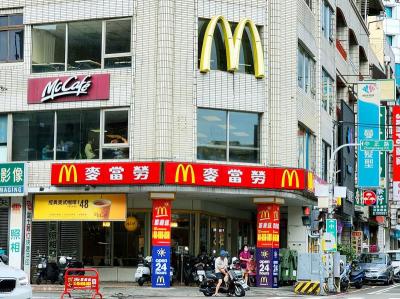
Fast food chain McDonald's is to raise prices by up to NT$5 on some products at its restaurants across Taiwan, starting on Wednesday next week, the company announced today. The prices of all extra value meals and sharing boxes are to increase by NT$5, while breakfast combos and creamy corn soup would go up by NT$3, the company said in a statement. The price of the main items of those meals, if ordered individually, would remain the same. Meanwhile, the price of a medium-sized lemon iced tea and hot cappuccino would rise by NT$3, extra dipping sauces for chicken nuggets would go up

Yangmingshan National Park’s Qingtiangang (擎天崗) nature area has gone viral after a park livestream camera observed a couple in the throes of intimate congress, which was broadcast live on YouTube, drawing large late-night crowds and sparking a backlash over noise, bright lights and disruption to wildlife habitat. The area’s livestream footage appeared to show a couple engaging in sexual activity on a picnic table in the park on Friday last week, with the uncensored footage streamed publicly online. The footage quickly spread across social media, prompting a tide of visitors to travel to the site to “check in” and recreate the

Minister of Digital Affairs Lin Yi-ching (林宜敬) yesterday cited regulatory issues and national security concerns as an expert said that Taiwan is among the few Asian regions without Starlink. Lin made the remarks on Facebook after funP Innovation Group chief executive officer Nathan Chiu (邱繼弘) on Friday said Taiwan and four other countries in Asia — China, North Korea, Afghanistan and Syria — have no access to Starlink. Starlink has become available in 166 countries worldwide, including Ukraine, Malaysia, the Philippines and Vietnam, in the six years since it became commercial, he said. While China and North Korea block Starlink, Syria is not


 RSS
RSS