


The government reiterated that the Diaoyutai Islands (釣魚台) are part of the Republic of China (ROC) and outlined its historical case supporting the claim to counter Japan’s efforts to nationalize the archipelago.
“We hope the Japanese government will clearly see the historical truth and not take any actions that could undermine the peaceful situation in East Asia,” the Executive Yuan said in a statement.
“The Republic of China will not recognize the validity of the so-called purchase deal between the Japanese government and the private owner,” it said.
The Executive Yuan asserted that the ROC’s sovereignty over the island group is an indisputable historical fact.
China mentioned the Diaoyutais as early as 1403 in historical documents and they were listed as part of China in Chinese and foreign maps in the 18th and 19th centuries, the Executive Yuan said.
Historical documents have also shown that Chinese people first found, named and used the land and that they were not uninhabited islets.
The Executive Yuan said the Japanese government has been trying to take over ownership of the Diaoyutais since 1885 and that it secretly ordered an inspection of the island group to set up a “national marker” there.
However, Okinawa Prefecture head Sutezo Nishimura reported that the island group had been named by China and used for many years and he suggested a delay in the project, arguing that it was not appropriate to set up national markers, the Executive Yuan said.
According to the government, the territory is now under the jurisdiction of Yilan County, which registered the Diaoyutais as national land in accordance with the Land Act (土地法) in January 2004 and listed the total area as measuring 612 hectares spanning 61 parcels of land.
According to current land values, posted by the government in January this year, the Diaoyutai Islands are worth NT$190 per square meter, or a total of NT$1.16 billion (US$39.1 million).
The Japanese government’s purchase of three of the Diaoyutai Islands from a private owner on Tuesday has sparked condemnation in Taiwan.
President Ma Ying-jeou (馬英九) traveled on Friday last week to Pengjia Islet (彭佳嶼), located 141km west of the Diaoyutais, to symbolically protest Japan’s move and reassert the ROC’s sovereignty over the archipelago.

Taiwan has received more than US$70 million in royalties as of the end of last year from developing the F-16V jet as countries worldwide purchase or upgrade to this popular model, government and military officials said on Saturday. Taiwan funded the development of the F-16V jet and ended up the sole investor as other countries withdrew from the program. Now the F-16V is increasingly popular and countries must pay Taiwan a percentage in royalties when they purchase new F-16V aircraft or upgrade older F-16 models. The next five years are expected to be the peak for these royalties, with Taiwan potentially earning

STAY IN YOUR LANE: As the US and Israel attack Iran, the ministry has warned China not to overstep by including Taiwanese citizens in its evacuation orders The Ministry of Foreign Affairs (MOFA) yesterday rebuked a statement by China’s embassy in Israel that it would evacuate Taiwanese holders of Chinese travel documents from Israel amid the latter’s escalating conflict with Iran. Tensions have risen across the Middle East in the wake of US and Israeli airstrikes on Iran beginning Saturday. China subsequently issued an evacuation notice for its citizens. In a news release, the Chinese embassy in Israel said holders of “Taiwan compatriot permits (台胞證)” issued to Taiwanese nationals by Chinese authorities for travel to China — could register for evacuation to Egypt. In Taipei, the ministry yesterday said Taiwan
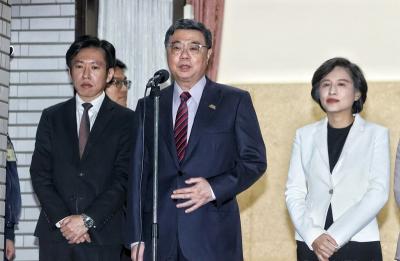
Taiwan is awaiting official notification from the US regarding the status of the Agreement on Reciprocal Trade (ART) after the US Supreme Court ruled US President Donald Trump's global tariffs unconstitutional. Speaking to reporters before a legislative hearing today, Premier Cho Jung-tai (卓榮泰) said that Taiwan's negotiation team remains focused on ensuring that the bilateral trade deal remains intact despite the legal challenge to Trump's tariff policy. "The US has pledged to notify its trade partners once the subsequent administrative and legal processes are finalized, and that certainly includes Taiwan," Cho said when asked about opposition parties’ doubts that the ART was
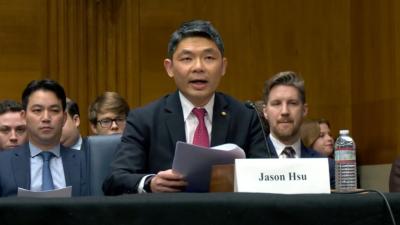
If China chose to invade Taiwan tomorrow, it would only have to sever three undersea fiber-optic cable clusters to cause a data blackout, Jason Hsu (許毓仁), a senior fellow at the Hudson Institute and former Chinese Nationalist Party (KMT) legislator, told a US security panel yesterday. In a Taiwan contingency, cable disruption would be one of the earliest preinvasion actions and the signal that escalation had begun, he said, adding that Taiwan’s current cable repair capabilities are insufficient. The US-China Economic and Security Review Commission (USCC) yesterday held a hearing on US-China Competition Under the Sea, with Hsu speaking on


 RSS
RSS