


Asymmetrical warfare, mobile land-based long-range precision strike capability and multi-functional unmanned aerial vehicles (UAVs) are to make up the principle focus of the military, the Ministry of National Defense (MND) said in its report entitled Modernization of the Military over the Next Five Years.
The report, sent to the legislature last week for approval, sought to define and clarify Taiwan’s development of basic and asymmetrical combat capabilities, as well as the preservation of combat capabilities.
The development of the military’s asymmetrical forces places emphasis on the development of mobile land-based, long-range precision and area-of-effect strike capabilities, building and purchasing multi-functional UAVs as well as attack helicopters capable of littoral and beachhead attack capabilities and the establishment of all-frequency electronic detection, electronic countermeasures and cyberwarfare attack and detection capabilities, the report said.
Asymmetrical warfare is the establishment of a military force not overtly noticeable in peacetime, but capable of hitting enemy forces’ strategic centers hard in times of war and seeks to attack the vulnerabilities of the enemy to destroy or incapacitate their ability to continue to wage war, the report said.
It seeks to create positional advantages over the enemy and make the best use of all military forces by making the enemy reluctant to start a war after considering its potential losses, the report said.
Meanwhile, according to an unnamed ministry official, the mobile long-range strike capability includes the Hsiung Feng IIE missile and other surface-to-surface tactical ballistic missiles.
During the 1996 Taiwan Strait Crisis, the armed forces modified a type of missile so that it would be able to reach coastal cities in China, but because it was an deployed in an emergency situation, the accuracy and reliability of the modified missiles were not ideal, the official said.
After years of research and modification, the missile’s range, precision and reliability have developed to the extent that it has become an “effective countermeasure,” the official said.
However, because of the sensitivity of the issue, the official declined to comment further on the missile’s capabilities.
On the issue of UAVs, the official said the production of UAVs was part of a global trend, pointing out that the Chinese were now developing UAVs with attack capabilities.
The Chinese claim that the “Yilong” UAV they designed is superior to the US Predator, the official said, adding that although the UAVs the Chung-Shan Institute of Science and Technology has designed are based on the Predator, the long-range goal of the design is to manufacture a weapon on a par with the Reaper-class drones.
The institute has already handed over to the army 32 of its self-designed and researched UAVs, all of which are being used in training exercises in Taimali Township (太麻里) Taitung County, the official said.
The UAV would be used primarily for scouting and reconnaissance, the official said.
The official also said that despite many flaws in the design of the UAV, the military was confident that it would be able to correct those flaws and move towards the next stage of designing attack-capable UAVs.

NATIONAL SECURITY: Authorities are working to confirm the identities of the military personnel involved and investigating possible illegal conduct and regulatory violations Authorities are probing possible national security implications after Kinmen police and immigration officers on Sunday found a Chinese woman allegedly posing as a tourist while engaging in prostitution involving more than 10 military personnel. The woman, surnamed Chen (陳), has since been deported, authorities said, adding that investigators are still working to confirm the identities of those implicated, as the records only listed code names and aliases. The case stemmed from a report received by the Kinmen District Prosecutors’ Office on Friday last week from the Jinhu Precinct of the Kinmen County Police Bureau. On Sunday, police, along with the National Immigration

GLOBALGIVING: ‘ Caving to external pressure is not acceptable for an organization that has cultivated justice reform and human rights for 30 years,’ one NGO said A slew of non-government organizations (NGOs) have withdrawn from the GlobalGiving fundraising platform after it announced it would use “Chinese Taipei” instead of “Taiwan” from next month. The Taiwan Good Rice Association wrote on Facebook on Friday that it was informed on April 28 via a teleconference call of the change, which was made because the platform wanted to operate in China. Taiwan Good Rice is to terminate all cooperative relationships with GlobalGiving in response to the platform’s “unilateral and non-negotiable” decision to remove references to Taiwan, the NGO said. “Taiwan is in the official name of Taiwan Good Rice Association and the
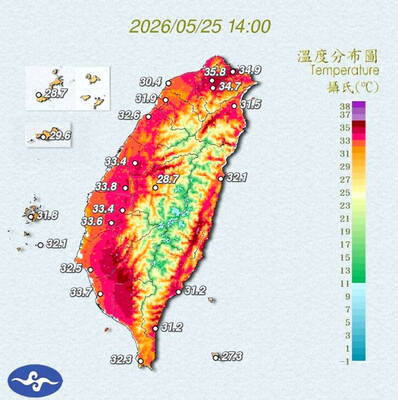
STAY COOL: The HPA recommended that people stay hydrated, use air-conditioning or fans while indoors, wear loose-fitting clothes and walk in the shade while outdoors Employers must implement measures such as installing cooling equipment, and providing drinking water and rest breaks for outdoor workers starting from Monday next week, the Taipei Department of Labor said on Sunday. Employers who fail to comply could face fines of NT$30,000 to NT$300,000 under the Occupational Safety and Health Act (職業安全衛生法), the department said. Businesses in Taipei employing fewer than 100 workers, as well as registered self-employed workers with labor insurance coverage, could receive on-site assessments and guidance from occupational safety consultants to help them apply for central government subsidies to implement or improve heat-protection measures, it said. Under the Ministry of

Chinese Nationalist Party (KMT) Chairwoman Cheng Li-wun (鄭麗文) yesterday briefed her party’s Central Standing Committee regarding her scheduled visit to the US between Monday next week and June 16, saying that her purpose would be to persuade the US that the Republic of China (ROC) Constitution was a “one China” constitution that would foster stable and peaceful cross-strait relations. The ROC Constitution is the most important defense for all Taiwanese citizens, as it upholds our democracy and has contributed to our robust economy, which aligns with international and US interests, she said. “We would not be troublemakers and drag the US under,”


 RSS
RSS