


The Democratic Progressive Party (DPP) is extending its first olive branch toward China with the reinstatement of its Department of China Affairs, DPP Chairman Su Tseng-chang (蘇貞昌) said yesterday.
Su also gave people a clearer idea of his initiative, “the Taiwan consensus,” which was used by former chairperson Tsai Ing-wen (蔡英文) as the main theme of her China policy during her presidential campaign.
“We have to improve mutual understanding through dialogue; to ensure democratic development peacefully and to determine Taiwan’s future with democracy. That is what I call the Taiwan Consensus,” Su told a press conference after the party’s Central Executive Committee meeting.
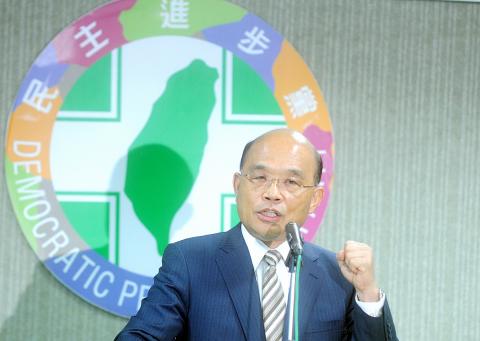
Photo: Wang Yi-sung, Taipei Times
A proposal to reinstate the Department of China Affairs, which was merged with the Department of International Affairs in August 2007, is the DPP’s first olive branch extended to China, Su said.
That would be followed by the establishment of a committee tentatively called the “China Affairs Committee,” which would include party heavyweights and academics and would serve as a platform to formulate the party’s China policy.
A search for a director of the department would begin immediately after the CEC meeting passed the proposal, Su said, adding that the director would then work on establishing the committee.
Regarding the DPP’s China policy, Su reiterated that the party would actively seek closer engagement with Beijing and engage in the process with enthusiasm and confidence.
However, Su said the DPP would stand firmly by its positions, values and viewpoints rather than doing anything to please China.
“The party will stay true to what it believes in, but the mentality, approach and strategy [of its engagement with China] would be adaptable and flexible,” he said.
Asked on whether he expects Beijing to echo the party’s friendly gesture, Su said “interaction and engagement would have to be mutual — as do good intentions and the extending of olive branches.”

Taiwan has received more than US$70 million in royalties as of the end of last year from developing the F-16V jet as countries worldwide purchase or upgrade to this popular model, government and military officials said on Saturday. Taiwan funded the development of the F-16V jet and ended up the sole investor as other countries withdrew from the program. Now the F-16V is increasingly popular and countries must pay Taiwan a percentage in royalties when they purchase new F-16V aircraft or upgrade older F-16 models. The next five years are expected to be the peak for these royalties, with Taiwan potentially earning
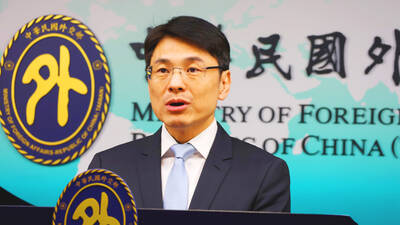
STAY IN YOUR LANE: As the US and Israel attack Iran, the ministry has warned China not to overstep by including Taiwanese citizens in its evacuation orders The Ministry of Foreign Affairs (MOFA) yesterday rebuked a statement by China’s embassy in Israel that it would evacuate Taiwanese holders of Chinese travel documents from Israel amid the latter’s escalating conflict with Iran. Tensions have risen across the Middle East in the wake of US and Israeli airstrikes on Iran beginning Saturday. China subsequently issued an evacuation notice for its citizens. In a news release, the Chinese embassy in Israel said holders of “Taiwan compatriot permits (台胞證)” issued to Taiwanese nationals by Chinese authorities for travel to China — could register for evacuation to Egypt. In Taipei, the ministry yesterday said Taiwan
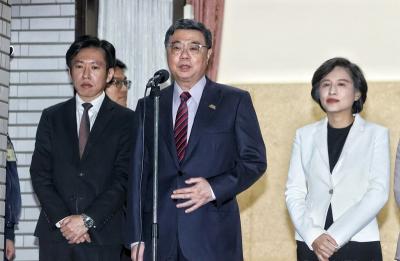
Taiwan is awaiting official notification from the US regarding the status of the Agreement on Reciprocal Trade (ART) after the US Supreme Court ruled US President Donald Trump's global tariffs unconstitutional. Speaking to reporters before a legislative hearing today, Premier Cho Jung-tai (卓榮泰) said that Taiwan's negotiation team remains focused on ensuring that the bilateral trade deal remains intact despite the legal challenge to Trump's tariff policy. "The US has pledged to notify its trade partners once the subsequent administrative and legal processes are finalized, and that certainly includes Taiwan," Cho said when asked about opposition parties’ doubts that the ART was
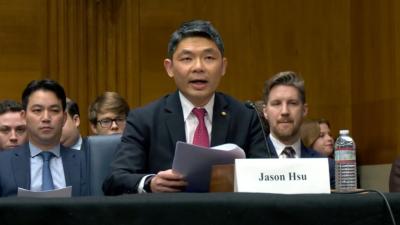
If China chose to invade Taiwan tomorrow, it would only have to sever three undersea fiber-optic cable clusters to cause a data blackout, Jason Hsu (許毓仁), a senior fellow at the Hudson Institute and former Chinese Nationalist Party (KMT) legislator, told a US security panel yesterday. In a Taiwan contingency, cable disruption would be one of the earliest preinvasion actions and the signal that escalation had begun, he said, adding that Taiwan’s current cable repair capabilities are insufficient. The US-China Economic and Security Review Commission (USCC) yesterday held a hearing on US-China Competition Under the Sea, with Hsu speaking on


 RSS
RSS