


Two members of US Congress — Republican Representative Michael McCaul from Texas and Democratic Representative Shelley Berkley from Nevada — are commemorating the 30th anniversary of former US president Ronald Reagan’s “six assurances” and the 25th anniversary of the lifting of martial law in Taiwan by entering special statements in the US Congressional Record.
Both representatives said they were acting “to further underline our unwavering commitment and affirm our support for the strong and deepening relationship between the US and Taiwan.”
Reagan issued the “six assurances” on July 14, 1982, to reaffirm US policy toward Taiwan and stipulate that the US would not pressure Taiwan to negotiate with China. On the same date, five years later, then-president Chiang Ching-kuo (蔣經國) lifted martial law in Taiwan. It had been in place for 38 years — the longest period of rule by martial law of any regime in the world.
“The coincidence in dates of these two critical junctures in Taiwan’s history, five years apart, highlights the indispensable role that the US and the Taiwan Relations Act each played in the island’s democratization,” Formosa Association for Public Affairs president Mark Kao (高龍榮) said.
“Beijing does not believe in the legitimacy of either the ‘six assurances’ or the Taiwan Relations Act because both documents fly in the face of its aspiration to annex Taiwan by force,” Kao said.
McCaul and Berkley said in their Congressional statements: “The people of Taiwan continue to live day after day under the ominous shadow cast by over 1,400 short and medium-range ballistic missiles that China has aimed at them.”
“The PRC [People’s Republic of China] persists in claiming Taiwan as a ‘renegade province’ refusing to renounce the use of force to prevent Taiwan’s formal de jure independence,” they added.

The Ministry of Finance this afternoon announced the winning numbers for the March-April uniform invoice lottery. The winning number for the NT$10 million (US$318,060) special prize is 19531471, and the winning number for the NT$2 million grand prize is 85941329. Three numbers were drawn for the NT$200,000 first prize: 07225810, 20231230 and 83518781. Those with receipts matching the last seven digits of any of the first-prize numbers will win the NT$40,000 second prize, while those matching the last six digits will win the NT$10,000 third prize. Those whose receipts match the last five digits of the first-prize numbers can claim the NT$4,000 fourth prize,

SIX SUBSIDIES: The monthly allowance for older farmers is to increase to NT$10,000, and NT$5,000 is to be given to homemakers under the national pension system, Lai said The government is to implement major welfare policies for disadvantaged groups, including raising the monthly allowance for older farmers to NT$10,000 and providing homemakers with NT$5,000 per month, President William Lai (賴清德) said yesterday. Lai made the remarks during a visit to Wangling Temple in Chiayi County, saying that the planned increases were being introduced amid economic growth and an increase in tax revenue. Touting a policy, in which the government plans to provide a monthly allowance of NT$5,000 for every child under the age of 18 in a bid to address Taiwan’s low birthrate, Lai said that if received for the
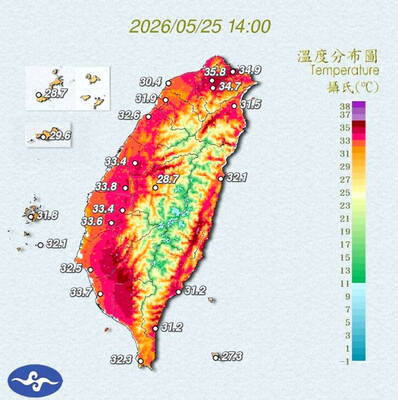
STAY COOL: The HPA recommended that people stay hydrated, use air-conditioning or fans while indoors, wear loose-fitting clothes and walk in the shade while outdoors Employers must implement measures such as installing cooling equipment, and providing drinking water and rest breaks for outdoor workers starting from Monday next week, the Taipei Department of Labor said on Sunday. Employers who fail to comply could face fines of NT$30,000 to NT$300,000 under the Occupational Safety and Health Act (職業安全衛生法), the department said. Businesses in Taipei employing fewer than 100 workers, as well as registered self-employed workers with labor insurance coverage, could receive on-site assessments and guidance from occupational safety consultants to help them apply for central government subsidies to implement or improve heat-protection measures, it said. Under the Ministry of
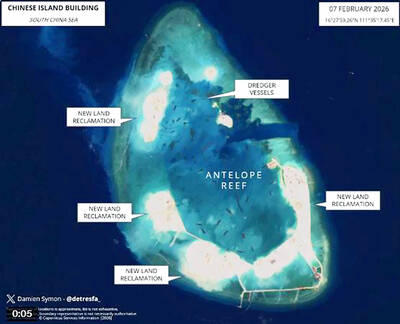
ISOLATION: The outposts would serve as support and backup bases, forcing US forces to either face China head-on or reroute, increasing travel time and operational costs China’s outposts in the South China Sea could be used to delay and constrain foreign forces during a conflict in the Taiwan Strait, giving Beijing a critical window to carry out amphibious landing and blockade operations, a report said. The Chinese Communist Party’s (CCP) forward operating bases on islands and reclaimed features in the South China Sea could delay foreign forces long enough for the Chinese People’s Liberation Army (PLA) to secure a key 48-to-72-hour window in the Taiwan Strait, a report commissioned by the Mainland Affairs Council found. The report, conducted by the Institute for National Defense and Security Research, examined


 RSS
RSS