


Starting on Aug. 1, parents with children aged four to 12 will face a penalty if the children do not wear seatbelts while sitting in the backseats of cars, the Ministry of Transportation and Communications said yesterday.
Drivers flouting the regulation will be fined NT$1,500 if driving on ordinary roads and NT$3,000 to NT$6,000 if driving on freeways or expressways, the ministry added.
The amendment to Article 31 of the Act Governing the Punishment of Violation of Road Traffic Regulations (道路交通管理處罰條例), which was passed by the legislature in August last year, requires all car passengers to buckle up when sitting in the backseat.
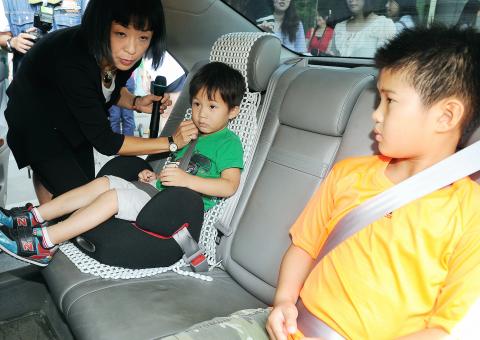
Photo: Chu Pei-hsiung, Taipei Times
The government began enforcing the amendment on Feb. 1, but adults were given a six-month grace period before the penalties went into effect.
For passengers aged four to 12, the government decided to extend the grace period by a further six months.
Hsieh Chao-i (謝潮儀), executive secretary of the ministry’s Road Traffic Safety Committee, said research showed that passengers who do not fasten their seatbelts are 3.6 times more likely to die in traffic accidents than those who do.
Passengers sitting in the backseat without seatbelts are 2.7 times more likely to get killed than those who buckle up, Hsieh added.
Jing Chuan Child Safety Foundation Chairman Lin Jih-jia (林志嘉) said the US National Highway Traffic Safety Administration has published an investigative report showing that the fatality rate for child passengers could be reduced by 70 percent if children’s safety seats are used correctly.
Infants who do not sit in children’s safety seats are eight times more likely to be injured than those who do. Countries such as New Zealand and the UK have passed similar legislation to protect child passengers.
Lin said the number of infants born in the first quarter of this year has increased by 17 percent compared with the same time last year, and the birth rate is expected to exceed 9 percent in the Year of the Dragon. As traffic accidents remain the main cause of death for children under the age of 14, Lin said that the seatbelt requirement is designed to protect the future generation.
The nation has already required children under the age of four to be placed in infant car seats since 2004.
The new seatbelt requirement applies to child passengers aged four to 12, or those weighing between 18kg and 36kg. Parents need to purchase booster seats if the seatbelt strap rubs against a child passenger’s neck.

Considering that most countries issue more than five denominations of banknotes, the central bank has decided to redesign all five denominations, the bank said as it prepares for the first major overhaul of the banknotes in more than 24 years. Central bank Governor Yang Chin-lung (楊金龍) is expected to report to the Legislative Yuan today on the bank’s operations and the redesign’s progress. The bank in a report sent to the legislature ahead of today’s meeting said it had commissioned a survey on the public’s preferences. Survey results showed that NT$100 and NT$1,000 banknotes are the most commonly used, while NT$200 and NT$2,000

The Centers for Disease Control (CDC) yesterday reported the first case of a new COVID-19 subvariant — BA.3.2 — in a 10-year-old Singaporean girl who had a fever upon arrival in Taiwan and tested positive for the disease. The girl left Taiwan on March 20 and the case did not have a direct impact on the local community, it said. The WHO added the BA.3.2 strain to its list of Variants Under Monitoring in December last year, but this was the first imported case of the COVID-19 variant in Taiwan, CDC Deputy Director-General Lin Ming-cheng (林明誠) said. The girl arrived in Taiwan on

South Korea is planning to revise its controversial electronic arrival card, a step Taiwanese officials said prompted them to hold off on planned retaliatory measures, a South Korean media report said yesterday. A Yonhap News Agency report said that the South Korean Ministry of Foreign Affairs is planning to remove the “previous departure place” and “next destination” fields from its e-arrival card system. The plan, reached after interagency consultations, is under review and aims to simplify entry procedures and align the electronic form with the paper version, a South Korean ministry official said. The fields — which appeared only on the electronic form

The Ministry of Foreign Affairs (MOFA) is suspending retaliation measures against South Korea that were set to take effect tomorrow, after Seoul said it is updating its e-arrival system, MOFA said today. The measures were to be a new round of retaliation after Taiwan on March 1 changed South Korea's designation on government-issued alien resident certificates held by South Korean nationals to "South Korea” from the "Republic of Korea," the country’s official name. The move came after months of protests to Seoul over its listing of Taiwan as "China (Taiwan)" in dropdown menus on its new online immigration entry system. MOFA last week


 RSS
RSS